3A Expertise - "Energy Efficiency and Ecological Transition for Industry" Course

Main image
Visual expertise 3A EFFIGENIE 2026
Headline

General engineer, studentorprofessional training contract, third-year expertise in energy efficiency and ecological transition for industry: EFFIGENIE.

Main body text

Campus

Arts et Métiers Campus Arts et Métiers Lille

Objectives

  • Educational and scientific

EFFIGENIE's expertise aims to bring you to a level of expertise that will enable you to make informed decisions on issues relating to the design and management of energy systems in the context of the ecological transition applied to industry. 

Thanks to this expertise, engineering students will be able to propose solutions that reduce energy consumption and minimize environmental impact for both industry (from SMEs to multinationals) and housing. They will acquire skills in understanding, designing, and implementing solutions that address multi-domain and coupled energy challenges (electrical, thermal, and fluid mechanics). 

The L2EP (Laboratory of Electrical Engineering and Power Electronics) and LMFL (Laboratory of Fluid Mechanics) in Lille naturally joined forces to contribute their complementary expertise, which is essential for mastering this type of complex issue.

While primarily geared toward industry, this program also offers the opportunity to pursue a doctoral degree.

SPECIFICITY – 2 possible courses of study – PROFESSIONAL TRAINING CONTRACT and STUDENT status

The assessment can be carried out:

  • in the form of a 12-month professional training contract. During this period, the learner is employed by a company (at a minimum of 80% of the minimum wage) and alternates between periods at the School and in the company (on average, 2 days in the company + 3 days at school per week in the 9th semester, then full-time in the company in the 10th semester).
  • as a student.

Program

  • Detailed description of the modules

The program consists of three specific modules: the first module focuses on the tools and technological resources needed for the energy transition. The second applies energy concepts in industrial and urban environments in the context of the ecological transition. The third module is devoted to energy management and optimization.

Module 1 - Tools and technological resources for the energy transition

  • Wind power / Tidal power
  • Solar thermal and photovoltaic
  • Nuclear
  • New carbon sources
  • Transportation and electrical distribution networks
  • Energy Storage and System Services
     

Module 2 – Energy applications in industrial and urban environments

  • Positive energy buildings (BEPOS)
  • Energy solutions for industry
  • Carbon footprint assessment / Life cycle assessment (LCA)
  • Environmental regulations and standards
     

Module 3 – Energy Management and Optimization

  • Energy management
  • Modeling and optimization tools
  • Energy savings of projects
  • Energy transition strategies
  • EN 16247-1 normative energy diagnosis and ISO 50001 method
     

Key scientific and educational leaders in the field

Marcello MELDI, François GRUSON, Thomas ROILLET, Antoine DAZIN, Sophie SIMONET, Eric SEMAIL, Xavier KESTELYN

Related technology platform

Part of the training is based on the "EPMLab" (Electrical Power Management Lab) technology platform at the Lille campus, in association with L2EP. This platform provides innovative industrial resources (real-time network simulator, converters, etc.). 

Target sectors and jobs

  • Energy industry (producers, network operators, storage)
  • Sustainable building and construction
  • Local authorities and urban planning
  • Energy transition and environmental consulting
  • Startups and innovative companies in cleantech

Examples of occupations

  • Energy efficiency engineer
  • Energy Transition Project Manager
  • Carbon footprint consultant
  • Energy manager in a local authority or company
  • Smart Energy Systems Engineer

Some of the courses are shared with the Specialized Master's Degree in New Energy Management (SYSPEC), which benefits from contributions from industry players and organizations such as EDF, RTE, SAFRAN, INNOVENT, and ADEME.
 

Partners

EDF, RTE, Enedis, Safran, Engie, CWS, GE, Schneider Electric, Innovent – the MEDEE research cluster on Energy Management in Electric Drives

Practical information

  • Required level: Knowledge of energy engineering/electrical engineering/maths and IT at M1 level (first year of Master's 2/second year Arts et Métiers)
  • Level: Graduate
  • Course language: French
  • Period: Semester 9
  • Number of hours: 150
  • ECTS credits: 13

Contacts

Remote video URL

3A Expertise - "Polymer and Composite Parts Development" Course

Main image
Li-U-Line
Headline

General engineer, student curriculum, third-year expertise in polymer and composite parts development.

Main body text

Campus

Arts et Métiers Campus Arts et Métiers Paris

Objectives


In 2017, polymers and composites were the most widely processed materials (by volume) in the world (300 million tons/year). Composites now account for the majority (by weight) of materials used in aircraft such as the Airbus A350 XWB. In the European Union, the plastics sector employs around 1.5 million people, 90% of whom work in production.

The objective of this unit of expertise is therefore to train generalist engineers specializing in the life cycle of polymers and composites, and in particular in the design and manufacture of parts.

Teaching staff

  • Katell DERRIEN
  • Bruno Fayolle
  • Albert LUCAS
  • Laurent GUILLAUMAT
  • Alain GUINAULT
  • Gilles REGNIER
  • Emmanuel RICHAUD
  • Sebastien ROLAND

Program

1. Presentation and selection of polymers

2. Implementation processes

3. Characterization                 

4. Mechanical properties of composites

These courses are illustrated by guest lectures (in 2017-2018: Airbus, 3P Performance Plastics Products, Areva, IFREMER , etc.).

They are applied during practical work, carried out using the equipment of the PIMM and CNAM. The courses are also put into practice during mini-projects, carried out in partnership with manufacturers who have proposed the problem:

In 2017-2018: selection of a new resin for a nuclear application and study of the failure of a clip-on connector.

Key scientific and educational leaders in the field

Emmanuel RICHAUD

Related technology platform

  • PIMM laboratory
  • CNAM

Assessment methods


Each module leads to a test. Mini projects are graded. Practical work is graded.

Benefits of the training

This program trains engineers with theoretical and practical knowledge of transformation processes, enabling them to best meet industry expectations.

Career opportunities

In 2016-2017, the majority of students who completed internships related to the subject were offered a permanent contract or a VIE (international volunteer program) to ensure their continued employment.

Partners

  • Manufacturers: Safran, Airbus, Areva TN, Hutchinson, 3P Performance Plastics Products, Delphi
  • Institutions: IFREMER

Targeted companies

Manufacturers in the aerospace, automotive, and packaging industries

Examples of internship opportunities offered / projects carried out

  • Safran Composites: characterization of composites
  • Dassault: Optical deformation measurement device
  • ONERA: characterization of degraded epoxies
  • Airbus; Structural damping materials
  • Plastic Omnium: Durability of bonded assemblies
  • PolyOne: Designing new self-sealing packaging
  • Loma innovation: development of new products
  • Hutchinson: implementation of FKM

Practical information 

  • Education: French
  • October – end of January
  • 150h

Contacts

Manager: Emmanuel Richaud

Keywords

#Polymers #Composites #Processes

Advanced materials and processes for energy and nuclear applications

Main image
Li-U-Line
Headline

General engineer, student curriculum, third-year expertise in advanced materials and processes for energy and nuclear power.

Main body text

Campus

Arts et Métiers Campus in Arts et Métiers

Objectives

  • Understanding current and future energy issues, particularly nuclear power
  • Acquire skills in selecting and usin d manufacturing materials and processes in the field of nuclear system design, which can be transferred to industrial fields involving value-added parts optimized in terms of advanced manufacturing.
  • Develop a cross-disciplinary approach combining materials, mechanics, and processes in the context of technologies used in energy production, taking into account economic and regulatory aspects.
  • Understand the tools for optimizing the design of structures and high value-added parts used in the nuclear industry, taking into account specific constraints.

The aim is to train engineers who are receptive and responsive to current industrial issues in terms of technical, economic, and ecological innovation, for the complementary choice of a manufacturing process or set of processes.

Related technology platform

Mechanics, Surfaces and Materials Processing (MSMP) Research Laboratory

Teaching methods

From October to February:

  • 150 hours of specialized classes
  • 128 project hours

February to September: internship in partnership with the MSMP laboratory

Doing an internship in Bristol

Second-year engineering students interested in this area of expertise have the opportunity to complete their internship in Bristol, UK.
The allocation of these internship offers is conditional on the choice of expertise for the 2018 academic year.
The assignment schedule is as follows:
- April 9 to May 13, 2018: submission of preferences
- May 31, 2018: assignment decisions
The final choice of internship must therefore be made after the assignment decision.
Contact: Mohamed El Mansori, professor and researcher

Targeted companies

Companies belonging to the nuclear, aerospace, automotive, ophthalmic, and other sectors.

Examples:

Contacts

Agnès Fabre - Senior Lecturer

Keywords

#Materials #ManufacturingProcess #Surface #Fabrication #Nitriding #ShotBlasting #Machining #Stamping #Casting #Polishing #Nanoindentation #Microgeometry #Microstructure #XRD #SurfaceFatigue

3A Expertise - "Factory of the Future 4.0: From 3D Prototyping to UGV (PROTeUS)" course

Main image
CL-Exp-UGV
Headline

Thisthird-yeargeneral engineering course, taken as part ofa professional training contract or student program, will teach you techniques for machining difficult materials and complex surfaces.

Main body text

VIDEO EXPERTISE 

Remote video URL

WHAT BECAME OF THEM AFTER THE EXPERTISE 

ADVANTAGES OF THE TRAINING PROGRAM

  • Training focused on the Factory of the Future / Industry 4.0
  • As part of their projects and training, students will have access to a technical platform with manufacturing and experimentation resources.
  • Possibility of doing an internship abroad and validating international mobility at the same time
  • Testimonials from industry professionals (30% of the training)

CAREER OPPORTUNITIES

Some examples of career paths taken by our recent graduates:

  • Fellowship in mechanical engineering at CERN (Switzerland)
  • Project Manager at Airbus Defense and Space
  • Doctoral thesis in additive-subtractive manufacturing at KU Leuven LOUVIN (Belgium)

EXAMPLES OF INTERNSHIP OFFERS PROPOSED / PROJECTS CARRIED OUT

The internships offered take place in France and internationally in direct collaboration with leading companies in the fields of transportation, aeronautics, energy, and biomedicine:

  • Cutting of superalloy castings (turbine casting) in France         
  • Optimization of a technological process on a machining center (AIRCRAFT INDUSTRIES) in the Czech Republic
  • The use of additive manufacturing in the medical field for the production of knee implants (MISAN) in the Czech Republic.
  • Study and modeling of the influence of oxidation on the fatigue behavior of composite materials (Arts et Métiers )
  • Implementation of AMC3 software and COM methods with the aim of creating a methodology for qualifying the machinability of alloys (Snecma)
  • Continuous improvement for industrial performance management (Airbus Defense and Space)

PARTNERS

The expertise benefits from the partners of the Burgundy Laboratory of Materials and Processes (LaBoMaP) and the International College for Research in Production Engineering (CIRP) for the organization of internships:

  • In leading companies (France and internationally): Safran Group, Airbus, Turbine Casting, Alstom, Seco Tools, etc.
  • In research centers in Germany, England, the Czech Republic, Portugal, Switzerland, Canada, and the United States.

KEY SCIENTIFIC AND EDUCATIONAL LEADERS OF THE EXPERTISE

Head of expertise:Fabien Viprey

Arts et Métiers teaching team 

Arts et Métiers teaching team

External faculty members: Emmanuel Duc (SIGMA Clermont), Ferdinando Salvatore (ENISE)

Industry experts: Vincent Dessoly and Mickael Rancic (SAFRAN Group), Théo Dorlin (RENAULT), Cosme de Castelbajac (MITIS), Frédéric LeMaître (MBDA), and Lamice Denguir (Faurecia Clean Mobility)

TWO POSSIBLE ROUTES 

CONTENTS

  • Prototyping and Additive Manufacturing
  • Green manufacturing: responsible and sustainable production
  • Design and structure of production facilities
  • Realistic geometric modeling of the material removal process
  • Ordering and management of production resources
  • Product and process industrialization
  • Management: marketing, strategy, CSR, occupational health and safety, ergonomics (30 hours)
  • Supply chain and collaborative approaches (30 hours)
  • Engineering & society: Risk management, change management, decision-making (30 hours)
  • New approaches to industrial management: Project management, Maintenance, Industry 4.0
  • Modern languages (Engineering and the world)
  • Professional support for students

PRACTICAL INFORMATION

Training

  • Required level: Graduate
  • Course language: French
  • Period: Fall
  • Number of hours: 150 hours
  • ECTS credits: 13
  • Assessment methods: Continuous assessment

Related technology platform 

Location  

KEYWORDS

#HighSpeedMachining, #FactoryoftheFuture, #DifficulttoMachineMaterials, #LeanManufacturing

3A Expertise - "Digital Modeling and Virtual Immersion" Course

Main image
ChaSSExp3eA
Headline

Thisthird-yeargeneral engineering course, availableasa professional contractorstudent program, will train you in digital modeling and virtual immersion.

Main body text

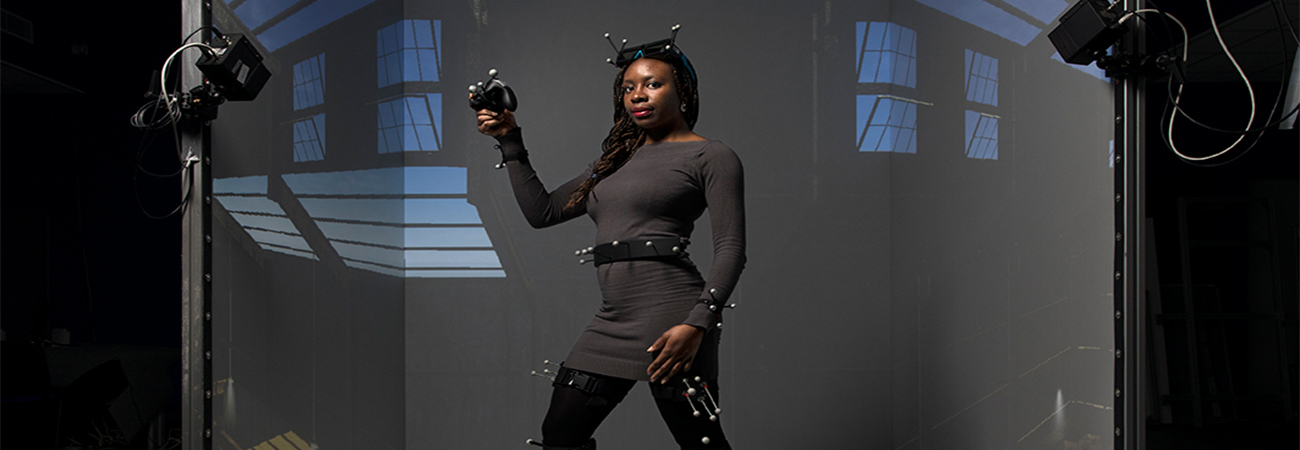
On video

Remote video URL

Institute

Chalon-sur-Saône Institute Arts et Métiers 

Objectives

  • Mastering the scientific and technological barriers in the life cycle of a digital product
  • Understand and master digital modeling technologies, 3D interfaces, and their use in virtual immersion in all areas of application: healthcare, industry, construction.

Program

Module 1: Research Methodology

  • Methodology scientific approach
  • Experimental study for virtual reality
  • Data analysis

Module 2: 3D imaging and immersion

  • Vision systems Virtual reality
  • Augmented reality

Module 3: Digital modeling and tools

  • 3D modeling
  • Object-oriented programming (C#)
  • Real-time 3D programming Virtual reality interfacing

Module 4: Human-machine interaction

  • Interactive systems
  • Sound interactions

Module 5: Perception in a virtual environment

  • Cognition of the Perception-Action Coupling

Module 6: Virtualization

  • Scientific locks for the industry of the future

End-of-studies internship (6 months)

Carried out individually in a company or laboratory, the internship must address a scientific issue. At the end of the internship, the required deliverables are:

  • An internship report
  • An oral defense

Key scientific and educational leaders

Manager: Jean-Rémy Chardonnet
Teaching team:Frédéric Mérienne, Ruding Lou, Florence Danglade, Fakhreddine Ababsa, and industry representatives and subject matter experts for nearly 30% of the total hours.

Related technology platform

PeTRiiV Platform

Assessment methods

Written and oral knowledge tests for each teaching unit
Challenge with presentation to companies

Partners

  • Karlsruhe Institute of Technology (Germany)
  • Cap-INSERM, LPPA-Collège de France, LEAD Laboratory, CRVM Laboratory, INRIA, LSIS Laboratory, CSIRO (Australia), Macquarie University (Australia), Los Andes University (Colombia), Iowa State University (USA), Rey Juan Carlos University (Spain)
  • Renault, Bouygues, CEA, Kairos 3D, Areva, Clinea, Theoris, VuLog, Lumiscaphe, Axtrid, TechViz, Fovea, Colas, Mosaïque Dynamique.
  • The great Chalon, Nicéphore City
     

Examples of proposed projects

Project examples

Practical information

  • Required level: Graduate
  • Course language: French
  • Period: Fall
  • Number of hours: 150 hours
  • ECTS credits: 13

Under a professional training contract

Professional training contract expertise program: download here

Contact

Jean-Remy Chardonnay 

Keywords

#HapticSystems #CAVE #VirtualImmersion #DrivingSimulation #AugmentedReality.

FUTURE ENGINES, HYBRIDIZATION, AND FUEL CELLS

Main image
Li-U-Line
Headline

General engineer, student curriculum, third-year expertise in future powertrains, hybridization, and fuel cells

Would you like to be part of the industry's shift towards developing new forms of motorization that are compatible with sustainable development? This third-year specialization is for you!
This training program is available exclusively under a professional training contract.

Main body text

Campus

Arts et Métiers Campus Arts et Métiers Châlons-en-Champagne

Objectives

Train operational engineers s in the field of powertrains (conventional, hybrid, and electric) and fuel cells.

  • operating with alternative energy sources (gas, biogas, biofuels, hydrogen, electricity, etc.),
  • intended for transport (land, river, sea) andindustry,
  • and meeting the requirements of the energy transition.

What does this training offer you?

  • You will be aware of the major energy strategies underway in France, Europe, and the rest of the world.
  • You will be trained ineconomic evaluation methods, well-to-wheel assessments, andlife cycle analysis.
  • You will be able to guide technological choices in energy transition processes;
  • You will be able to devise technical solutions that are compatible with sustainable development, implement them, and refine them.

ADVANTAGES OF THE TRAINING PROGRAM

1. Courses taught mainly by guest lecturers:

2. Easier access to specialized schools

3. Expertise in professional training contracts

PROGRAM

First Semester:

Expertise:
Module 1: Energy and environmentalissues
Module 2: Fuels and energy

Module 3: Engines and applications
Module 4:
Electrification

Module 4: Technical and economic analysis and developmenttools

Expertise project

Core curriculum and modern languages

For more details about the program, click here.

Second semester: Professional contract

EMPLOYMENT SUPPORT

Engineer in development, research, strategic analysis, projects, etc. within companies operating in fields such as:

  • The design, manufacture, and operation of engines or fuel cells (automobiles, heavy trucks, agricultural, marine, industrial)
  • Equipment
  • Alternative energy engineering
  • Transportation services
  • The production and/or distribution of conventional fuels, gas, biogas, biofuels, hydrogen, etc.

PRACTICAL INFORMATION

Required level: Second year of the Grande École program at Arts et Métiers or Master of Science in science and technology
Equivalent international level: Graduate

Language of instruction: French, with a few hours in English

Late September to early February
1. Expertise teaching: 150 hours / ECTS credits: 13
2. Expertise project: 120 hours / ECTS credits: 5
3. Core curriculum: 170 hours / ECTS credits: 13

End of February to end of August
Professional contract: minimum 33 weeks / ECTS credits: 30

Contact:
Florence Lesage
Email: florence.lesage@ensam.eu
Tel.: +33 (0)3 26 69 26 70

ADDITIONAL INFORMATION

This expertise is supported by the companies AVL and CRMT.

Keywords

#Engine #Motorization #Fuel #Hydrogen #Energy #Hybridization #Alternative Energy #Transportation #Industry


3A Expertise - "Materials and Additive Manufacturing (MadMan)" Course

Main image
Image of a man operating a machine
Headline

MADMAN: Additive Manufacturing Engineering - Advanced Design and Manufacturing

Main body text

Campus

Arts et Métiers Campus Arts et Métiers Paris

Objectives

  • Provide students with the skills necessary to design products suitable for additive manufacturing, with an emphasis on design and modeling aspects.
  • Provide students with knowledge of all additive manufacturing processes (polymers and metal), their design rules, advantages, and limitations.
  • Discover the Design For Additive Manufacturing (DFAM) method

Program

Design Block (approximately 70 hours):

  • Module 1 (11 hours): Creativity (F. Mantelet): Idea generation techniques and creative approaches that can be used to design innovative parts for additive manufacturing.

  • Module 2 (12 hours): Product Life Management (PLM) (F. Segonds): Basic principles of product life cycle management and how to apply them to the design of parts for additive manufacturing.

  • Module 3 (26 hours): Topological optimization (P. Lorong; E. Monteiro): Teaching related to design algorithms for optimizing the geometry of parts for additive manufacturing using specific CAD software.

  • Module 4 (8 hours): Reverse Engineering (I. Koutiri): Tools related to reverse engineering for designing a part based on an existing manufactured part.

  • Module 5 (10 hours): Surface design (I. Koutiri): CAD surface design applied to additive manufacturing.

Manufacturing block (approx. 60 hours):

  • Module 6 (23 hours): Additive manufacturing for polymer materials (S. Roland; I. Koutiri; E. Richaud): Presentation of polymer materials and associated processes.

  • Module 7 (12 hours): Additive manufacturing for metallic materials (M. Schneider; M. Dal): presentation of laser processes for metallic additive manufacturing.

  • Module 8 (24 hours): Quality and health of printed parts (N. Harcouët; I. Koutiri): Artificial intelligence tools and algorithms for quality control of parts. Health and fatigue of parts in additive manufacturing.

Project block (approximately 3 p.m.):

Theme: Eco-design for additive manufacturing or additive manufacturing for eco-design. How can these two concepts be closely linked? Student bibliographic project on eco-design.

Assessment: Weighted average grade per module: midterm tests, individual assignments, lab grades, and project defense.

Industrial and academic research conferences (5 hours)

Lectures given by figures from the industrial world and academic research on their issues and/or practices relating to these processes.

Assessment methods    

Grade per module: midterm tests, personal assignments, lab grades, and final exam.
Final grade: weighted average of each module.

Benefits of the training

Specialized training in additive manufacturing covering multiple sectors.

Project examples    

  • Design and production of industrial parts with optimized geometry
  • Development of a parallel cable robot for the direct manufacture of large parts
  • Manufacture of models and demonstrators for science education
  • Topological optimization of lightweight structures for aeronautics
  • Development of a structured metal foam for shock absorption
  • Feasibility study of laser sintering of hydroxyapatite for the manufacture of prostheses
  • Multimaterial assemblies using laser processes

Practical information

  • Course language: French
  • Period: Off-peak semester
  • Number of hours: 150
  • ECTS credits: 13
  • Responsible: Sébastien Roland, Head of the UEE

Targeted companies

Saffron, Thales, Sculpteo, Prodways,….

Contact

Sébastien Roland, Head of the UEE

Keywords

#AdditiveManufacturing #DFAM

Eco-design of goods and services

Main image
3A eco-design expertise visual Chambéry
Headline

General engineer, student curriculum, third-year expertise in eco-design of goods and services.

Main body text

Campus

Chambéry Institute Arts et Métiers

Objectives

  • Educational and scientific

In the current context, where various economic and regional stakeholders are taking environmental issues into account, EcoBS expertise provides future engineers with the tools they need to understand, identify, analyze, evaluate, and reduce the environmental impacts of activities related to the creation of value in goods and services. 
Life cycle engineering methodologies make it possible to take into account all of a product's environmental impacts throughout its life cycle.
This approach can be implemented throughout all phases of product/service development and marketing using eco-innovation, life cycle analysis, eco-design tools, and circular economy and functional economy concepts.
In line with the current trend toward dematerialization, the concept of a product also refers to a service.
 

  • Professionals and career opportunities

Be able to integrate tools into a company and its design process that enable the sustainable application of eco-design and eco-innovation approaches.

Leading this eco-design initiative: integration into the process, but also implementation of assessment tools and product and service innovation.

Program

  • Module 1 - Current situation

Overview of environmental issues and resources in our modern societies. Interactions between the economy, the environment, and society. Consequences and prospects for economic actors in product development models. 

  • Module 2 - Environmental Assessment of Products and Services 

Develop a Carbon Footprint (CF) and/or Life Cycle Assessment (LCA) for a product or service, evaluate the impacts in order to improve the company's environmental performance.  

  • Module 3 - Methods and tools for eco-innovation and eco-design 

Acquire methods and tools for integrating environmental parameters into the various phases of product design in order to reduce its environmental impact throughout its life cycle.

  • Module 4 - The various levers of eco-design 

Consider the management of the materials that make up the product in order to optimize production through sustainable processes and anticipate end-of-life (recycling, recovery, etc.). Low-techapproach .

New business models.

Key scientific and educational leaders in the field

  • Gabriel Banvillet
  • Tom Bauer
  • Carole Charbuillet
  • Jean-Marc Meurville
  • Véronique Perrot-Bernardet
  • Tatiana Reyes

Assessment methods

  • End-of-module exam
  • Tutorial reports
  • Presentations

Teaching methods

Benefits of the training

  • Current topic
  • Companies undergoing sustainable transition
  • Personalized student support
  • Cross-functional expertise that allows us to consider all sectors of activity
  • Personalized support for future entrepreneurs in the environmental sector

Career opportunities

  • Eco-design engineer
  • Sustainable Innovation Engineer
  • Sustainable Product Development Engineer
  • Industrial strategy consultant
  • Environmental analysis consultant

Some industrial partners

Atkid, Bam Aglo, POMA, CEA, EDF, GE, Decathlon, Genvia, Setec, Hermès, Bl Evolution, Imerys, Eurovia, Seaducer, Socea, Propellet, Neos, IDM, Radiall, Natural Solutions.

Targeted companies

All goods and services sectors: sports, aeronautics, electronics, construction, energy, transportation, consumer goods, services, etc.

Examples of internship opportunities offered / projects carried out

  • Definition of the sustainable development strategy within a logistics group by 2022
  • LCA of innovative structures
  • Establishment of a recycling facility in Cape Verde
  • Environmental renovation of a ski lift in a ski resort
  • LCA and eco-design of an aircraft cabin interior (A330)
  • Please note that the internship topic may not be related to the area of expertise (except for professional training contracts).

Practical information

  • Required level: graduate
  • Equivalent international level: graduate
  • Language of instruction: French
  • Period: September to February
  • Number of hours: 150
  • ECTS credits: 13

Work-study program

Work-Study Program Curriculum: Download here

Contact

Lou Grimal, Head of Expertise
 

Testimonials

"The ECOBS expertise allowed me to understand a new facet of engineering, namely its place in a societal and industrial world increasingly constrained by environmental issues. Eco-design is emerging as the solution for engineers faced with these challenges. The numerous company visits allowed me to make the connection between the theoretical environmental approach and the realities in the field." Nathan Back-to-school meal 2019

"Designing without knowing how to eco-design seems like heresy today." Romain

"ECOBS expertise deserves to be highlighted, as it enables us to develop a critical view of current industry technologies. It introduces us to problem-solving methods relating to innovation, eco-design, and product life cycle analysis." Valentin

"This semester gives you a comprehensive overview of all sources of pollution when designing a product." Hugo

"In my opinion, the environmental aspect is essential in training the engineers of tomorrow, since we will all be confronted with it, whether we like it or not." Xavier

"The EcoBS expertise is perfect for complementing an Arts et Métiers curriculum Arts et Métiers ecological concepts. The institute is located on the shores of Lake Bourget, surrounded by mountains. You are made to feel welcome and there are genuine links with the administration and teaching staff." Alexandre

Additional information

Accommodation information and eco-mobility information

Keywords

#EcoDesign, #EcoInnovation, #Recycling, #CircularEconomy