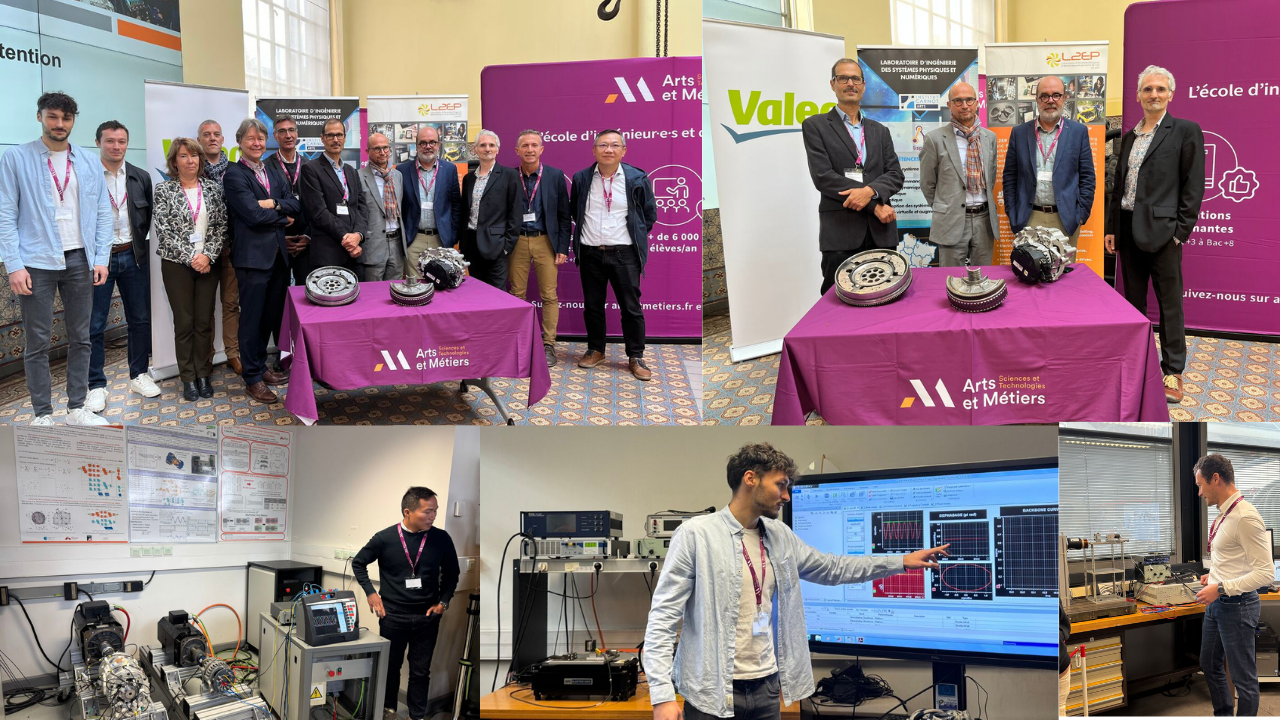
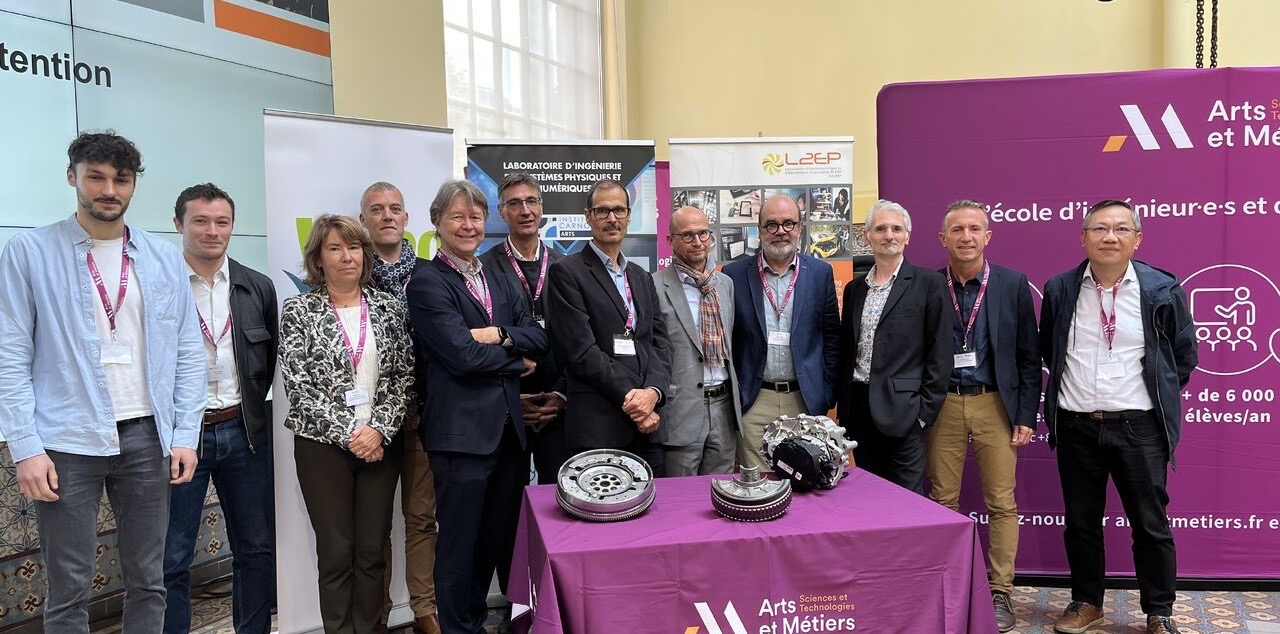
After seven years of fruitful collaboration, Valeo and Arts et Métiers and expanding their strategic partnership by inaugurating a new industrial research chair dedicated to "Vibroacoustics of electric powertrains."
Supported by Arts et Métiers its subsidiary AMVALOR, this new chair is fully in line with the challenges of the transition to quieter and more efficient electric mobility.
A long-term scientific and industrial collaboration
Since 2018, Valeo and Arts et Métiers on a first chair dedicated to " Nonlinear dynamics for the absorbers of the future. " Conducted on the Lille campus, this work has demonstrated the teams' ability to transform fundamental research into high value-added industrial innovations, drawing on the expertise of Professor Olivier Thomas at the Laboratory of Engineering of Physical and Digital Systems (LISPEN).
Building on these results, the partnership is entering a new phase with the creation of a second chair, also involving the Lille Laboratory of Electrical Engineering and Power Electronics (L2EP), with Professor Christophe Giraud-Audine. The objective: to control and reduce residual noise from electric machines and gearboxes, a key issue for the acceptability of electric vehicles.
As Hervé Mahé, Noise and Vibration Expert at Valeo and Deputy Director of the VIBRACCE Chair, explains:
These characteristic whistling noises, easily picked up by the ear and unpleasant for passengers, undermine one of the advantages most sought after by buyers: silence.
Reducing noise, a key challenge for electric mobility
With the electrification of powertrains, acoustic comfort is becoming a determining factor.
If NVH (Noise, Vibration, Harshness) exceeds a critical threshold, it can compromise the acceptability of this type of engine among users. As Christophe Giraud-Audine, lecturer-researcher at L2EP and deputy director of the VIBRACCE chair, explains:
Reducing and controlling noise from electric drive trains requires solutions that combine mechanical and electrical expertise. In the course of our work between 2018 and 2025, we have begun to combine mechanical solutions with electromechanical assistance, also drawing on the expertise of L2EP.
Two areas of research to anticipate and take action
Until 2032, the LISPEN and L2EP teams will pool their expertise in numerical computation, vibration mechanics, electrical engineering, and experimental know-how, while Valeo will contribute its in-depth knowledge of the market and its testing, computation, and design resources.
The chair's work will focus on two main areas:
Predict: develop electromagnetic-mechanical simulation tools capable of anticipating vibrations and noise from the design phase of motors and their power supply strategies;
Take action: propose innovative solutions for electrical control and active or passive noise and vibration reduction, such as piezoelectric absorbers, viscoelastic materials, and metamaterials.
An ambitious training and research program
The chair program includes at least six doctoral theses, a postdoctoral project, the recruitment of a research engineer, as well as training and scientific dissemination activities.
As Olivier Thomas, professor and researcher at LISPEN, who initiated this collaboration, and deputy director of the VIBRACCE chair, explains:
Acoustic comfort has become a key success factor for electric vehicles. Today, we are taking another step forward to continue supporting Valeo's technological leadership in electric mobility.
Contacts
Olivier Thomas ( LISPEN), Christophe Giraud-Audine (L2EP)