IDT4EU (Immersive Digital Twins for Europe) is a European project aimed at supporting teachers and students in integrating immersive digital twins into higher education.
Coordinated by the École Nationale Supérieure d’Arts et Métiers, the project is co-funded by the European Union under the Erasmus+ program. The project will run for 36 months and has a budget of 400,000 euros.
Developing Teaching Practices
Immersive digital twins are interactive digital replicas of real-world processes, environments, or systems, accessible through immersive technologies. In particular, they make it possible to reproduce complex situations
in realistic and secure environments, offering learners the opportunity to experiment, simulate, and analyze different scenarios without risk.
These technologies open up new possibilities for higher education, particularly in science and technology programs. They help align learning experiences with real-world industrial settings and provide students with more interactive and hands-on educational experiences.
However, integrating them into courses requires teachers and instructional teams to develop new skills. The IDT4EU project addresses this need.
Training Teachers in Immersive Technologies
The goal of IDT4EU is to contribute to the modernization of higher education by developing methods and tools for integrating immersive digital twins into educational programs.
The project has two objectives: to strengthen teachers’ digital skills and to offer students more engaging learning experiences that are aligned with the needs of the business world.
The work will focus in particular on engineering disciplines and technical training programs, where simulation technologies and digital twins can offer significant opportunities for testing complex systems and processes.
Two Areas of Focus
The IDT4EU project is organized around two main areas:
- Development of methodologies related to immersive digital twins: educational frameworks , technical recommendations, design and testing of pilot training programs, and creation of a repository of open-access educational resources.
- Teacher training and support: design and implementation of training programs for teaching staff, immersive workshops, simulations, mentoring initiatives, and a skills certification program.
Special attention will also be given to disseminating the project’s results through the organization of webinars and conferences and the publication of resources and best practices for European academic and industrial communities. These materials will be designed to be reusable and adaptable to different institutional contexts across Europe, with the aim of making a lasting contribution to the transformation of engineering education and the evolution of teaching practices.
The role ofArts et Métiers
Arts et Métiers coordinates the IDT4EU project and works with four European partner
:
- Warsaw University of Technology (WUT) - Poland;
- Politecnico di Milano (POLIMI) - Italy;
- NEdHo – New Education Horizons (NEDHO) - Finland;
- Inokufu - France.
The diversity of partners allows for the integration of academic, pedagogical, and technological expertise to develop solutions that can be replicated at various European higher education institutions.
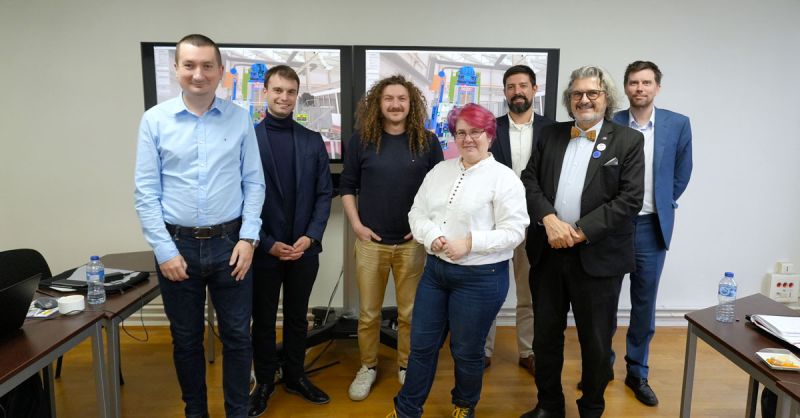
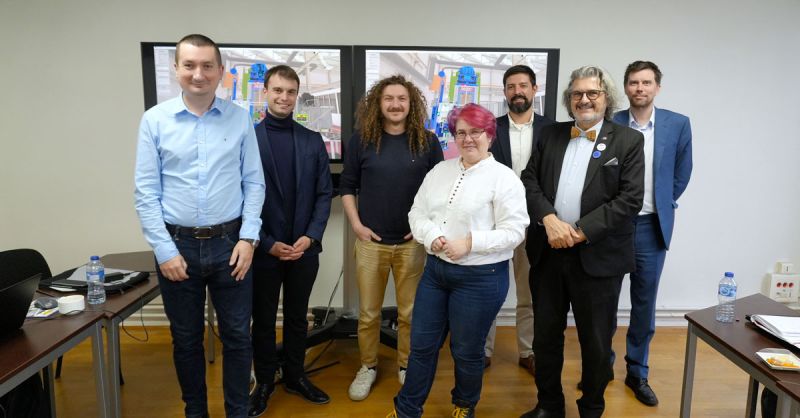
From left to right: Krzysztof Ejsmont—WUT / Daniele Perossa—POLIMI / Léopold Boyart Bienenfeld— Arts et Métiers / Cristina Obae—NEdHo / Matthieu Sonnati—Inokufu / Thierry Koscielniak— Arts et Métiers / Sébastien Fernandez— Arts et Métiers
Contacts
- Thierry Koscielniak, project lead, expert in digital strategy and educational innovation
- Leopold Boyart Bienenfeld, Project Administration Coordinator, European Project Manager