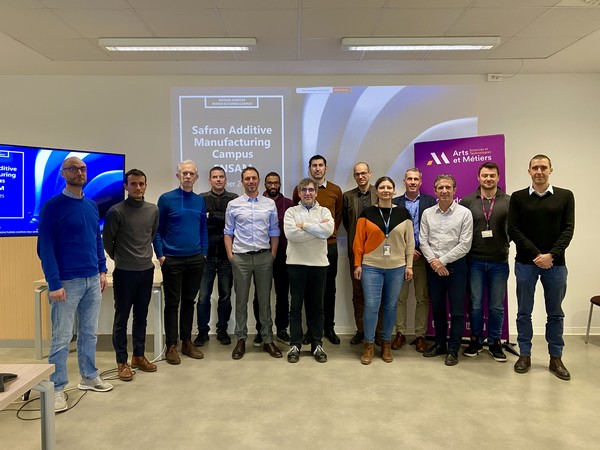
The new CESAME chair, created with Safran Additive Manufacturing Campus, aims to develop innovative processes in aeronautics.
A strategic partnership between academia and industry
The CESAME chair aims to promote and develop innovative metal additive manufacturing processes in theaerospace industry. This strategic partnership was established between Arts et Métiers Safran Additive Manufacturing Campus (SAMC), a center of excellence dedicated to metal additive manufacturing processes within the Safran group, a world leader in the aerospace industry.
This new chair is based on a shared vision and goal: to achieve a complete understanding and mastery of all the physical processes involved in additive manufacturing in order to optimize performance, the durability of the materials and structures obtained, and the design of advanced technological solutions.
Through this collaboration, Arts et Métiers providing its scientific expertise and the innovative capabilities of all its laboratories in the fields of processes, materials, mechanical behavior, and durability under service conditions, both digitally and experimentally. For its part, SAMC brings in-depth knowledge of the market, industrial needs, and current and future technical challenges, as well as its expertise in metal additive manufacturing processes.
Innovative processes and high-performance materials
The CESAME Chair focuses on six key areas of research:
- laser-matter interaction and its consequences on microstructures
- experimental and numerical process thermodynamics
- multi-material processes
- the links between microstructure and mechanical behavior
- surface and volume effects
- engineered materials
The combination of these different projects should lead to a reduction in weight and improved performance of the aeronautical equipment needed for future civil aircraft programs that will emerge by 2035.
The collaboration between Arts et Métiers the Bordeaux Institute of Mechanics and Engineering (I2M / Arts et Métiers, Bordeaux INP, CNRS, Inrae, University of Bordeaux), the Processes and Engineering in Mechanics and Materials Laboratory (PIMM), and SAMC is based on a co-development model in which researchers and engineers work in synergy to transform innovative ideas into concrete applications.
Additive manufacturing opens up unparalleled opportunities for improving performance and reducing weight, and presents a challenge to the academic world. Performance optimization requires complete control of the value chain, from understanding the physical processes involved in the manufacturing process to knowledge and modeling of the behavior of these new-generation materials and structures.
Nicolas Saintier, professor at the Bordeaux-Talence campus, head of the Dumas department at I2M and holder of the CESAME chair
Promising spin-offs for aeronautics
The expected outcomes for this new chair are manifold. The CESAME chair includes significant scientific and technological advances in process control and the performance of materials obtained through additive manufacturing, but also contributes to training a new generation of engineers capable of meeting the technical and environmental challenges of the aeronautics industry of the future.
This collaboration should enable significant progress in process control, particularly powder bed FA, with a view to developing and producing increasingly complex parts while ensuring complete flight safety.
Luc Namer, Head of Technology at SAMC
Looking ahead, the applications of the work carried out by the chair are part of an environment of increased international competitiveness, positioning Arts et Métiers SAMC at the forefront of process innovation for aeronautics. The CESAME chair is thus establishing itself as a catalyst for innovation and a strategic lever for a sustainable and high-performance aeronautics industry.
Contact
Nicolas Saintier, I2M: nicolas.saintier@ensam.eu