Thesis defenses
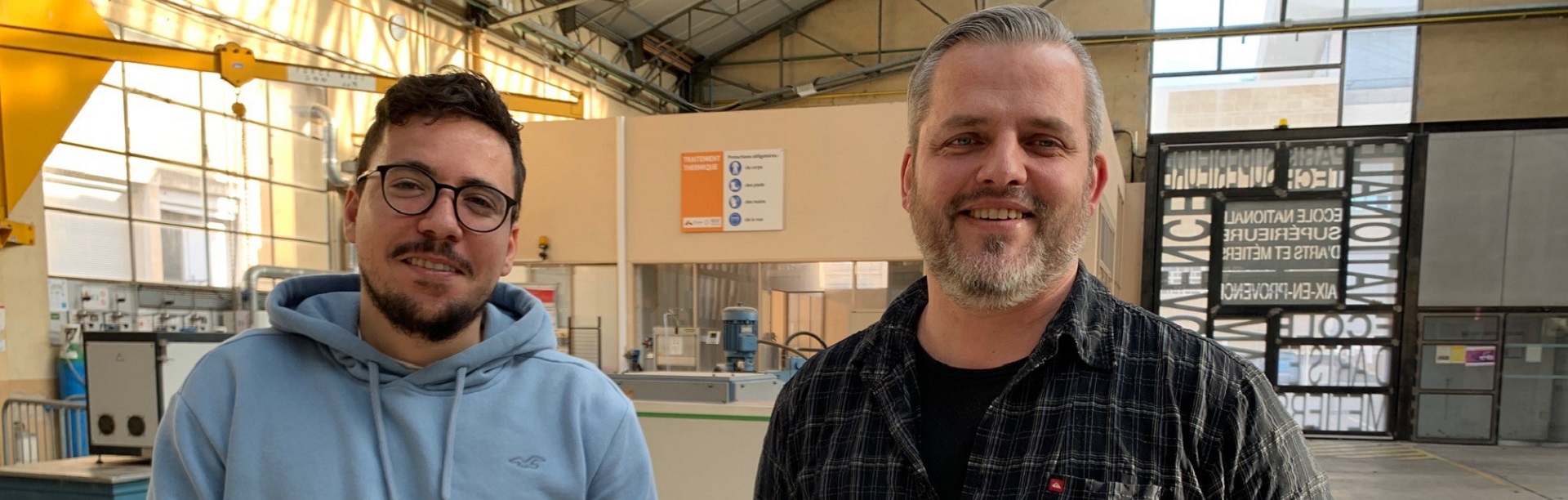
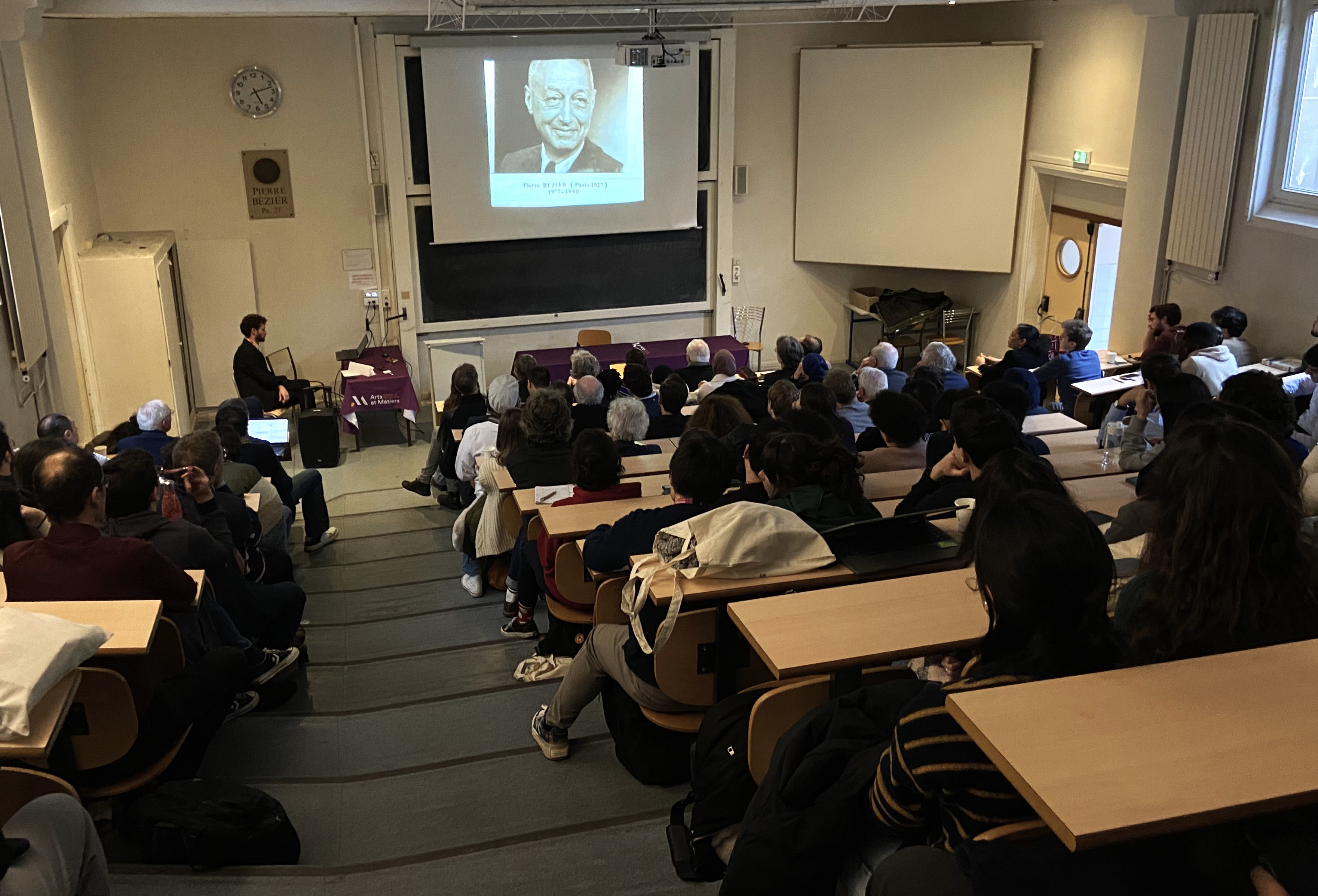
At the Arts et Métiers campus Arts et Métiers ,three doctoral students defended their theses last December.
Find out the closing dates for the winter season at the Arts et Métiers campuses and institutes.
Arts et Métiers AMVALOR are joining forces with ten French and Italian partners to support small and medium-sized industrial companies in their transition to decarbonization.
Find out more about the "Learning centers and learning spaces" project, one of the nine major Evolutive Learning Factory projects.
Each campus now has libraries and Fablabs.
The novelty of this project lies in:
The year 2024 will be devoted to the planning and design of learning centers. The Aix-en-Provence and Châlons-en-Champagne campuses already have several building blocks that form a learning center. The aim will be to complete them.
The other campuses all have libraries, fablabs, and co-modal rooms. The project aims to rethink the spaces and/or create links between them.
The work will be carried out in 2025 and 2026.
>>> Would you like to make a donation as an individual? individual ? Click HERE
>>> Would you like to make a donation as a professional ? Click HERE
Find out more about the project to rebuild the legendary Delage V12 Labourdette car, one of the nine major projects undertaken by Evolutive Learning Factory
The inter-campus project "Scarabée d'Or, a challenge for young people" showed that by working together, more than fifty students from the Cluny, Angers, and Metz campuses and the Arts et Métiers institute Arts et Métiers Chalon-sur-Saône were able to rebuild an identical replica of the Citroën Scarabée d'Or half-track vehicle.
Placing students in real-world situations through multidisciplinary and integrated projects is an important component of the CDIO (Conceive, Design, Implement, Operate) standard. It serves to evaluate skills in addition to knowledge. These skills are scientific and technical, but also collaborative (soft skills).
The novelty of this project consists of:
This multidisciplinary, inter-campus project will provide an opportunity to develop remote collaborative engineering, new design and redesign tools, machining methodologies, and more.
This project is also a way for Arts et Métiers its identity and its position as a leader in training eco-responsible engineers in mechanical engineering, energy engineering, and industrial engineering.
Finally, this project touches on the highly visible world of classic cars, driven by enthusiasts.
After a reverse engineering and design phase that began in 2019, the project has been in the implementation phase for several months now.
Groups of engineering students from campuses in Bordeaux, Aix-en-Provence, Cluny, Châlons-en-Champagne, Angers, and Metz have been involved in various aspects of the vehicle.
To date, this represents around 90 students involved, 25,000 hours (students and supervisors) and 5,000 hours for partners.
The year 2024 will be devoted to finalizing the design of the engine block and wooden structure.
The year 2025 will be dedicated to the construction of the engine and the wooden structure.
In 2026, the plan is to assemble the engine, test it on a test bench, and finalize the manufacture of all the peripherals (running gear, transmission, vehicle interior).
In 2027, the bodywork will be finalized and all the vehicle components will be assembled.
The year 2028 will be devoted to ensuring the reliability of the vehicle, with vehicle bench and track testing. Educational materials (calculation instructions, digital models, manufacturing ranges, etc.) will also be created to disseminate and exploit as many elements of the project as possible.
Ultimately, the project will contribute to training approximately 200 additional students by 2028, for a total of around 30,000 hours.
>>> Would you like to make a donation as an individual? individual ? Click HERE
>>> Would you like to make a donation as a professional ? Click HERE
This project involves rebuilding a legendary race car (the Delage V12 Labourdette) using modern eco-design and eco-manufacturing tools. The project is being carried out in partnership with various stakeholders (Les amis de Delage, Bertrandt, Renault, Stellantis, Arcelor, etc.). It will involve students from different campuses over a period of four years. It will enable
* Priority for 2024
Find out more about the "Recycling of metal alloys" project, one of the nine major Evolutive Learning Factory projects.
Recycling transforms waste into new products, using fewer natural resources and less energy than manufacturing from raw materials. It is therefore an important issue for the circular economy and the sustainability of industries.
Arts et Métiers training in materials and metal alloys, closely linked to manufacturing processes, mechanical properties, and durability.
The issue of improving the mechanical performance of materials with a view to lightening structures in order to reduce the consumption of raw materials and energy is also addressed.
The novelty of this project lies in
The aluminum recycling unit at the Lille campus will be equipped between 2024 and 2026 to characterize recycled aluminum alloys.
Similarly, the materials characterization platform at the Metz campus will be equipped between 2024 and 2026 with new means of characterizing high-performance steels and recycled steels.
New projects on materials recycling will emerge on campuses in 2025 and 2026.
>>> Would you like to make a donation as an individual? individual ? Click HERE
>>> Would you like to make a donation as a professional ? Click HERE
Find out more about the "energy impact" project, one of the nine major Evolutive Learning Factory projects.
The energy impact of production systems is an important issue because it concerns both environmental and economic challenges. Monitoring and reducing this impact protects the environment and limits global warming, but also reduces energy costs for businesses and improves their competitiveness.
Arts et Métiers numerous manufacturing processes—metallurgy, plastics processing, machining, assembly—and a mesocenter for computing called CASSIOPE.
The novelty of this project consists of:
The year 2024 will be devoted to instrumentation and analysis of energy consumption data from the CASSIOPE mesocenterArts et Métiers high-performance computing.
The year 2025 will be devoted to optimizing the energy efficiency of ventilation/blower systems and fuel cells.
For all campuses, an energy monitoring system for buildings will be implemented in 2024, 2025, and 2026, with an initial demonstration model to be built in 2023 on the Lille campus.
Similarly, the technology cells will be equipped with energy monitoring systems.
Some campuses will be equipped with clean, carbon-free energy sources (solar panels, hydrogen storage, electrolysers, fuel cells) with a view to developing self-consumption of green energy from the production system (2024-2026, Aix-en-Provence).
>>> Would you like to make a donation as an individual? individual ? Click HERE
>>> Would you like to make a donation as a professional ? Click HERE
High-performance computing (HPC) enabled by contemporary modeling and calculation codes leads to high energy consumption by supercomputers. The aim of this project is to equip the school's computing center and design a predictive model of energy consumption based on the strategy chosen to perform the calculations. This model will be used both to reduce energy consumption at the school and as an educational demonstration tool for students.
* Priority for 2024
Find out more about the "connected factory" project, one of the nine major Evolutive Learning Factory projects.
To remain competitive while addressing the challenges of decarbonization, sustainable development, and social responsibility, manufacturers are developing information systems that provide real-time access to and sharing of data related to their production processes. This enables them to improve productivity by optimizing production systems and processes, reducing energy consumption and waste, and preventing machine breakdowns.
Arts et Métiers technology platformsArts et Métiers design, manufacturing, control, sustainability, and maintenance units, but without complete links across the production chain and/or product life cycle.
The novelty of this project consists of:
In 2023, the Bordeaux campus developed a connected cabinet demonstrator.
This concept will be developed on the Angers and Lille campuses in 2024. In 2025, it will be the turn of the Cluny and Châlons-en-Champagne campuses, followed by the Paris and Metz campuses in 2026.
Similarly, ELF's online documentary resources will be rolled out across campuses, starting with Angers and Metz in 2024.
The implementation of an organized data archiving system for reuse by any campus and integration into a secure information system is the subject of a demonstration involving the Angers, Cluny, and Metz campuses.
In 2024, 2025, and 2026, the other campuses will be integrated. Energy consumption measures will also be rolled out across all campuses following an initial demonstration on the Lille campus in 2023.
>>> Would you like to make a donation as an individual? individual ? Click HERE
>>> Would you like to make a donation as a professional ? Click HERE
Following an initial trial on the Bordeaux campus, this project aims to equip all campuses with hardware and software for managing the flow of materials, parts, and equipment. The challenge is to strengthen teaching across the entire logistics chain, from suppliers to end customers.
* Priority in 2024