Raphaël Fourest, a first-year student in the Grande Ecole Engineering Programme Arts et Métiers campus Arts et Métiers Lille, has launched his own association, Horlozarts—a project he leads with four other classmates—dedicated to exploring the inner workings and manufacturing of watch movements. In other words, the mechanism that makes the heart of every mechanical watch beat. But why invest in the long and costly process of making a mechanical watch when you can simply buy a digital watch, whose features can completely replace your phone? Through Horlozarts, Raphaël aims to look beyond this abundance of features and raise awareness of the beauty and appeal of a work of art in precision mechanics. Here’s a closer look at the beginning of a success story!
What training have you completed?
Starting in my senior year of high school, I decided to pursue a general engineering program, though I wanted it to have a strong technological focus, as mechanics and hands-on work were what interested me most. I then attended a PTSI/PT preparatory class in Versailles before enrolling in the Grande Ecole Engineering Programme Arts et Métiers the Lille campus, a school that, given its proximity to the industrial sector, had everything I was looking for.
How did you come up with the idea of creating Horlozarts?
I am passionate about watchmaking: whether it's watches or clocks, the mechanisms that make them work are a great source of beauty and mystery to me. I am also fascinated by everything related to manufacturing, particularly machining and all aspects of craftsmanship. This is one of the reasons why I enrolled at Arts et Métiers.
For some time now, I have been toying with the idea of investing in a fully equipped watchmaking workshop. However, after doing some research, I had to put this project on hold due to its prohibitive cost, reserving it for the start of my professional career.
Not wanting to wait that long, I came up with the idea of setting up this workshop on the Lille campus. This would allow me and anyone else interested to discover, without constraints, the process of crafting watches and clocks by hand. It was also an opportunity to set up a concrete and ambitious project with friends who were just as passionate as I was.
And so the idea for Horlozarts was born.
Tell us about your Horlozarts association
There are many watch enthusiasts. And mechanics enthusiasts too. But entering the world of watchmaking is either very restrictive (not all enthusiasts want to train as watchmakers) or very expensive (the tolerances for watch parts are around 2-5 microns, so the machines used to make them are very costly). This is a shame for people who simply want to enjoy a manual hobby.
Horlozarts' mission is to provide students with all the tools they need to design and manufacture their own watches or clocks. In addition to reference texts from renowned watchmakers around the world, we have written educational resources specifically designed to guide students in designing watch parts using 3DExperience, the CAD (Computer-Aided Design) software used here at Arts et Métiers. These resources also include theoretical explanations of the associated mechanisms.
Once the workshop is fully operational on campus, members will have the opportunity to learn how to use a variety of watchmaking tools, with additional resources to guide them in their use.
What qualities and skills acquired in engineering have you been able to put to good use in this new experience?
As engineers, we are often asked to find solutions to complex scientific problems. However, I firmly believe that engineers should be able to go beyond that. Although our studies focus mainly on hard sciences, that does not mean that we should not acquire legal and/or managerial skills as well before entering the professional world.
Let's take a concrete example: we decided not to join the AEG, the student association that oversees all student activities on campus. Although this could have made certain aspects of our lives easier, particularly from a legal standpoint, we preferred to explore all the facets involved in creating an association. This led us to delve into the Civil Code to understand in detail all the procedures involved in creating an association under the 1901 law.
Gadzart has everything it needs to succeed in the world of entrepreneurship, especially when surrounded by staff who are so motivated to help students with their projects. In this regard, we would like to extend our special thanks to Mr. Sylvain Bigot, Ms. Dorine Van Der Waals, Mr. Laurent Steveny, Ms. Emilie Rennuit, and everyone else who helped us bring this project to fruition.
And for those who aren't passionate about watchmaking?
Horlozarts' primary objective is to manufacture watch movements, but that's not all. As design engineers, for example, we may need to use software such as 3DX, which is not necessarily covered in detail in class. This is therefore an opportunity, beyond watchmaking, to perfect our skills in this field. The same applies to machining. Even though all the parts are manufactured by hand, the concepts covered in machining tutorials remain relevant.
In addition to developing engineering skills, as the association is not affiliated with the AEG, there will be a whole legal and financial aspect to manage, a team to coordinate, canvassing to be done, and a professional presence to maintain on social media. So there is something for everyone, whatever their interests and skills.
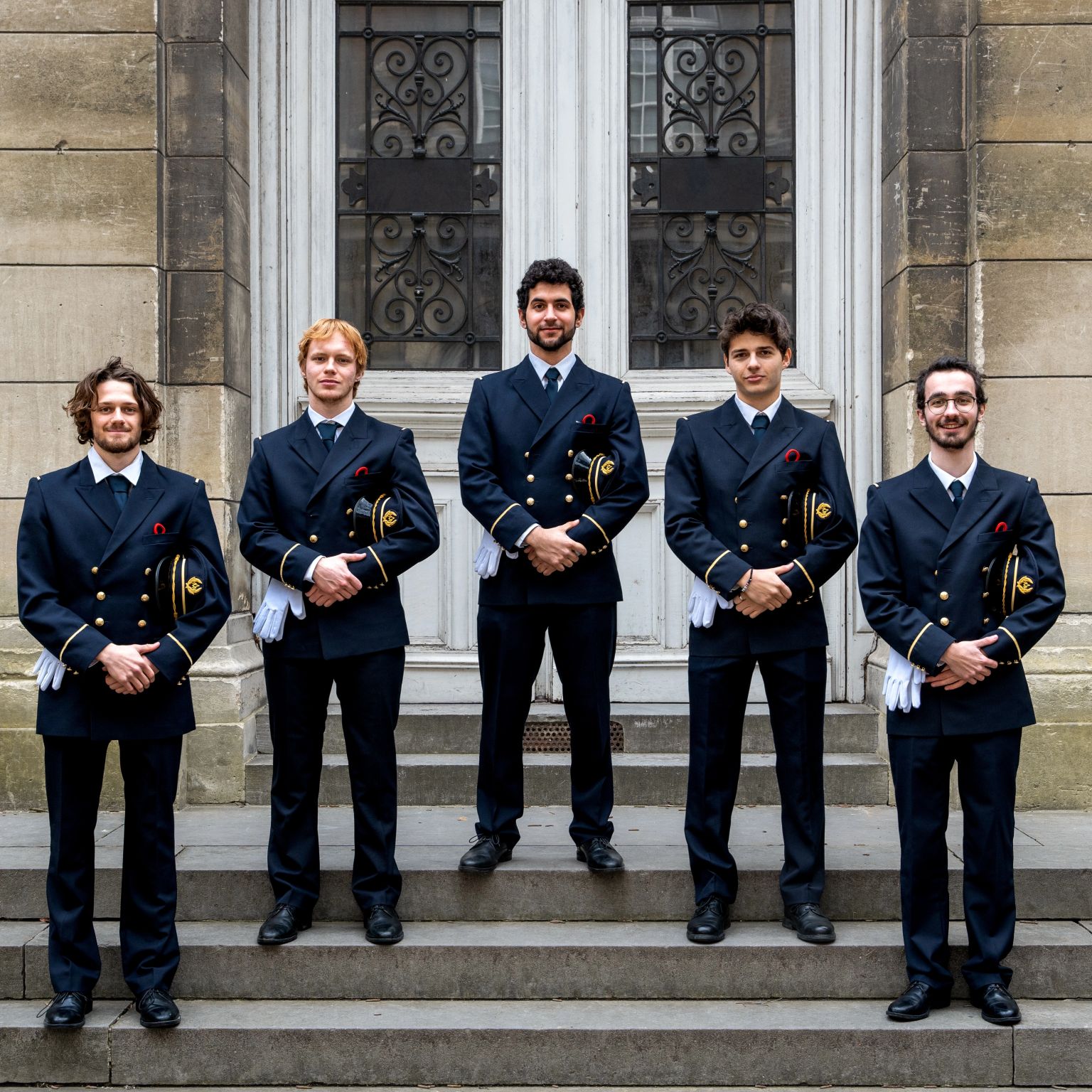
From left to right:
Corentin Blanchard, Antoine Debionne, Raphaël Fourest, Paul Lurin, and Alban Fréville, students in the Grande Ecole Engineering Programme the Arts et Métiers campus Arts et Métiers Lille