PIMM secures new European funding

The PIMM laboratory located on the Paris campus has just secured new funding for a European H2020 project with EDF. The goal is to extend the lifespan of nuclear power plants.

The PIMM laboratory located on the Paris campus has just secured new funding for a European H2020 project with EDF. The goal is to extend the lifespan of nuclear power plants.
Companies have the opportunity to support Arts et Métiers its development objectives through the sponsorship campaign and the apprenticeship tax.
Sponsorship in higher education institutions plays a crucial role in financing and supporting various academic, cultural, and social projects.
The ELF (Evolutive Learning Factories) Arts et Métiers program Arts et Métiers to transform campuses into Industry 4.0 training factories, serving as true talent incubators. A €15 million fundraising campaign over five years has been launched to support this program, with donations coming from companies and individuals.
Companies can participate in the fundraising campaign, which aims to raise €15 million over five years. This campaign is being conducted jointly by the School, the Arts et Métiers Foundation Arts et Métiers the Société des Ingénieurs Arts et Métiers 3.
Companies can make their expertise and know-how available for projects of general interest. For example, skills-based sponsorship allows professionals to contribute to educational and research projects.
Opportunity to repurpose and reuse equipment or resources that are no longer needed by the company but may be of great educational value to the school. For example, donating computer equipment, laboratory equipment, or industrial machinery allows the school to modernize its facilities and provide students with state-of-the-art tools without having to bear the high costs of purchasing new equipment.
Corporate sponsorship allows companies to benefit from tax deductions: 60% of your donation is deductible from corporate income tax, up to a limit of €20,000 or 0.5% of turnover. This means that a donation of €100,000 costs you only €40,000.
The Apprenticeship Tax (TA) is an effective tool for this modernization. It generates significant leverage in the search for additional funding.
Companies choose the higher education institution to which they will allocate this annual tax, thereby contributing to the funding of apprenticeships and technological and vocational training.
By supporting expertise that suits you or by setting up an educational program on a specific topic:
These chairs bring together companies and research laboratories around a common goal: to develop knowledge and train talent in the scientific and technological challenges of the future.
🔗 More information about the chairs
Training chairs enable companies to contribute directly to education by partnering with a key theme (e.g., sustainable design, energy transition, etc.). They promote exchanges between professionals and students through teaching, projects, visits, or conferences.
Companies can also make shorter-term commitments by sponsoring a module or teaching unit: sharing expertise, case studies, professional immersion, or mentoring.
Engineer Arts et Métiers, specializing in Environment and Risk Management (EGR).
This program is accredited by the Commission des Titres d'Ingénieur (CTI) and has received the EUR-ACE label.
Environmental and Risk Management Engineers (EGR) are responsible for preventing industrial and environmental risks (protecting infrastructure, property, and the environment) and occupational risks (health and safety in the workplace).
Their extensive scientific knowledge enables them to participate in manufacturing processes and product development, focusing on innovation and eco-design.
The EGR engineer is capable of:
Theoretical training: 1,700 hours of academic training spread over 3 years in 5 teaching units:
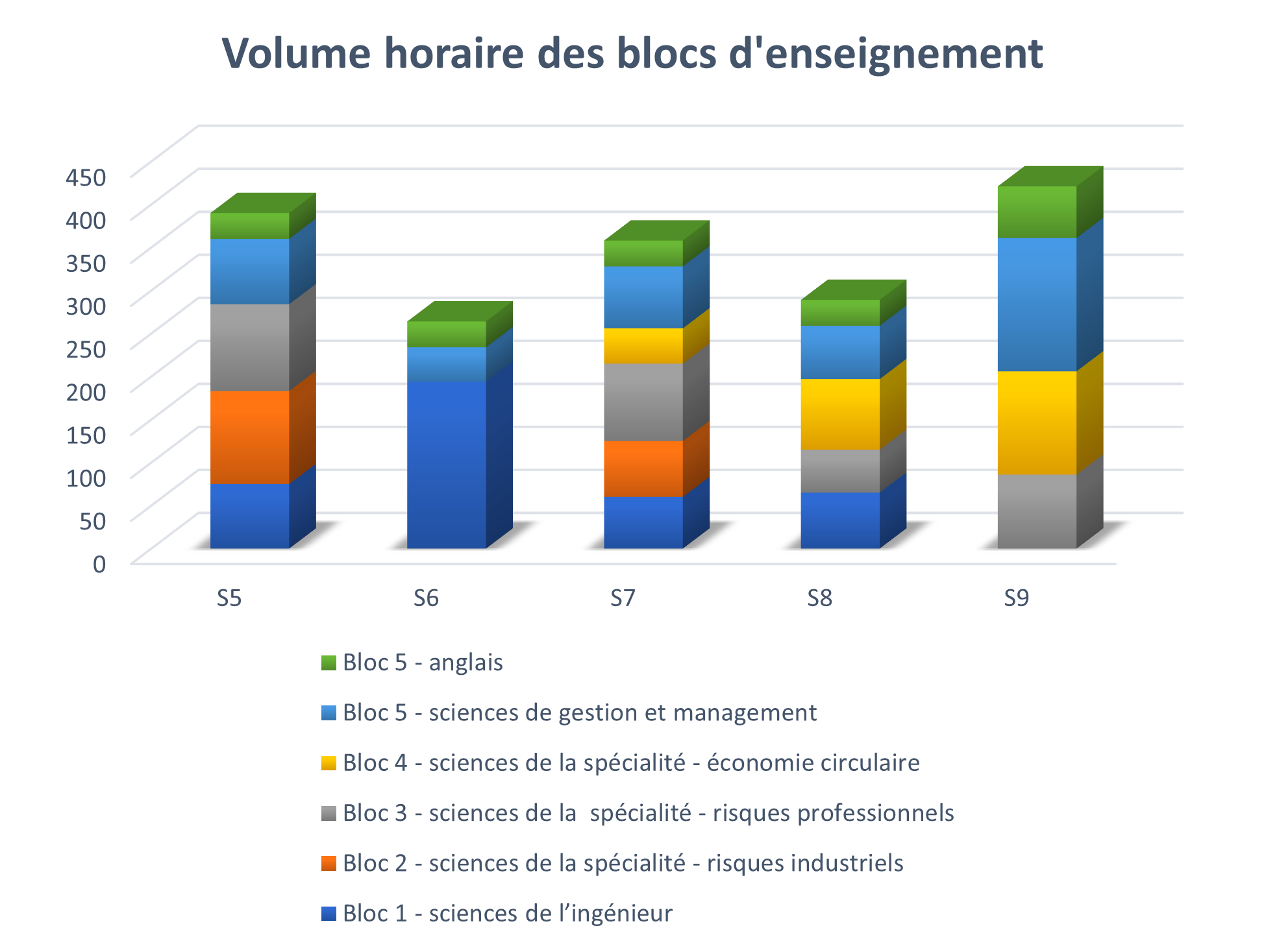
Work-study program with periods spent in the workplace and periods spent at school. In-person lectures and tutorials.
In-company training with a gradual shift to work-study (one week/one week at the start of training, increasing to three weeks/three weeks in the final year), and periods of full-time study.
During these industrial sequences, three projects (Risk Analysis, Co-construction and Implementation of an Action Plan, Engineering Project) will be carried out. Each will be the subject of a thesis and an oral defense.
Combining technical, economic, and human components, these projects are part of a process of progress in risk management and prevention.
Training is available through apprenticeships or continuing education.
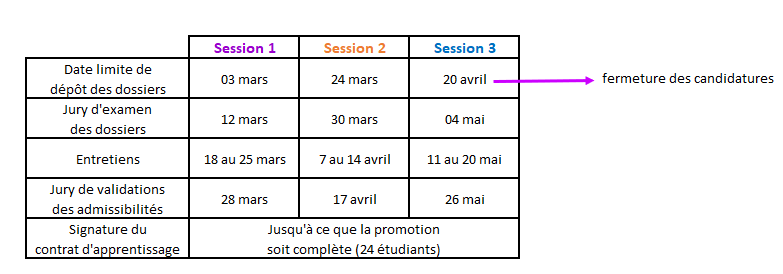
Find all the information you need about the admissions calendar, admission requirements, and eligible degrees at Admissions Specialized Engineering Programs | Arts et métiers
Sectors of activity: metallurgy, electronics, energy distribution, chemicals, pharmaceutical production, agri-food, construction, transportation, etc.
• Graduation rate: 75%
• Exam participation rate: 100%
• Extension rate (additional time to acquire missing skills): 21%
• Dropout rate due to changing employers: 33%
• Rate of notifications of program completion/interruption during training: 8%
• Rate of continuation of studies: Figures to be released
• Rate of job placement: Figures to be released
*Find data on past promotions on the Data Observatory page:
https://artsetmetiers.fr/fr/observatoire-des-donnees
Graduates may continue their studies toward a Ph.D., MBA, Master of Science , or Specialized Master's.
12 weeks mandatory as part of the degree program.
This training course may be accessible to people with disabilities. If you are affected, please contact us to see if specific support can be provided.
Students are enrolled at the apprentice training center (CFA), AMTALENTS, a subsidiary of the Arts et Métiers group Arts et Métiers to work-study programs and vocational training.
Enedis - Framatome - Solvay - Eiffage - Saint Gobain - Tefal - Bayer - EDF CNPE Tricastin - Brioche Pasquier - CEA Alduc - Dassault Aviation - CEA INES - AERE - MTB Group - Compagnie Nationale du Rhône - Air Liquide - MND France - Schneider Electric Industries - Caterpillar - Arkema France - Tradival - PSM 73 - Sila - Grid Solutions- Crea - SATELC - Cogifluid - Montabert - Technolabo Services TLS - ANETT NBD - ADS - EDF - Orano CE Tricastin - Roch Mécanique- Adhex Technologies - Clyde Union Pumps - ARO Welding Technologies
The program is accessible through apprenticeship or continuing education.
Admission requirements:
>> Inscrivez-vous en cliquant ici <<
The theoretical training takes place atthe Arts et Métiers Institute Arts et Métiers Chambéry, with the exception of the second semester, which is held at the Arts et Métiers campus Arts et Métiers Cluny.
Arts et Métiers Institute in Chambéry
Savoie Technolac
4 rue du Lac majeur
73375 Le Bourget du Lac
Accommodation information and eco-mobility information
180 ECTS (including 80 ECTS for professional modules)
RNCP code - 39166


The energy engineering program trains engineers in the fields of energy production, conversion, and supply over a three-year period, alternating between theoretical training and practical training in a company.
This program is accredited by the Commission des Titres d'Ingénieur (CTI) and has received the EUR-ACE label.
Energy engineers are energy generalists. They are involved in everything from drafting specifications for energy optimization studies to managing energy production systems and planning their operation. They also oversee project management.
Two options are offered in this program:
Practical training: 18 months of in-company training, subject to projects validating the acquisition of skills in line with the theoretical training program.
Face-to-face, alternating between work experience and school, with lectures and practical work.
Validation and certification based on:
Operations engineer, process engineer, planning engineer, network operations engineer, project engineer, design and consulting engineer,etc. TOEIC score (minimum 785)
• Graduation rate: 85%
• Exam participation rate: 100%
• Extension rate (additional time to acquire missing skills): 15%
• Dropout rate due to change of employer: 29%
• End-of-training/training interruption notification rate: 0%
• Rate of continuing education: Figures to be released
• Employment placement rate: Figures to be released
* Find data on past promotions on the Data Observatory page at
https://artsetmetiers.fr/fr/observatoire-des-donnees
Courses are taught by professors who are experts in their field, as well as by external lecturers recognized for their expertise in specialized scientific and/or technical fields.
Students are enrolled at the apprentice training center (CFA) of AMTalents, a subsidiary of the Arts et Métiers group Arts et Métiers to vocational training.
FRAMATOME, EDF, CORIANCE, CLIMESPACE
Training is available through apprenticeships or continuing education.
Find all the information you need about the admissions calendar, admission requirements, and eligible degrees at Admissions Specialized Engineering Programs | Arts et métiers
Admission requirements:
Graduates can continue their studies with a PhD, MBA, or Specialized Master's program.
12 weeks mandatory as part of the diploma program
This training course may be accessible to people with disabilities. If you are affected, please contact us to see if specific support can be provided.
Arts et Métiers Center in Paris
151 Boulevard de l’Hôpital - 75013 Paris


The industrial engineering department (opened in 1999) offers two options that meet the needs of manufacturing companies in the fields of industrial methods and logistics by training engineers with practical experience and industrial expertise tailored to professional life and its requirements.
This program is accredited by the Commission des Titres d'Ingénieur (CTI) and has received the EUR-ACE label.
Engineering degree from ENSAM (Ecole Nationale SupérieureArts et Métiers) specializing in Industrial Engineering in partnership with AMTALENTS.
Train field engineers capable of bridging the gap between design and manufacturing whil
ly optimizing industrial performance.
These engineers must be able to:
Use rational methodologies to identify and solve problems related to the industrialization of a product.
Leading industrial projects: defining the specifications for a production system and accepting delivery of that system
Mathematics, Mechanics and Strength of Materials, Mechanical Engineering, Electricity
Metrology, Machining processes, Casting processes, Forming and assembly processes, Unconventional processes, Knowledge of materials and Material properties, Polymers and composites, Automated production systems
General Methods, Flow Management – CAPM, Organization and Optimization Tools – Industrial Productivity and Performance, Logistics, IT, Automation, Maintenance
General Organization of the Company, Training in Company Life, Management, Quality Management and Assurance, Marketing, Project Management, Corporate Communication
Practical training: 18 months of in-company training, subject to projects validating the acquisition of skills in line with the theoretical training program.
The degree provides students with the skills needed to work as industrial engineers in production-
ctory sectors. The aim of the program is to train engineers to work in the fields of design, implementation, and production management.
At the end of the training, the IT engineer will have acquired the following skills:
Face-to-face, alternating between work experience and school, with lectures and practical work.
Validation and certification based on:
• Graduation rate: 96%
• Exam participation rate: 100%
• Extension rate (additional time to acquire missing skills): 4%
• Dropout rate due to changing employers: 10%
• End-of-training/training interruption notification rate: 2%
• Rate of continuing education: Figures to be released
• Employment placement rate: Figures to be released
* Find data on past promotions on the Data Observatory page at
https://artsetmetiers.fr/fr/observatoire-des-donnees
Graduates can continue their studies with a PhD, MBA, or Specialized Master's program.
12 weeks mandatory as part of the diploma program
Courses are taught by professors who are experts in their field, as well as by external lecturers recognized for their expertise in specialized scientific and/or technical fields.
Students are enrolled at the apprentice training center (CFA), AMTalents, a subsidiary of the Arts et Métiers group Arts et Métiers to work-study programs and vocational training.
Air France, Airbus Helicopters, Alstom Transport, Cl Brakes, Coca Cola, Dassault, Degremont, EDF, Faurecia, La Poste, Micronor, Naval Group, PSA, Renault, SNCF, Safran Aircraft Engines, Safran Nacelles, Souriau, Telma, Thales, Trophy Kodak, Valeo…
Training is available through apprenticeships or continuing education.
Find all the information you need about the admissions calendar, admission requirements, and eligible degrees at Admissions Specialized Engineering Programs | Arts et métiers
This training course may be accessible to people with disabilities. If you are affected, please contact us to see if specific support can be provided.
Arts et Métiers , Paris Campus
151 Boulevard de l’Hôpital
75013 Paris


Arts et Métiers engineer Arts et Métiers Mechanics and Mechatronics
This degree meets the needs of companies that need to design and build specialized machinery. We train future engineers dedicated to the field of industrial equipment design and operation, with hands-on experience and expertise tailored to professional life and its demands.
This program is accredited by the Commission des Titres d'Ingénieur (CTI).
Train engineers capable of designing, developing, installing, and maintaining dedicated, specific, and unique equipment that is technically and economically effective and efficient.
Upon completion of this training, engineers will be able to:
Theoretical training
Practical training
The in-company training program accounts for approximately 60% of the total training time.
It includes aninternational assignmentlasting at least 12 weeks and the completion of an engineering project defended at the end of the training program.
Methods used and evaluation procedures
Criteria for obtaining the diploma
Validation based on:
Optional: dual degree in engineering and management
A course module specifically designed for future engineers allows engineering apprentices to obtain a dual degree in one year. The aim is to promote a culture of entrepreneurship and innovation through a dual degree partnership with IAE Metz.IAE Metz. Learn more about this dual degree and how to enroll.
Training is available through apprenticeships or continuing education.
Find all the information you need about the admissions calendar, admission requirements, and eligible degrees at Admissions Specialized Engineering Programs | Arts et métiers
Students are enrolled at the apprentice training center (CFA) of AMTalents, a subsidiary of the Arts et Métiers group Arts et Métiers to vocational training.
Small and medium-sized enterprises and large contractors and subcontractors from various professional sectors.
Face-to-face, alternating between work experience and school, with lectures and practical work.
Graduates can continue their studies with a PhD, MBA, or Specialized Master's program.
12 weeks mandatory as part of the diploma program
This training course may be accessible to people with disabilities. If you are affected, please contact us to see if specific support can be provided.
Engineer in Special Machine Design, Industrial Robotics Engineer, Industrial Systems Engineer, leading to a Master of Science degree Master of Science equivalent to five years of higher education).
Graduates can continue their studies in an MBA or Specialized Master's program.
• Graduation rate: 70%
• Exam participation rate: 100%
• Extension rate (additional time to acquire missing skills): 30%
• Dropout rate due to changing employers: 15%
• Notification rate of program completion or interruption during training: 9%
• Rate of continuing education: Figures to be released
• Employment placement rate: Figures to be released
* Find data on past promotions on the Data Observatory page at
https://artsetmetiers.fr/fr/observatoire-des-donnees
The training lasts three years and includes 1,800 hours of face-to-face instruction.
Arts et Métiers Campus Arts et Métiers Metz
180 ECTS
RNCP code - 39304
Coordinator
Contact: fip.c2ei@ensam.eu
Michel, Guillaume, Julien, Benjamin, Antoine, and Corentin joined the C2EI Specialized Engineering Program in 2019:


The Mechanical Engineering and Robotics specialization trains engineers to work in the field, capable of managing activities and/or projects in the areas of engineering and production and able to support companies in the deployment of digital technologies and new approaches to the industry of the future. These specialists are also capable of performing management functions in technical, societal, and organizational areas.
The training aims to acquire and apply the skills necessary to manage, operate, and develop an industrial production system:
Theoretical training: 1,780 hours—40% at school and 60% in the workplace (time spent in the workplace increases during the course of study)

Validation based on:
Engineers in design offices, methods offices, production managers, etc., capable of supporting the changes associated with the deployment of digital technologies and continuous improvement methods.
Sectors: metallurgy, automotive, rail, aerospace, space, energy, healthcare, etc.
• Graduation rate: 72%
• Exam participation rate: 100%
• Extension rate (additional time to acquire missing skills): 28%
• Dropout rate due to change of employer: 17%
• Notification of program completion or interruption during training: 5%
• Rate of continuing education: Figures to be released
• Employment placement rate: Figures to be released
* Find data on past promotions on the Data Observatory page at
https://artsetmetiers.fr/fr/observatoire-des-donnees
Training is available through apprenticeships or continuing education.
Find all the information you need about the admissions calendar, admission requirements, and eligible degrees at Admissions Specialized Engineering Programs | Arts et métiers
In person, work-study, in-company and school-based with lectures, tutorials, practical work (in workshops and on machines) and projects.
Graduates can continue their studies with a PhD, MBA, or Specialized Master's program.
This 12-week mobility program is a requirement for obtaining the degree.
Students are enrolled at the apprentice training center (CFA), AMTalents, a subsidiary of the Arts et Métiers group Arts et Métiers to work-study programs and vocational training.
The entire program takes place on the Arts et Métiers campus Arts et Métiers Châlons-en-Champagne.
This training course may be accessible to people with disabilities. If you are affected, please contact us to see if specific support can be provided.
Arts et Métiers Campus Arts et Métiers Châlons-en-Champagne
Rue Saint Dominique – CS 70508
51006 Châlons-en-Champagne
Initial training: 180 ECTS
Continuing education: 150 ECTS
RNCP code - 39303
Email: CFA.ArtsetMetiers@ensam.eu
Tel.: 33 (0)3 26 69 26 51


Mechanical Engineering Specialization, Industrial Engineering & Production Specialization, in partnership with ITII* Aquitaine.
This program is accredited by the Commission des Titres d'Ingénieur (CTI) and has received the EUR-ACE label.
Theoretical training at a training center: 1, 650 hours
Practical training in a company: 3,000 hours
International professional mobility: 12 weeks
Union of Chemical Industries (UIC), Union of Metallurgy Industries and Trades (UIMM), and nearly 100 companies in the region
Registration on the website: itii-aquitaine.com or formation-maisonindustrie.com
For more information and registration forms: CLICK HERE
The theoretical training takes place at the Bordeaux-Talence " Arts et Métiers " campus and at the CFAI
"The Mechanical Engineering apprenticeship program provides access to a wider range of careers."
Read his interview on Facebook
"What I like most about this program is the diversity of the modules offered. We learn a little bit of everything we need to be engineers, managers, and project leaders, and we even get advice on how to start our own businesses!"
*ITII: Institute of Industrial Engineering Techniques

