
The PIMM laboratory located on the Paris campus has just secured new funding for a European H2020 project with EDF. The goal is to extend the lifespan of nuclear power plants.
"Electrical cables are essential to the proper functioning and safety of a nuclear power plant," explains Xavier Colin, a lecturer and researcher at the PIMM (Processes and Engineering in Mechanics and Materials) laboratory at the Arts et Métiers campus Arts et Métiers Paris. "And there are an average of 25,000 of them per plant, representing a total length of 1,500 km. Being able to predict their durability is therefore a major challenge, especially since it is complicated—if not impossible when not planned for in advance—to check their condition on site."
A long-standing collaboration with EDF
PIMM has been collaborating with EDF on this subject since the early 2000s. "We have completed six joint doctoral theses," says Xavier Colin, "and some of our doctoral students now work at EDF. In addition, since 2009, PIMM has been the reference laboratory for polymer sustainability at the Material Aging Institute (MAI), a research institute created by EDF with nuclear power plant operators from around the world."
It was therefore only natural that PIMM became involved in the Team Cables project, coordinated by EDF and bringing together 13 partners from six different countries. This project has secured European funding totaling €5.5 million.
International visibility
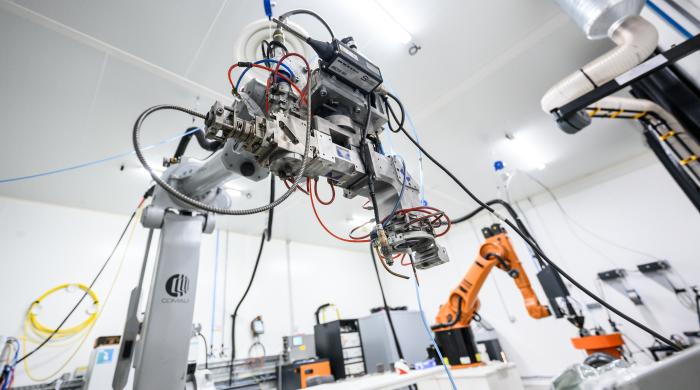
"We will be working on developing a kinetic model to predict damage and the lifespan of electrical cables," says Xavier Colin. "We subject the cable to accelerated aging and analyze the physical, chemical, and mechanical phenomena of the material at different scales. This project therefore requires in-depth knowledge in various scientific fields (chemistry, physics, mechanics, computer science, etc.) and expertise that the PIMM teams have proven they possess. It is a flagship area of our activity that brings us international visibility."