Virtual Human Project: The Unity toolkit for avatar animation

VIRTUAL HUMAN PROJECT

How can you imagine a good virtual reality immersion without a sense of social presence with the virtual characters populating the environments? For Geoffrey Gorisse, a lecturer and researcher atthe Arts et Métiers institute Arts et Métiers Laval, the visual and behavioral consistency of avatars is crucial to promoting social interaction effects in a virtual reality application.

Master of Science CPSE - Cyber-Physical Systems Engineering

Main image
MR CPSE visual
Headline

Master of Science MoS) Master of Science Cyber-Physical Systems Engineering (CPSE)

Main body text

RENTAL

Arts et Métiers Campus inArts et Métiers

PROGRAM

Teaching language: English
ECTS credits: 30 credits/session (60 ECTS for the M2)

Learning outcomes are achieved through a well-balanced training program that combines theoretical and practical learning sequences, during which students are placed in both academic and real-life industrial settings, in order to develop multiple cross-disciplinary skills.

  • From September to January (courses): 4 professionalizing and 6 scientific modules, a language module (24 hours), a long multidisciplinary project (128 hours). This project aims to further investigate the concepts introduced in the various modules and to further interact with state-of-the-art methods, models, and tools through real-life industrial projects.
  • From February to September: Master of Science in academia or industry, in France or abroad.

The four professionalizing modules are as follows (48 hours):

  • Research methodology (12 hours)
  • Artificial Intelligence and Data Analytics (12 hours)
  • Industry 4.0: concepts, survey, and future trends (12 hours)
  • Digital factory and supply chain management (12 hours)

The 6 scientific modules are as follows (144 hours):

  • Digital Mock-Up for CPS modeling and advanced engineering (24 hours)
  • Reverse engineering and digital prototyping of CPS (24 hours)
  • Continuity for CPS engineering in a heterogeneous context ( 24 hours)
  • Supervision of CPS during the engineering and operation phases (24 hours)
  • Advanced robotics (24 hours)
  • Mechatronics, advanced control, identification, and fault detection for CPS (24 hours)

We use RoboDK for offline simulation and programming of industrial robots.

KEY STRENGTHS

  • Deep theoretical knowledge of the mainstream concepts, methods, models, and tools involved in CPS engineering and Industry 4.0 technologies and processes
  • Extended practical skills for the definition of multidisciplinary technical solutions for CPS engineering
  • Deep understanding of the overall value chain, strategic management, and supply chain management
  • Structured research methodology to address a wide range of Industry 4.0-related research challenges
  • Transversal skills gained when confronting both academic and industrial multidisciplinary projects
  • International exposure through courses taught in English and exchanges with foreign students

CAREERS

  • PhD in a field related to Industry 4.0 and CPS, in academia or in industry (CIFRE), to become a recognized expert in an area of Industry 4.0.
  • R&D in large companies or startups, in numerous sectors (manufacturing, construction, services, consultancy, etc.) and fields (automotive, aerospace, health, IoT, etc.).

ADMISSION

Prerequisites 

  • First year of a Master of Science degree or an equivalent foreign degree
  • For Arts et Métiers : through the 2A and 2B selection processes

PREREQUISITES 

  • First year of a Master of Science degree or an equivalent foreign degree
  • For Arts et Métiers : through the 2A and 2B selection processes

PROCEDURE 

Applications end mid-June
. The admission process includes an oral presentation to evaluate the motivations and level of English.

==> Apply online

COST OF MSc

Tuition fee for EU/EEA and non-EU/EEA citizens: around €250/academic year and it must be paid on the registration day, at the latest. There is no application fee.

PARTNERS

  • Academic partners: MAP Laboratory, Marseille (France), IMATI-CNR, Genoa (Italy), ETS Montreal, Quebec (Canada), LURPA Laboratory, ENS Cachan (France)
  • Industrial partners: Polyshape, SAFRAN, PSA, Cap Gemini, Airbus, Cetim
  • Sponsor: RoboDK (we use RoboDK for offline simulation and programming of industrial robots)

CONTACTS

Outstanding Achievement Award presented to Nicolas Perry for his closed-system tracheal valve project

Outstanding Action Award Ceremony

On Tuesday, September 22, Nicolas Perry received the Outstanding Action Award at the Health Innovation Forum in Bordeaux. This award, presented by the newspaper La Tribune, recognizes the project launched during lockdown by the Bordeaux professor and researcher, which aims to design closed-system tracheal valves for COVID-19 patients in intensive care.

The collaborative workspace: a real driver forArts et Métiers strategyArts et Métiers

Main image
etc.
Headline

A project that serves as a real lever forArts et Métiers strategyArts et Métiers terms of developing student entrepreneurship and promoting technology!

Main body text

What is a collaborative workspace?

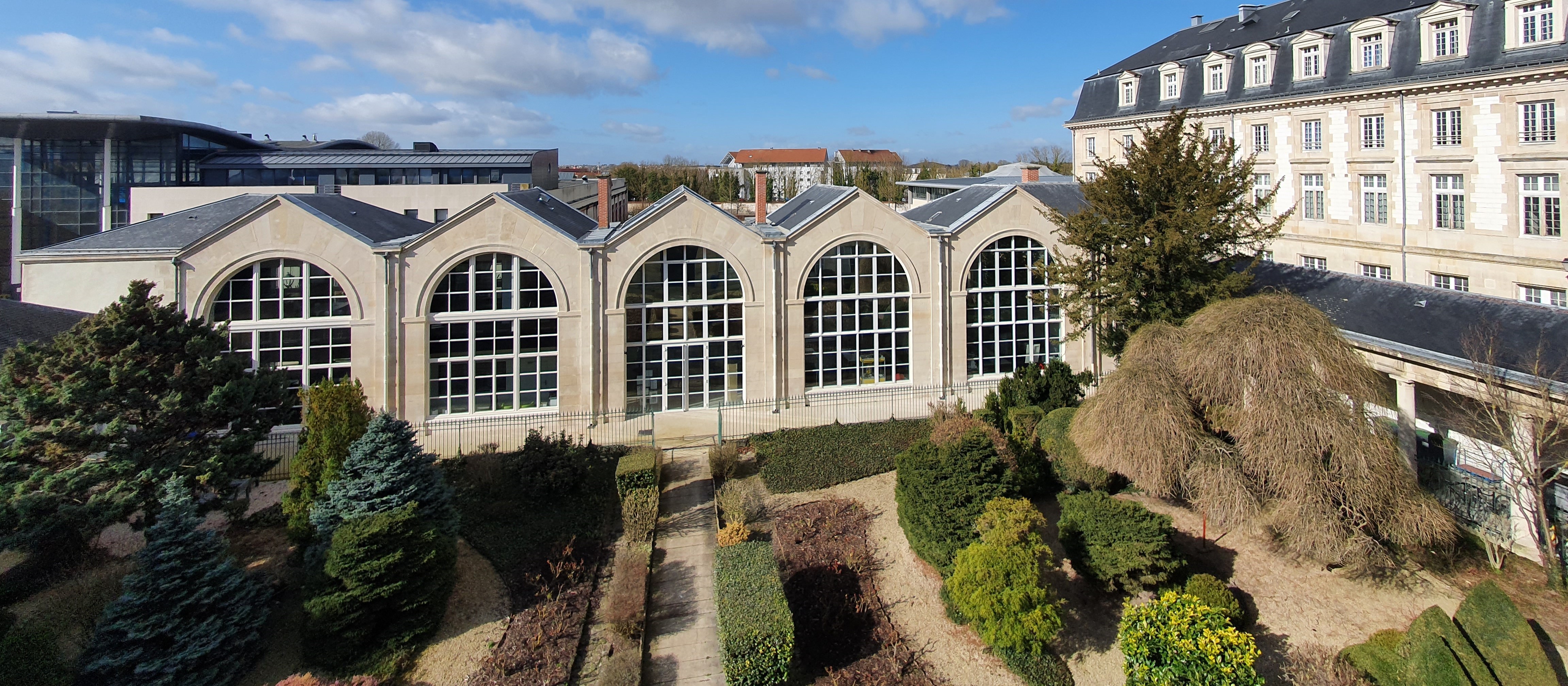
Ubuilding on the Arts et Métiers campus Arts et Métiers Châlons-en-Champagne which will house a multifunctional space dedicated to collaborative work in the fields of engineering and technology. 

A multifunctional space

A true hub for sharing, this space will offer a comprehensive range of equipment, services, and activities designed to facilitate and encourage creativity, ingenuity, and teamwork. It will be accessible to all students on campus and in the city of Châlons-en-Champagne, as well as to project leaders wishing to test ideas or create prototypes in collaboration with students.

The different spaces 

  • A document center with a two-story library (providing access to historical documents and a self-service computer room)
  • A space for creativity and engineering with a flexible coworking/brainstorming/digital engineering hub and a prototyping hub (3D scanning and printing, robotics, laser cutting, etc.).
  • A multimedia room (to promote achievements)
  • A boardroom

The collaborative workspace will enable our students to fully utilize their skills and have a dedicated place to build a project!

The work is scheduled for completion in September 2021.

© OMADA Architects

Two Master of Science students Master of Science a solution to reduce CO2 emissions

Two Master of Science students Master of Science a solution to reduce CO2 emissions

The Driving Simulation Conference Europe VR (DSC) took place at the Antibes Convention Center from September 9 to 11, 2020. For this 19th edition, two first-year students in the Master of Science atthe Institut Arts et Métiers Chalon-sur-Saône presented their solution for optimizing wait times at red lights and thereby reducing a vehicle’s CO2 emissions.