CESAME Chair

Main image
CESAME
Headline

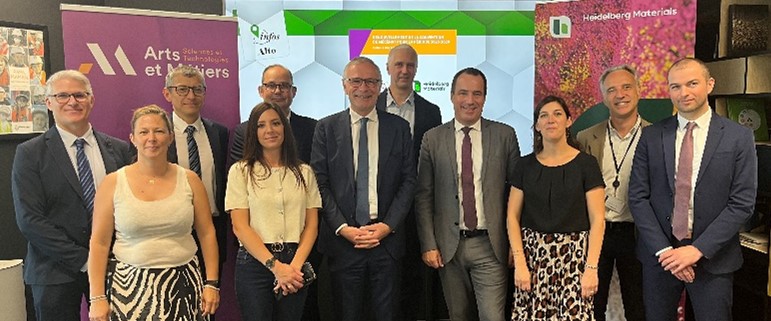
The new CESAME chair, created with Safran Additive Manufacturing Campus, aims to develop innovative processes in aeronautics.

Main body text

A strategic partnership between academia and industry 

The CESAME chair aims to promote and develop innovative metal additive manufacturing processes in theaerospace industry. This strategic partnership was established between Arts et Métiers Safran Additive Manufacturing Campus (SAMC), a center of excellence dedicated to metal additive manufacturing processes within the Safran group, a world leader in the aerospace industry.

This new chair is based on a shared vision and goal: to achieve a complete understanding and mastery of all the physical processes involved in additive manufacturing in order to optimize performance, the durability of the materials and structures obtained, and the design of advanced technological solutions. 

Through this collaboration, Arts et Métiers providing its scientific expertise and the innovative capabilities of all its laboratories in the fields of processes, materials, mechanical behavior, and durability under service conditions, both digitally and experimentally. For its part, SAMC brings in-depth knowledge of the market, industrial needs, and current and future technical challenges, as well as its expertise in metal additive manufacturing processes.

Innovative processes and high-performance materials

The CESAME Chair focuses on six key areas of research:

  • laser-matter interaction and its consequences on microstructures
  • experimental and numerical process thermodynamics
  • multi-material processes
  • the links between microstructure and mechanical behavior
  • surface and volume effects
  • engineered materials

The combination of these different projects should lead to a reduction in weight and improved performance of the aeronautical equipment needed for future civil aircraft programs that will emerge by 2035.
The collaboration between Arts et Métiers the Bordeaux Institute of Mechanics and Engineering (I2M / Arts et Métiers, Bordeaux INP, CNRS, Inrae, University of Bordeaux), the Processes and Engineering in Mechanics and Materials Laboratory (PIMM), and SAMC is based on a co-development model in which researchers and engineers work in synergy to transform innovative ideas into concrete applications.  

Additive manufacturing opens up unparalleled opportunities for improving performance and reducing weight, and presents a challenge to the academic world. Performance optimization requires complete control of the value chain, from understanding the physical processes involved in the manufacturing process to knowledge and modeling of the behavior of these new-generation materials and structures.

Nicolas Saintier, professor at the Bordeaux-Talence campus, head of the Dumas department at I2M and holder of the CESAME chair

Promising spin-offs for aeronautics 

The expected outcomes for this new chair are manifold. The CESAME chair includes significant scientific and technological advances in process control and the performance of materials obtained through additive manufacturing, but also contributes to training a new generation of engineers capable of meeting the technical and environmental challenges of the aeronautics industry of the future.  

This collaboration should enable significant progress in process control, particularly powder bed FA, with a view to developing and producing increasingly complex parts while ensuring complete flight safety.

Luc Namer, Head of Technology at SAMC

Looking ahead, the applications of the work carried out by the chair are part of an environment of increased international competitiveness, positioning Arts et Métiers SAMC at the forefront of process innovation for aeronautics. The CESAME chair is thus establishing itself as a catalyst for innovation and a strategic lever for a sustainable and high-performance aeronautics industry. 

Contact

Nicolas Saintier, I2M: nicolas.saintier@ensam.eu

Fluidetronics Chair

Main image
Chair
Headline

Arts et Métiers, through its subsidiary AMValor, and MMT, which specializes in engineering and the sale of manufacturing licenses for mechatronic devices, are joining forces to create a five-year industrial chair.

Main body text

This chair focuses on the development of "fluidetronic" systems, combining MMT's expertise in mechatronics with the fluidics skills of the LIFSE laboratoryArts et Métiers.

A technology partnership

The chair focuses on the development and optimization of fluidic systems, with a particular interest in:

  • Regenerative pumps
  • Positive displacement pumps
  • Centrifugal machines

The research work will include the design, analysis, optimization, and experimental and numerical characterization of these devices. The objective is to develop innovative technologies that will significantly improve the performance and durability of these systems.

Practical applications for industry

The advances resulting from this chair will find applications in various industrial sectors, with a particular focus on electric and autonomous vehicles. These innovations aim to address the challenges of energy performance and reliability in demanding industrial environments.

By combining academic and industrial expertise, this chair illustrates the desireArts et Métiers MMT to innovate together in order to meet the technological challenges of tomorrow.

Contacts

Scientific leaders: Smaïne Kouidri (smaine.kouidri@ensam.eu) and Florent Ravelet (florent.ravelet@ensam.eu), LIFSE

The Bordeaux-Talence campus, a springboard for innovative industrial startups

meeting with five men around a table and a computer

The Arts et Métiers campus Arts et Métiers Bordeaux-Talence has positioned itself as a true incubator for innovation by welcoming promising startups in the industrial sector. Among them, Handddle and Perception Manufacturing perfectly illustrate the dynamism of this ecosystem, with the advantages offered to entrepreneurs who choose to set up there and the opportunities for engineering students on campus.

Research Ethics Committee (REC)

Main image
Research Ethics Committee (web page banner)
Headline

The Arts et Métiers Research Ethics CommitteeArts et Métiers CER AM) and the Arts et Métiers Data Protection Officer support the Arts et Métiers group's research staff Arts et Métiers ensure the protection of human participants involved in its projects. 

Main body text

The CER's mission is to issue ethical opinions on research projects carried out or supervised by Arts et Métiers staff Arts et Métiers involving human subjects. The CER's internal regulations were approved by the Board of Directors of the Ecole Nationale SupérieureArts et Métiers September 26, 2024. The CER procedural note is the reference document that guides Arts et Métiers staff members who are conducting or supervising a project in submitting an application to the CER.

Composition of the CER  

The CER is composed of voting members (including a chair and vice-chair) and non-voting members, whose appointment procedures are specified in the internal regulations of the CER Arts et Métiers.

Voting members (four pairs of members from within the Arts et Métiers group Arts et Métiers four external figures)

  • Claudio VERGARI and Laura VALDES TAMAYO / Arts et Métiers
  • Fabrice MANTELET and Frédéric SEGONDS / Arts et Métiers
  • Jean-Yves DANTAN and Marc LASSAGNE / Arts et Métiers
  • Sylvain FLEURY and Olivier CHRISTMANN / Arts et Métiers
  • Emilie LOUP ESCANDE / Picardie Jules Verne University
  • Stephanie BUISINE / CESI
  • Santiago Arroya-Tobón / Aix-Marseille University
  • Nathalie ANDRE / University of Poitiers

Non-voting members

  • Director of Research: Eléanor FONTAINE
  • The personal data protection officer and ethics officer: Sébastien GARCIA
  • Director of Scientific Information and Open Science: Christine OLLENDORFF
  • Scientific integrity advisor: Jean-Christophe BATSALE

Chair and Vice Chair of the CER

  • Sylvain Fleury and Laura Valdes Tamayo

Who should I contact?

  • Requests for referral should be sent to the CER office: bureau.cer@ensam.eu
  • For data processing compliance (if the protocol holder is a member of the Arts et Métiers group): The Data Protection Officer (DPO): dpo@ensam.eu

Scientific integrity

Main image
Scientific integrity (web page banner)
Headline

Arts et Métiers a signatory, via France Université (formerly CPU), of the National Charter of Ethics for Research Professions.Aninternal charter on "responsible conduct in research" is currently being drafted and aims to outline the various frameworks with which public officials must comply. 

Main body text

Scientific integrity, research ethics, and professional conduct are three essential components of responsible research behavior. 

  • Scientific integrity refers to good practices in the production and dissemination of scientific knowledge. It guarantees the honesty and rigor of research activities.
  • Ethics refers to a set of obligations specific to the practice of a profession. In France, when a researcher is a public servant, his or her obligations are set out in the General Civil Service Code.
  • Research ethics concerns, on the one hand, the major issues raised by certain scientific developments and, on the other hand, more operational issues relating to the compliance of research protocols with the rules of law and ethical recommendations in force.

Pour en savoir plus sur les différents acteurs institutionnels de ces trois domaines, >> cliquez ICI <<

What is scientific integrity? 

In France, scientific integrity is defined in the Research Code (Article L. 211-2) as the set of rules and values that must govern research activities in order to guarantee their honesty and rigor. Essential to the proper functioning of scientific communities, scientific integrity is also the foundation of a relationship of trust between the world of research and other components of society. Beyond the specificities of individual disciplines, good research practices are based on common principles, as set out in the European Code of Conduct for Research Integrity: 

  • Reliability in design, methodology, analysis, and resource utilization.
  • Respect for colleagues, research participants, society, ecosystems, cultural heritage, and the environment.
  • Honesty in the design, conduct, evaluation, and dissemination of research, in a transparent, fair, comprehensive, and objective manner.
  • Responsibility for research activities, from conception to publication, their management and organization, for training, supervision, and mentoring, and for the broader implications of research.

What is a breach of scientific integrity?

Any practice that undermines the reliability of results and the proper functioning of research communities is likely to constitute a breach of scientific integrity. A breach can affect all aspects of research activities in all disciplines, whether public or private. Some examples of breaches that may affect: 

  • Planning and implementation of the research project: failure to obtain the necessary authorizations (ethical approval, participant consent); failure to comply with authorized protocols; misuse of research funds.
  • Management and practices relating to data of any kind (including text corpora, archives, images, etc.): falsification or fabrication; deliberately deficient management or archiving; retention that is not legally justified, omission or selection that is not scientifically justified; problematic statistical processing; unmentioned embellishment.
  • Practices relating to publication, communication, and authorship: plagiarism; misuse of signatures or failure to acknowledge contributions; self-plagiarism; non-compliance with AI usage requirements; misuse or bias in citations; lack of impartiality or transparency in public statements.
  • Interactions between peers: biased peer review, appropriation of research projects or ideas, lack of supervision, undue obstruction of a peer's work, unfounded accusations of misconduct.

Failure to declare links or conflicts of interest may also constitute misconduct, as may violation of laws governing research involving humans or animals. In their most serious forms—which may include fabrication, falsification of data, and plagiarism (FFP)—misconduct is punishable by disciplinary sanctions.

Pour une présentation plus complète, >> cliquez ICI <<

Who should I contact?

3A Expertise - "Fluid Engineering and Rotating Machinery" Course

Main image
3A Expertise - "Fluid Engineering and Rotating Machinery" course (banner)
Headline

General engineer, student curriculum, third-year expertise in Fluid Engineering and Rotating Machinery

Main body text

Campus

Arts et Métiers Campus Arts et Métiers Paris

OBJECTIVE

The objective of this Expertise Unit is focused on acquiring the knowledge necessary for modeling and optimizing both the aerohydrodynamic and mechanical performance of rotating machines. This professional objective corresponds to careers in aeronautics, automotive, energy production and conversion, petrochemicals, agri-food, and healthcare. These courses are largely based on the design and control of rotating machinery.

PROGRAM

Module 1: Internal aerohydrodynamics of machines: 26 hours

This module consists of three parts: fluid dynamics, blade grid mechanics applied to the construction of axial machines, and the sizing and performance analysis of centrifugal and helico-centrifugal machines.

After a brief review of the characteristics of viscous flow and two-dimensional boundary layers, this course focuses on the study of grid profiles and the representation of the kinematic properties of flat blade grids. The nominal operation of a grid and a compression stage is then covered in this module. The final part explores in greater depth the kinematics of flow, the characteristics of the machine and the definition of losses, as well as the methodology for sizing centrifugal wheels.

Module 2: Aerohydrodynamics - Application: 20 hours of tutorials

This applied course is dedicated to deepening knowledge
in the design of turbomachinery. It mainly consists of a design office
where internal tools for sizing and analyzing the performance of
pumps and fans are presented to students. Working in pairs, the students
are then guided in the use of these tools to handle cases involving
compression turbomachinery design cases.

Module 3: Modeling energy systems: 3 hours of lectures + 18 hours of tutorials

The content of this course, which uses the Modélica modeling language, is based on a systems approach that takes into account the components of a system and how they are coupled. This course covers the case of a compressible fluid turbomachine and the effects of similarity, namely a gas turbine with all its components, the compressor, the turbine, and the combustion chamber, and their operating limits.

Module 4: Acoustics for Engineers: 15 hours

Acoustic problems, whether hydro or aero, are relatively common in the field of rotating machinery. It is therefore essential that engineers training at UE IFMAT have a minimum level of knowledge taught in this module. This course will therefore cover the following topics: physical characteristics of sound, sound levels, establishing the acoustic wave equation, acoustics in enclosed spaces, silencers, absorbers and diffusers, acoustic quality, acoustic measurements, machine noise, and an introduction to the aeroacoustics of turbomachinery.

Module 5: Design elements and architecture of rotating machines: 9 hours

This module covers the analysis of fluid/mechanical interactions for the mechanical design of the main components in the energy conversion chain. The following topics are covered in this module: thrust balancing, sealing systems, and the static and vibratory mechanical strength of shaft lines and components.

Module 6: Numerical simulation of flows in turbomachinery: 6 hours of lectures + 24 hours of tutorials

This CFD (computational fluid dynamics) module covers the numerical simulation of flows for applied problems involving turbomachinery. This project-based course introduces the fundamental concepts necessary for mastering this engineering tool, such as meshing, numerical resolution methods, boundary conditions, etc. The skills acquired at the end of this course are: defining a problem from a numerical point of view, simulating flows, characterizing a turbomachine, and post-processing the results obtained from CFD calculations.

EVALUATION METHODS

Each module leads to either a test, a mini-project, or practical work that will allow for the validation of the expected learning outcomes
at the end of this unit of expertise. 

CONTACTS

Arts et Métiers ParisArts et Métiers
Smaïne KOUIDRI
Fluid and Energy Systems Engineering Laboratory (Lifse)
33 1 44 24 62 30 
smaine.kouidri@ensam.eu