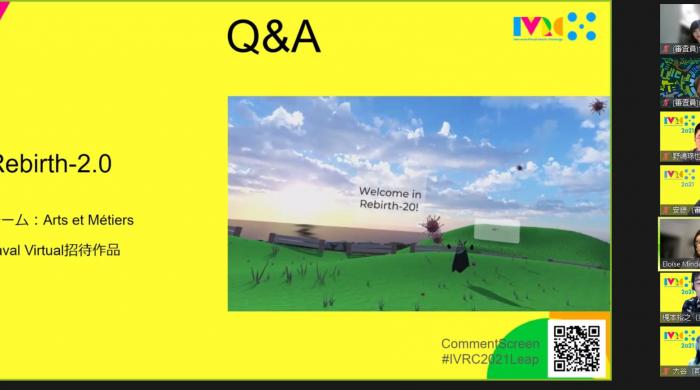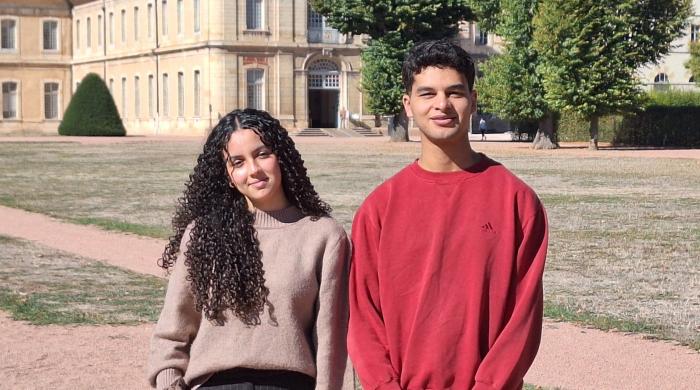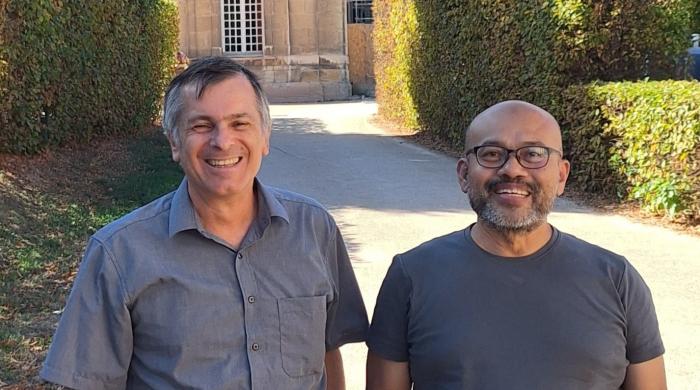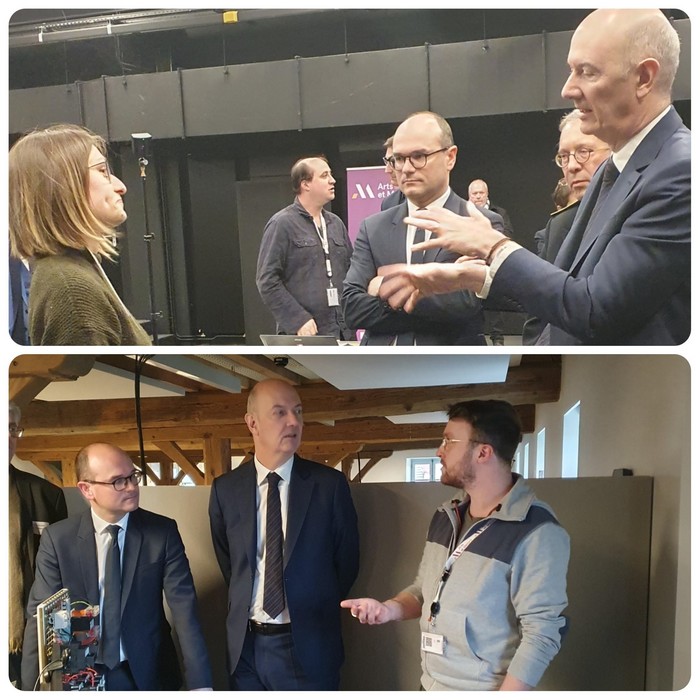
Eloïse Minder and Guillaume Klein, two doctoral students at LISPEN atthe Arts et Métiers Institute Arts et Métiers Chalon-sur-Saône, had the opportunity to talk with Roland Lescure, Minister Delegate for Industry, when he visited the new premises of the Arts et Métiers Institute Arts et Métiers Chalon-sur-Saône at Usinerie.
A look back at their research work.
Eloïse Minder on optimizing social interaction in virtual reality.
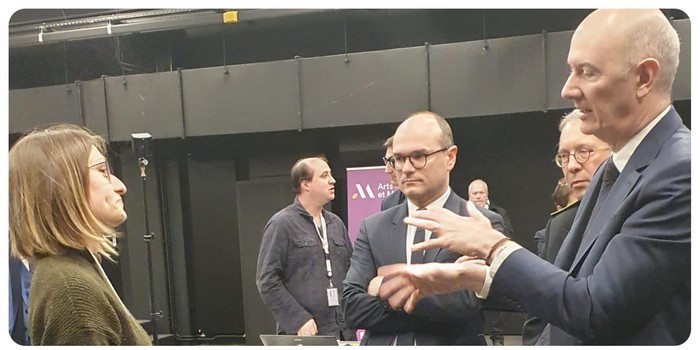
The subject of her thesis concerns the optimization of social interactions in virtual reality. She wants to reproduce the quality of experience experienced during face-to-face social interactions in virtual reality (VR).
To do this, she has set herself three objectives:
Understanding and studying what constitutes the quality of experience in social interactions outside of VR, then applying it to VR;
Identify and test ways to objectively measure the quality of VR interaction;
Study and test different avatar representations and their effects on the quality of social interaction.
She began her thesis on November 1, 2022. In three months, she completed the state of the art, i.e., studying interactions and publications on the subject related to virtual reality. One of her thesis co-supervisors, Christophe Guillet, put her in touch with Thierry Pozzo, a researcher at the UFR STAPS in Dijon and an expert in neuroscience who works in particular on the study of movement. Thanks to his advice, she was able to identify an initial approach for objective measurement through the measurement of movement. In order to optimize her thesis time, she decided to propose this topic for an internship, supervised by another of her co-advisors, Jean-Rémy Chardonnet, and herself. The offer is still open.
Guillaume Klein on remote assistance for maintenance at Suez Eau
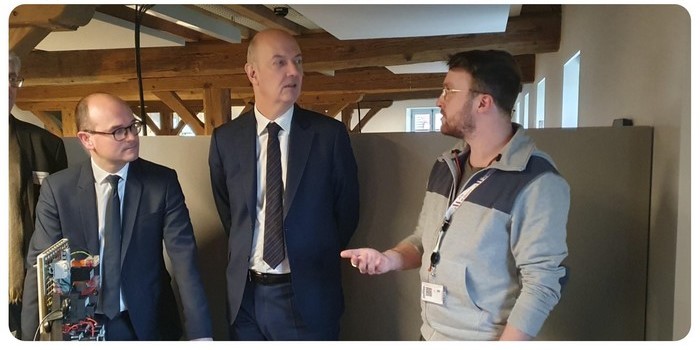
Guillaume is working on a project under a direct contract between AMVALOR and Suez Eau on "telecollaboration for industrial maintenance."
The main objective of his thesis is to continuously improve the responsiveness and resilience of maintenance teams responsible for wastewater treatment and the provision of drinking water to individuals and industries.
The purpose of the research is to explore and evaluate the possibilities offered by digital technologies for establishing a telecollaboration system for carrying out maintenance operations. Such a communication interface would ensure that urgent interventions run smoothly, even when the technician on assignment is unfamiliar with the infrastructure. He or she is assisted remotely by another expert technician.
After a phase of state-of-the-art research in maintenance and telecollaboration, coupled with observation and characterization of typical maintenance interventions, his research is now focused on evaluating the quality of remote assistance in a constrained industrial environment. The main issue being the quality of the available internet network, an initial experiment is currently underway with the aim of obtaining concrete results on the possibility of using telecollaboration. To this end, an application has been developed that provides employees with a range of communication options based on several scenarios of available internet bandwidth.