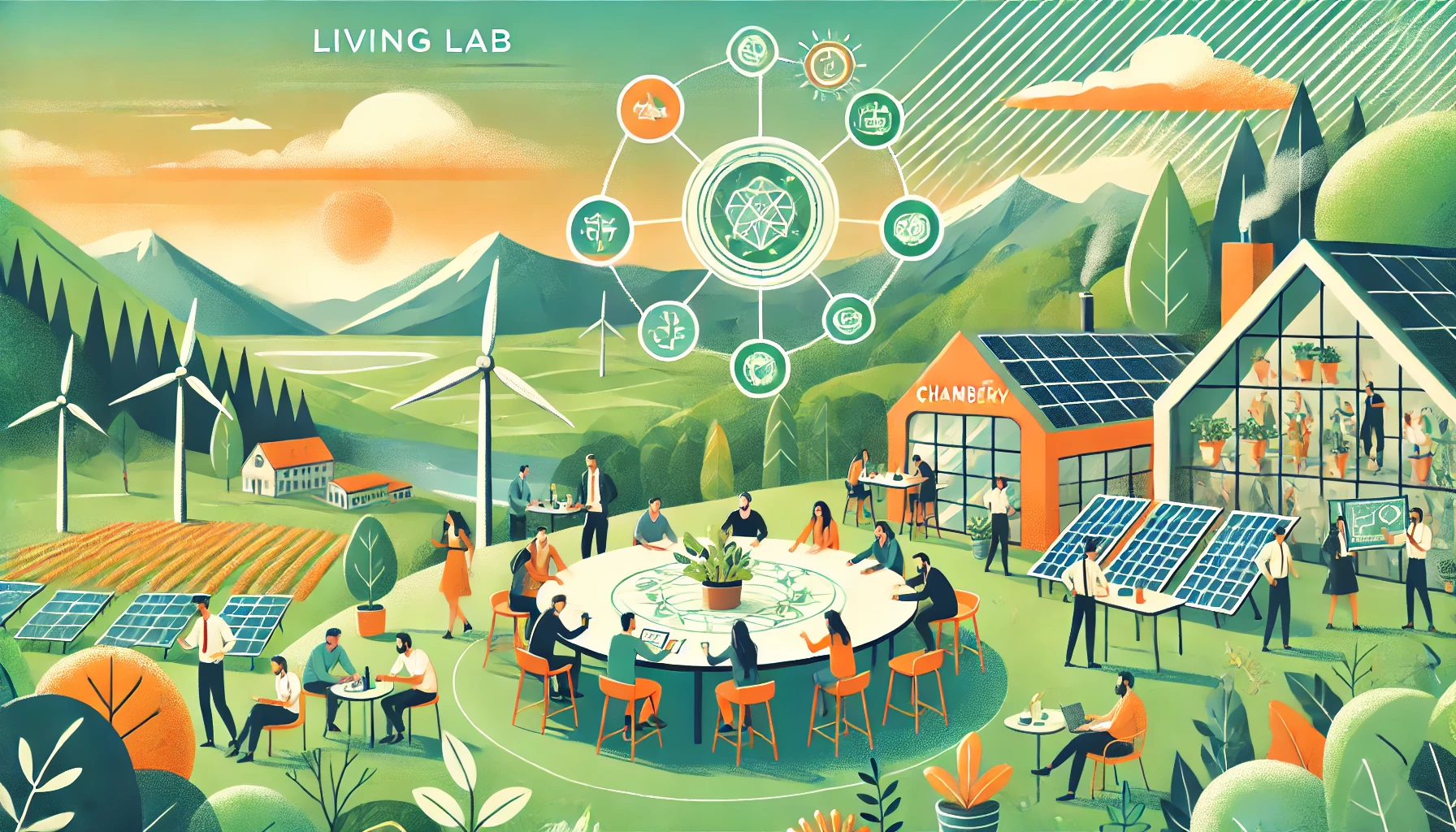
Horizon 2031, a new laboratory at the Chambéry Living Institute, aims to transform the region’s industrial landscape, support local industries, and inform public policy decisions.
The results of a feasibility study conducted by the Chambéry Institute in collaboration with the @AIR coop agency, with a view to the co-creation of a living lab, were presented on April 2.
About thirty people attended the presentation, including Laurent Champaney, CEO ofArts et Métiers, and other members of the institution’s executive committee. Also present were the president of the University of Savoie Mont Blanc, the mayor of Bourget-du-Lac (the town where the institute is located), and representatives from the AURA Region, the Montagne cluster, and France Active Savoie Mont-Blanc. Numerous discussions took place following the presentation.
The laboratory aims to support socio-economic, industrial, and public stakeholders in designing and testing sustainable, robust industrial practices tailored to the challenges of their respective regions. Building on the recognized expertise of the Chambéry Institute in eco-design, circularity, and industrial transition, the project addresses a growing need for concrete solutions, tested under real-world conditions and involving a diverse range of stakeholders. The living laboratory is designed as a collaborative, user-centered initiative that goes beyond a mere physical space to become a tool for collective intelligence serving the common good, the public interest, and the industrial fabric.
The methodology is based on strong local engagement: approximately 70 stakeholders are involved in a multi-stakeholder steering committee that brings together industry, local governments, academia, civil society, and citizens. This governance model ensures shared responsibility for strategic direction, decision-making that is genuinely responsive to on-the-ground challenges, and increased transparency through the creation of shared resources.
Our service offering is built around five complementary pillars: a sustainability and resilience assessment to aid decision-making; support for short- and long-term industrial projects; training and skills development initiatives; the provision of shared resources, spaces, and communication tools; and a cooperative foundation that fosters mutual understanding and mutual support.
The roadmap calls for a gradual ramp-up over five years, in terms of governance, the business model, and expected impacts. By 2031, the Living Lab aims to transform the region’s industrial fabric, support local industries, inform public policy decisions, and extend this approach to other areas across otherArts et Métiers campuses.