General engineer, student program, or professional training contract, third-year expertise in Industrial Management.
Campus
Arts et Métiers Campus Arts et Métiers Lille
8 Boulevard Louis XIV - 59046 Lille Cedex
Objectives
This expertise aims to train engineers capable of planning and managing complex systems characterized by strong interaction between technological, organizational, financial, and human variables.
Industrial management engineers will have an integrated view of industrial and manufacturing realities, enabling them to work in technology and business management in a competitive and constantly changing environment. They will have a set of skills based on quantitative methods that will enable them to model, analyze, and solve interdisciplinary, organizational, and economic technological problems, as well as communicate their findings.
Engineers will be made aware of the transition to the industry of the future , which affects all areas of production.
SPECIFICITY – 2 possible courses of study – PROFESSIONAL TRAINING CONTRACT and STUDENT status
This training can be carried out:
- in the form of a 12-month professional training contract.During this period, the learner is therefore employed by a company (at a minimum of 80% of the minimum wage) and alternates between periods at the School and in the company (on average, 2 days in the company + 3 days at the School per week in S9, then full-time in the company in S10).
- as a student
Program
Module M1: Financial Management
The success of a company's activities requires a mastery of economic and accounting information so that it can be used in financial and operational decision-making. Decision-making on investment projects requires an analysis of their economic and financial viability.
This module will cover the following points:
- Financial accounting
- Cost analysis of the product, process, or activities
- Investment project: planning, budget, and financing
Module M2: Production Support Functions
Support functions provide assistance to industrial activities. Their objectives are to improve and optimize manufacturing. They mainly concern industrialization, quality management, and facility maintenance.
This module will cover the following points:
- Improvement of industrialization and adaptation of production equipment: Continuous improvement .
- Implementation of the quality approach, monitoring and control of quality indicators
- Process maintenance plan, processes, and maintenance activity management
Module M3: Decision Support Methods
Industrial challenges are becoming increasingly complex, leading organizations to rely on mathematical analyses and tools to make decisions that were previously largely basedon on the manager's intuition. Decision support tools provide relevant answers to production issues involving several possible choices and facilitate strategic or operational decision-making in imprecise and/or uncertain environments.
This module will cover the following points:
- Operational research for the management of complex systems
- Production flow modeling and simulation
- Cross-functional technologies
Key scientific and educational leaders in the field
Manager: Nathalie Klément
Faculty: Gabriel Zambrano, Anthony Quénehen, Stéphane Thiery
Assessment methods
Continuous assessment, exams, individual and team projects.
Advantage of training
- Creation of a training chair based on this expertise starting in the 2021 academic year: a special relationship with industry partners who will speak to students throughout the semester and who will propose and supervise study projects. More information about the chair.
- Green Belt certification will be offered to students in the program thanks to the new partner of the Training Chair.
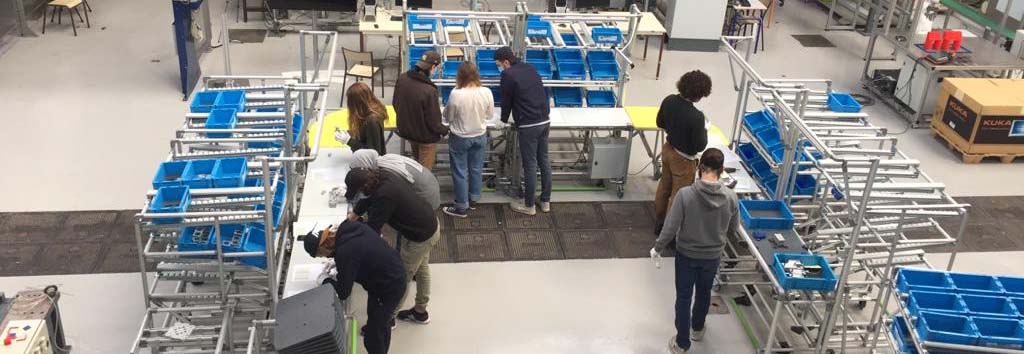
Related technology platform
Partners
Strong partnerships with the local industrial fabric
Career opportunities
All sectors in industrial management
Targeted companies
Industrial sector companies (large groups, SMEs, production sites, creation of innovative products, etc.)
Examples of end-of-study internships completed
- TOYOTA : improvement of internal logistics flows
- RENAULT : analysis of the functionalities of the control system for Renault's assembly plants
- FAURECIA : continuous improvement in the field of logistics
- Schneider Electric Industries : adapting Big Data techniques to a production line
- AIRBUS HELICOPTERS : continuous improvement in production costs for the H175 program
- Zodiac Aerospace : study of the implementation of preventive maintenance
- HERMES : optimizing workflow and securing supplies inventory in the watchmaking workshop
Practical information
- Required level: M1
- International equivalent level M2
- Course languages: French / English (10%)
- Period: Fall
- Number of hours: 150 hours
- ECTS credits: 13
Contact
Keywords
Financial management, continuous improvement, quality, operational research, flow simulation