
Arts et Métiers : Train more engineers?
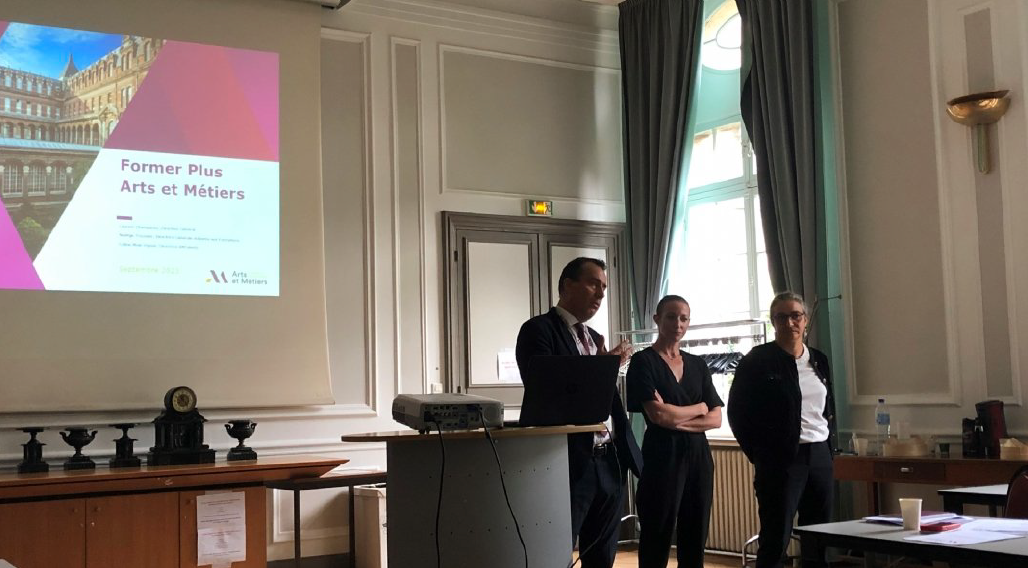
At a press conference on September 12, 2023, Arts et Métiers its intention to train more engineers. How? By developing partnerships, increasing the range of courses on offer, opening new campuses, and more.
Solidarity initiative "J'en pince pour le Faubourg" for students at the Lille campus

Solidarity campaign "J'en pince pour le Faubourg" (I'm crazy about Faubourg): Students at the Arts et Métiers campus Arts et Métiers Lille are taking action!
3A Expertise - "Low technologies and sustainable development" course
Main image
low-tech illustration
Headline
General engineer, student program or professional training contract, third-year expertise in low technologies and sustainable development.
Main body text
CAMPUS
Arts et Métiers Campus Arts et Métiers Châlons-en-Champagne
BACKGROUND
Sustainability throughout the entire product life cycle is one of the sustainable development challenges that future engineers will face.
The Low Technologies (Low Tech) approach will enable students to become aware of the environmental challenges facing companies and to take part in addressing these challenges by devising a more sustainable design and production model.
This expertise is taught at the Arts et Métiers campus Arts et Métiers Châlons-en-Champagne, where students can take advantage of technology platforms, the FabLab, sports facilities, student housing, and the university restaurant. In addition, the city offers many cultural events.
OBJECTIVES
- Training engineers for the ecological transition
- Designing low-impact systems
- Being a player in the circular economy of regional development
- Rethinking the role of engineers in these new environmental challenges
- Experimenting with the limits of sustainable development
SPECIFICITY – 2 possible courses of study – Under STUDENT status or PROFESSIONAL TRAINING CONTRACT
- As a student
- In the form of a 12-month professional training contract. During this period, the learner is therefore employed by a company (minimum wage indexed to the SMIC) and alternates between periods at the School and in the company.
ADMISSION
You will have access to this expertise after the second year of the Arts et Métiers Grande École program.
KEY FEATURES
- Training as a student or under a paid professional training contract with a minimum of 33 weeks in a company
- Lessons to give meaning to studies and career plans
- A program in tune with major environmental issues
- Cross-disciplinary expertise enabling professional integration in all sectors
- A field of expertise related to business needs
PROGRAM
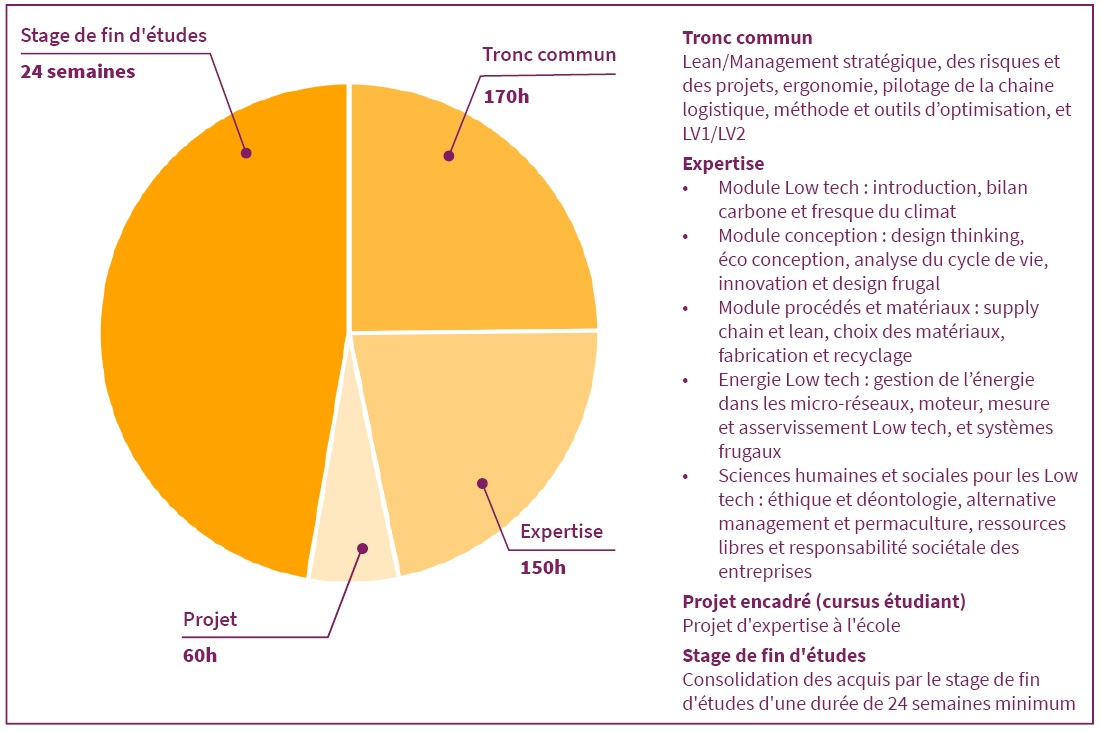
The training is structured into different periods carried out at school and in the workplace according to the defined schedule:
- First semester (September to January): alternating between 3 to 4 weeks at school and 3 to 4 weeks in a company
- Second semester (February to June): full-time work placement (end-of-studies internship)
- Evaluations (June or July): report and defenses
EMPLOYMENT SUPPORT
Professions : design office engineer, research and development engineer, process improvement and optimization engineer, etc.
Skills : training engineers in ecological transition, designing low-impact systems, rethinking the role of the engineer, and testing the limits of sustainable development.
Sectors : metallurgy, automotive, rail, aeronautics, space, energy, healthcare, pharmaceuticals, agri-food, etc.
CONTACTS
Ibrahim Demirci and Jérôme Isselin, senior lecturers
+33 (0)3 26 69 91 35 / +33 (0)3 26 69 91 18
expertise-lowtech.chalons@ensam.eu
KEYWORDS
#SustainableDevelopment #Lowtech #Lowtechnologies #Sobriety #Environment #Climate
Incubator news
Main image
incubator website banner
Headline
Discover all the latest news from the Arts et Métiers Paris incubator
Main body text

The ambition of the INCube-D project, supported by the European Union and the Ile-de-France Region, is to promote the creation and success of innovative companies in the industrial sector, capable of offering solutions to the new challenges of sustainable and responsible industry.
This ambition is broken down into several objectives: amplifying the incubator's action, improving the sourcing of projects from ENSAM students: engineers and researchers, and strengthening the quality of support in several areas by structuring specific incubation pathways, continuing work on diversity within the incubator, and working to identify and disseminate best practices in support aimed at consolidating the chances of success for projects.
The project contributes to the objective of supporting the creation of sustainable businesses in the Paris region. Encouraging diversity of profiles is a key element of the project. Public support is a decisive lever in ensuring that these groups are not excluded from support mechanisms because of the cost they may represent. Finally, one of the incubator's strategic priorities is to develop and promote the local anchoring of the projects it supports.
All of the resources of the ENSAM Paris Campus will be mobilized for the project, including technical resources (premises, machinery, expertise), scientific resources (laboratories), and the entire Arts et Métiers network.
The Arts et Métiers incubator Arts et Métiers VivaTech 2025: an exceptional opportunity
For the first time, and thanks to co-financing from the European Union and the Ile-de-France region, the Arts et Métiers incubator in Paris took part in VivaTech from June 11 to 14, 2025.
More information at: https://artsetmetiers.fr/fr/actualites/lincubateur-arts-et-metiers-vivatech-2025-une-opportunite-exceptionnelle
Incubation Committee
The next incubator committee meeting will be held on Tuesday, October 14, 2025.
Do you have a sustainable and innovative industrial project? Join the incubation program to boost your solution!
Applications are now open.
For more information, please contact us at: incubateur@ensam.eu
The incubator is certified
- Paris Innovation Fund by the City of Paris, a fund to support the development of innovative companies working on projects related to the ecological, economic, and social transition of tomorrow.
- Innov'up by the Ile-de-France Region, the aid aims to support research, development, and innovation projects relating to products, services, processes, organizations, and social innovation.
