General engineer, student program or professional training contract, third-year expertise in low technologies and sustainable development.
CAMPUS
Arts et Métiers Campus Arts et Métiers Châlons-en-Champagne
BACKGROUND
Sustainability throughout the entire product life cycle is one of the sustainable development challenges that future engineers will face.
The Low Technologies (Low Tech) approach will enable students to become aware of the environmental challenges facing companies and to take part in addressing these challenges by devising a more sustainable design and production model.
This expertise is taught at the Arts et Métiers campus Arts et Métiers Châlons-en-Champagne, where students can take advantage of technology platforms, the FabLab, sports facilities, student housing, and the university restaurant. In addition, the city offers many cultural events.
OBJECTIVES
- Training engineers for the ecological transition
- Designing low-impact systems
- Being a player in the circular economy of regional development
- Rethinking the role of engineers in these new environmental challenges
- Experimenting with the limits of sustainable development
SPECIFICITY – 2 possible courses of study – Under STUDENT status or PROFESSIONAL TRAINING CONTRACT
- As a student
- In the form of a 12-month professional training contract. During this period, the learner is therefore employed by a company (minimum wage indexed to the SMIC) and alternates between periods at the School and in the company.
ADMISSION
You will have access to this expertise after the second year of the Arts et Métiers Grande École program.
KEY FEATURES
- Training as a student or under a paid professional training contract with a minimum of 33 weeks in a company
- Lessons to give meaning to studies and career plans
- A program in tune with major environmental issues
- Cross-disciplinary expertise enabling professional integration in all sectors
- A field of expertise related to business needs
PROGRAM
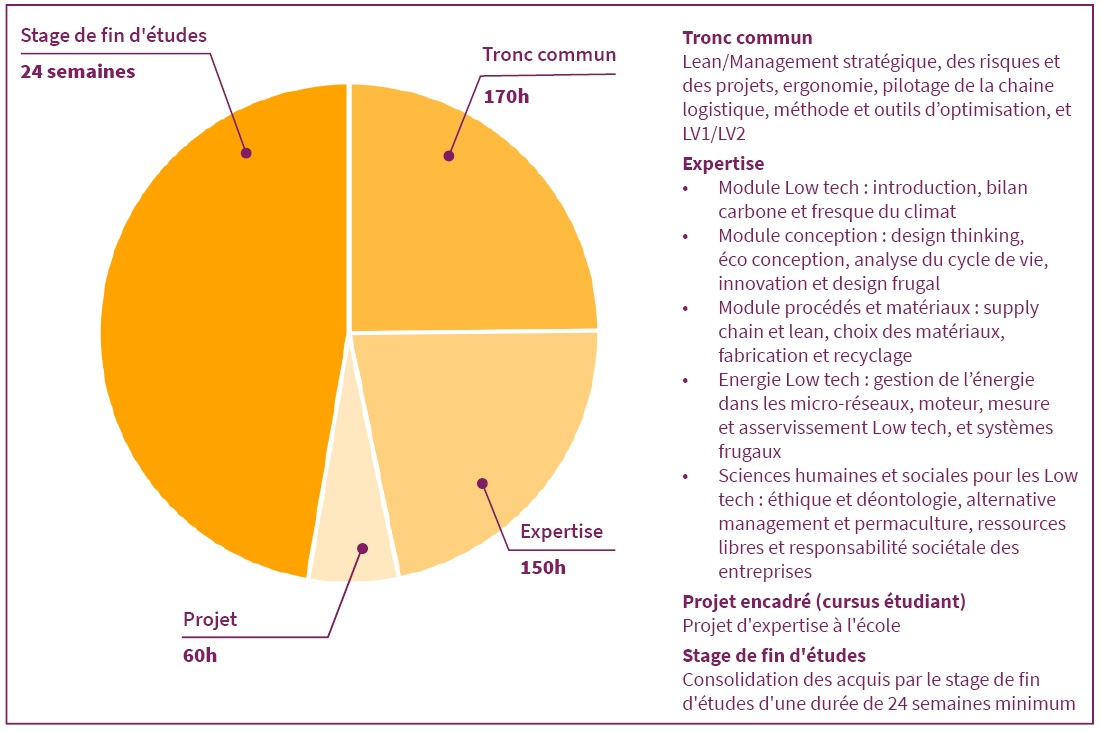
The training is structured into different periods carried out at school and in the workplace according to the defined schedule:
- First semester (September to January): alternating between 3 to 4 weeks at school and 3 to 4 weeks in a company
- Second semester (February to June): full-time work placement (end-of-studies internship)
- Evaluations (June or July): report and defenses
EMPLOYMENT SUPPORT
Professions : design office engineer, research and development engineer, process improvement and optimization engineer, etc.
Skills : training engineers in ecological transition, designing low-impact systems, rethinking the role of the engineer, and testing the limits of sustainable development.
Sectors : metallurgy, automotive, rail, aeronautics, space, energy, healthcare, pharmaceuticals, agri-food, etc.
CONTACTS
Ibrahim Demirci and Jérôme Isselin, senior lecturers
+33 (0)3 26 69 91 35 / +33 (0)3 26 69 91 18
expertise-lowtech.chalons@ensam.eu
KEYWORDS
#SustainableDevelopment #Lowtech #Lowtechnologies #Sobriety #Environment #Climate