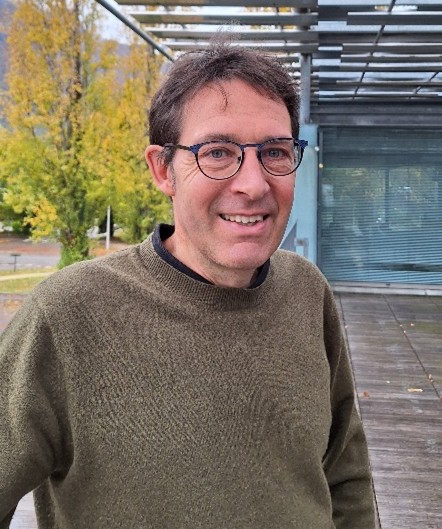
During his stay in Chambéry, Tom Dedeurwaerdere, professor atthe Catholic University of Louvain, reflects on his collaboration with theArts et Métiers teamsArts et Métiers on the methodological challenges of research that seeks to combine engineering, social sciences, and concrete societal impact.
This combination of technical rigor, local roots, and openness to citizen participation makesArts et Métiers particularly stimulating partner!
What made you decide to accept this invitation to Arts et Métiers, and how did your collaboration with Lou Grimal come about?
The collaboration with Lou Grimal is relatively recent but developed naturally. It all began in 2024, when she organized an international ESS Lab conference at Darmstadt University of Applied Sciences. On that occasion, I presented my work on strong sustainability and transdisciplinary research methodologies, particularly those involving partnerships with non-academic actors. Our discussions revealed strong complementarities between the approaches developed at ENSAM Chambéry, particularly around low tech, territorial transition, and participatory life cycle analysis, and my work on transformational research methods. This convergence led us to continue our discussions and then to consider an official invitation. My visit provided an opportunity to combine methodological advances with concrete engineering cases, and for Chambéry to strengthen the participatory dimension already present in several research projects. We worked with doctoral students and the AMVALOR valorization team to select and adapt methodologies such as ASIRPA in real time (Analysis of the Societal Impact of Research – ongoing project), and to structure a research framework combining technical rigor and societal utility.
How do you feel after your stay in France?
The stay was very positive. I was already familiar with France through European collaborations, but this was my first long immersion in an Arts et Métiers campus. I was particularly impressed by the "T" profiles that Chambéry trains: engineers with solid technical expertise, but open to dialogue with other disciplines and societal issues. This hybridization is essential for addressing contemporary challenges. I also really appreciated the way the campus operates: a human-scale structure that encourages scientific spontaneity, effective exchanges, and the building of solid working relationships. I really felt like I was an integral part of the team.
In your opinion, what are the benefits of international collaboration? And what about your experience with Arts et Métiers
International collaborations are essential, especially in emerging fields such as transformational research. They enable us to reach critical mass, structure fledgling networks, and compare experiences from different cultural and institutional contexts. What sets Arts et Métiers, and Chambéry in particular, apart is their ability to link engineering and societal transformation. There, I found teams that are actively experimenting with participatory methodologies in technical projects, which is an ideal environment for enriching approaches from Switzerland, German-speaking countries, and Scandinavia, which have historically been leaders in this field. This complementarity between technical rigor, regional roots, and openness to citizen participation makesArts et Métiers particularly stimulating partner.
What made you want to pursue research and your current topics?
My career path has been marked by two areas of study: materials engineering and philosophy of science. Very early on, I became interested in issues of technological ethics and social responsibility in engineering, subjects that were not covered in my initial technical studies, which led me to philosophy. A major turning point was writing a report for the Walloon government on sustainability research. This study revealed to me the gap between academic production and its real impact on societal transformation. This observation profoundly influenced my career path. I then turned my attention to studying transformational research methodologies, combining my field experience, my reading, and my international collaborations. This is how I gradually integrated these issues into my work, developing a transdisciplinary framework linking social sciences and engineering.
When did you decide to become a researcher?
The choice was made gradually. I have always loved mathematics and physics, but it was the desire to give meaning to my skills that led me to research. After completing my PhD in philosophy, I had the opportunity to join an interdisciplinary team involved in European projects, which confirmed my interest in collaborative research and interdisciplinary interactions. Over time, I realized that this was a field where I could combine my curiosity, social commitment, and scientific thinking.
What advice would you give to students interested in a career in research?
The first thing I would tell them is to follow their inspiration. Research is a demanding path, where results are built over the long term. Without passion, without a personal vision, it becomes difficult to go the distance. I also advise them to cultivate curiosity, to dare to explore, test, make mistakes, and change their perspective. Research is not just a set of technical skills: it is a way of thinking, intellectual rigor, learning autonomy and collaboration. Finally, I remind them that research is also a human adventure. You discover both the phenomena you are studying... and a lot about yourself.
About Tom DEDEURWAEDERE
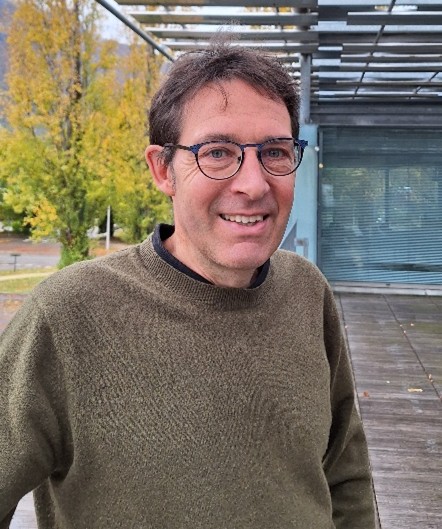 Tom Dedeurwaerdere is a professor at the Catholic University of Louvain (UCLouvain), where he also heads the Biodiversity Governance research unit at the Center for Philosophy of Law. He has a dual background in materials engineering and philosophy of science, both of which he studied at UCLouvain, before obtaining a PhD in philosophy in 1999. After several years as a researcher and then postdoctoral fellow at the FNRS, he became an associate professor in 2003 and then a full professor in 2014, teaching philosophy of science and epistemology. A specialist in transdisciplinary methodologies, environmental governance, and the commons of knowledge, he has led numerous international projects, including an ERC Starting Grant (GENCOMMONS) and several European FP7 programs. Tom Dedeurwaerdere has published several major works with Routledge, MIT Press, and Oxford University Press, and has organized numerous international conferences.