The ANR Young Researcher Project (ANR JCJC), coordinated by Guillaume Pot from the LaBoMaP Wood Materials and Machiningteam, is called EffiQuAss and will enable the orientation of fibers within boards to be described.
Guillaume Pot, senior lecturer at LaBoMaP on the Arts et Métiers campus Arts et Métiers Cluny, is coordinating this project, which officially began on January 1, 2022, and will run for 48 months. The partners in this project are Loria (University of Lorraine), Silva (INRAE in Nancy), and Linnaeus University (Sweden).
The amount of ANR funding will enable the hiring of a postdoctoral researcher for one year and a doctoral student. Part of the funding will also be used to develop a high-resolution fiber orientation scanner.
EffiQuAss: describing the orientation of fibers within boards
The use of wood in construction is set to increase in the future so that Europe can achieve its CO₂ emission reduction targets. Currently, quality control for structural timber is unfavorable for the main species in Southern Europe, which are very heterogeneous. To determine the strength of these woods, which is mandatory for their use in construction, it is necessary to develop methods that take this heterogeneity into account.
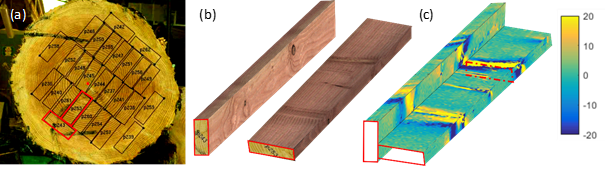
For several years, the Materials and Wood Machining team at LaBoMaP has been developing methods for measuring wood grain orientation and using these measurements to predict wood strength. Although the information obtained is very rich, this measurement is only superficial, and the challenge today is to describe the orientation of the fibers inside the boards, in terms of volume.
The development of eco-efficient sawmills
This is the objective of the ANR JCJC EffiQuAss project, which aims to better describe the orientation of fibers in the volume of boards, the traceability of which is ensured from the moment the logs are sawn. This traceability will make it possible to know which log and which tree each board comes from, as well as the position of the boards in the log. By modeling the orientation of the fibers in the log, then in the boards, in 3D, this research project will provide original results. The results of this project will improve the efficiency of wood grading, which is essential for the development of eco-efficient sawmills and the optimal use of forest resources.