Arts et Métiers currently Arts et Métiers around ten partnership-based research chairs that support innovation in areas with a significant societal and/or industrial impact.
" The chair provides a long-term contractual collaboration between a research institution, in this case Arts et Métiers, and companies, " emphasizes Ivan Iordanoff, Director of Research and Innovation. "It fulfills two objectives. The first is to conduct fundamental and applied research. The second is to disseminate this knowledge. "
Arts et Métiers, through its subsidiary AMVALOR, is developing an ambitious program of research chairs focusing on topics with a strong societal and/or industrial impact. 2024 was a successful year, with the institution renewing or creating several chairs. And another chair is already in the process of being renewed!
In concrete terms, the chairs involve one to three industrial partner
s around one or more of the institution's laboratories. The partners agree to define a groundbreaking scientific theme that can be divided into several areas of research.
A research chair is a renewable partnership that may involve one or more industrial partners with a minimum financial commitment of €750k for five years.
ISYTHERM 2 with Valeo
The chair is a continuation of the collaboration on thermal system components that began five years ago within the joint VALEO-LIFSE laboratory.
Following the development of an experimental platform and a modeling device for characterizing thermal and aerodynamic components, the partners will now focus on integrating AI into these research topics.
Objective: to design a new generation of innovative turbomachinery!
CESAME, with SAMC, a subsidiary of Safran
The chair focuses on mastering the microstructures generated by the metal additive manufacturing process (Laser Beam Melting, LBM), with research areas covering the digital and experimental aspects related to laser-material interaction, process thermodynamics, and the mechanical behavior of materials.
PLM of the Future 2, with Capgemini Engineering
This involves the renewal in January 2025 until 2030 of the PLM (Product Lifecycle Management) chair of the future, initiated in 2017 between Capgemini Engineering, LCPI, and Lispen.
To ensure the future of digital continuity and anticipate the needs of industry, the partners want to accelerate their innovation approach focused on the product lifecycle.
In terms of research, the new work will explore the major challenges of tomorrow's PLM concerning the growing volume of data to be processed, the heterogeneity of available information, and the sustainability of technological choices.
Fluidetronics, with Moving Magnet Technologies
The chair focuses on the development of fluidic systems combining mechatronics and fluidics, with a focus on regenerative pumps, volumetric pumps, and centrifugal machines.
Research includes the design, analysis, optimization, and experimental and numerical characterization of these systems, as well as the development of technologies to improve the performance and durability of these devices in a variety of applications, particularly for electric and autonomous vehicles.
The six other chairs currently in progress
Mines Urbaines (I2M) with Fondation ParisTech, Chimie ParisTech, and Mines ParisTech
ϕ ML (multi-laboratory) with SKF Magnetic Mechatronics
CHIMERA (PIMM) with RTE
BELISAMA with Safran Aircraft Engines (LIFSE)
IPERFORM (LAMPA) with Chanel, Alstom, and France Travail
Create ID (multi-laboratory) with ESI Group
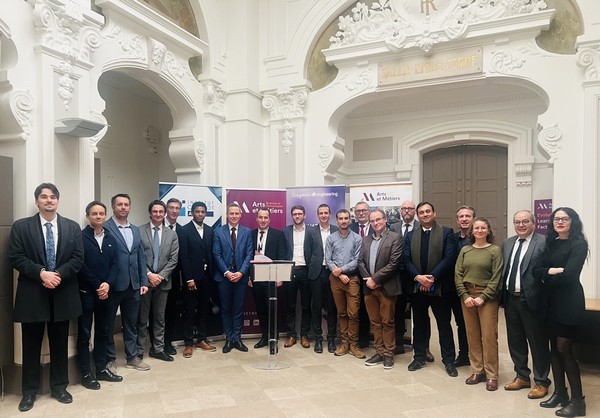
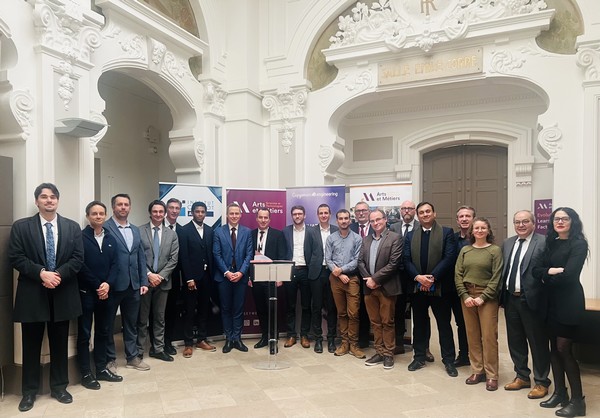
Partners gathered for the inauguration of the PLM Chair of the Future 2