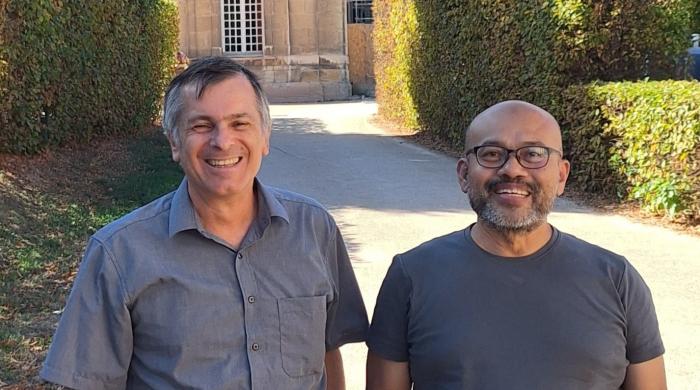

Alexandre Mangeot is an Arts et Métiers graduate Arts et Métiers Class of 2006) and completed his specialization year in “aeronautics and space” as part of the Grande Ecole Engineering Programme at the Bordeaux-Talence campus. In 2018, he founded HyPr Space (Hybrid Propulsion for Space), a startup specializing in hybrid (solid-liquid) propulsion for orbital launch vehicles.
During his arts education, Alexandre Mangeot had the opportunity to work on a PJE (Young Engineer Project) linked to the CNES PERSEUS program, which focused on hybrid propulsion. This initial experience convinced him of the potential of this technology, which he was able to explore in greater depth during his doctoral thesis on the subject, after completing his engineering degree. After gaining some professional experience, notably in a design office specializing in the design of ultralight aircraft seats and a post-doc to complete his thesis research, Alexandre embarked on entrepreneurship and founded his start-up HyPr Space (Hybrid Propulsion for Space, SAS). Created in 2018, HyPr Space was initially hosted by the Bordeaux Technowest incubator. However, the start-up wanted to move to our campus to benefit from closer proximity to the workshops for the production of its prototypes.
Hybrid propulsion: an effective technology, but obstacles to overcome
HyPr Space's technological innovation is based on specific mechanical characteristics of the main engine components: the tank, combustion chamber, and nozzle. According to Alexandre Mangeot, hybrid propulsion could be the best propulsion technology for orbital launchers, as it would offer propulsive performance equivalent to bi-liquid propulsion without the associated R&D and production costs, and the same robustness as solid propulsion without the associated pyrotechnic safety issues and chemical risks.
Research into hybrid propulsion began in the 1960s. A hybrid propulsion system is essentially a rocket engine that uses a mixture of liquid (oxidizer) and solid (fuel) propellants. A hybrid rocket motor consists of a tank (containing the oxidizer), a valve connecting the tank to the combustion chamber (containing the fuel), and a nozzle at the end of the combustion chamber through which the gases produced are expelled. When the engine is running, the oxidizer flows into the combustion chamber where it vaporizes and reacts with the solid fuel, igniting. The combustion of these propellants generates hot gases, which are expelled through the nozzle, providing thrust to the rocket.
This propulsion system offers numerous advantages over existing systems in the aerospace industry: reduced risk of explosions, modulation of engine thrust, limited piping, and lower fuel volume. However, the performance achieved in practice to date has been less than convincing. The main technological obstacle concerns high-power thrusters. In this case, the combustion chamber is large (to store enough fuel), but this leads to a decrease in the rate of solid fuel consumption and partial combustion of the propellants. The first aspect of the problem limits thrust, while the second limits the efficiency of the thruster. However, to reach orbit, it is necessary to have excellent characteristics in both areas. The technological innovation developed by HyPr Space addresses both aspects of the problem.
A 2demonstrator demonstrator planned for the end of 2020
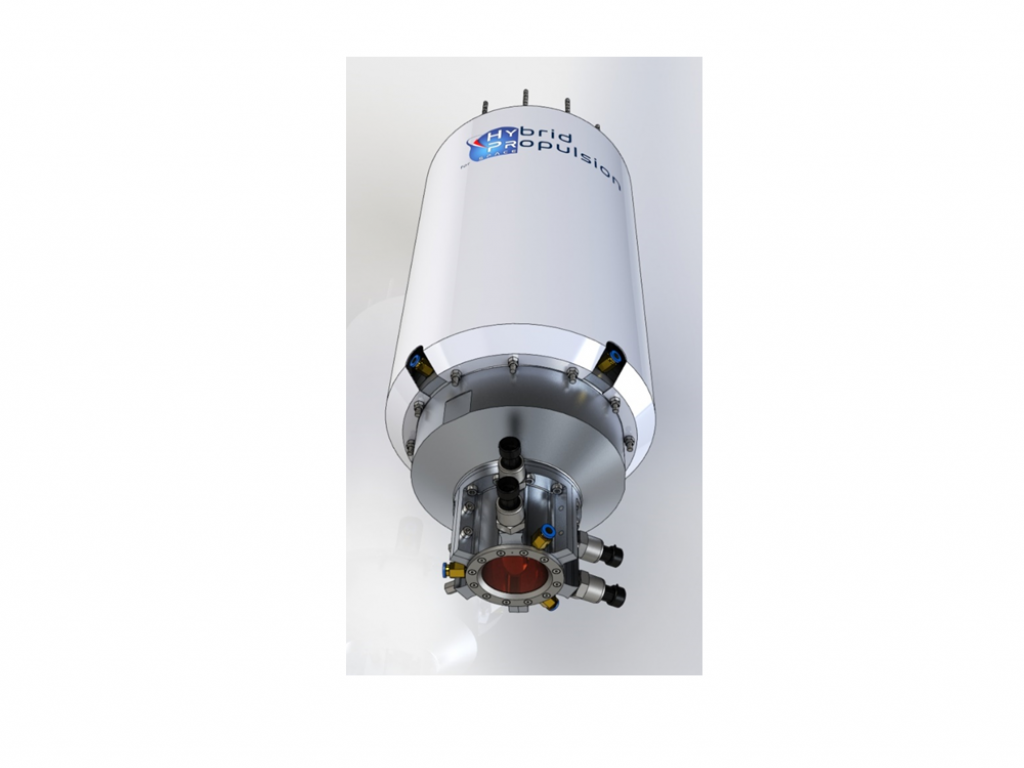
After an initial demonstrator, whose encouraging results led to the legal creation of the company and a patent application, the startup is currently assembling its second demonstrator (dimensions approximately 20 x 30 cm, second illustration), whose combustion chamber and nozzle components (aluminum, stainless steel, and titanium) were entirely machined by Israel Robles in the workshops on the Bordeaux-Talence campus. These services are governed by AMVALOR research contracts, which allow companies and startups to leverage the technological resources and expertise of Arts et Métiers staff. The prototype should be finalized in the fall, with the first firing scheduled for late 2020. The objective of this demonstrator is to validate the technological building block developed by HyPr Space, thereby confirming the ability of its young team of three enthusiasts to master a complex R&D project from start to finish.
Simulations of scientific missions to Mars
Alongside his professional activities, Alexandre Mangeot is also involved in the Mars Society (and Association Planète Mars in France), which promotes the exploration and colonization of the red planet. Alexandre has volunteered on several occasions as commander of scientific expeditions in Utah and the Arctic, conducting experiments to replicate living conditions on Mars. The teams for these expeditions were hand-picked and comprised members of several nationalities. The objective was twofold: to see how interdisciplinary teams can work in an isolated environment, and to study group psychology in these extreme conditions.