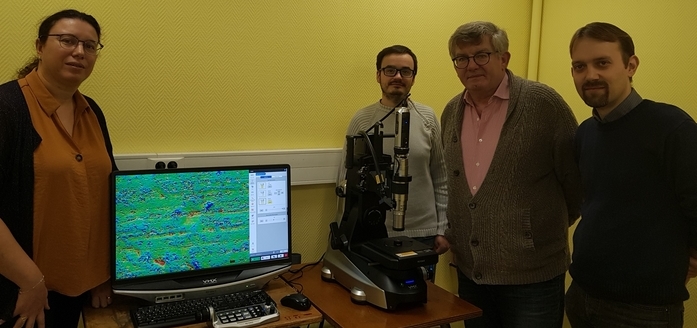
The Mechanics, Surfaces and Materials Processing Laboratory in Lille is the first in France to work with the latest model of the Keyence microscope. A tool that opens up many possibilities.
The Lille branch of MSMP and its French and Belgian partners have launched a second European Interreg program: the Alt Ctrl Trans project. "The project, which began in January 2019, aims to offer less polluting alternatives to hexavalent chromium, solutions that are better for the environment without requiring manufacturers to change their production processes," explains Alex Montagne, project manager.
Scheduled to run for four years, this project mobilizes the team's resources on the mechanical, tribological, and morphological characterization of surfaces.
Observation of large areas...
As part of this cross-border program, the MSMP team (Alex Montagne, Thierry Coorevits, Myriam Dumont, and Adrien Van Gorp) is initially working on characterizing chrome coatings.
The idea is to establish a benchmark for evaluating alternative solutions in the second phase of the project.
To meet new needs in two- and three-dimensional morphological characterization, the team has acquired a digital 3D microscope. The call for tenders resulted in the acquisition of the latest VHX model from Keyence. "We are the first in France to implement this tool,"says Alex Montagne. Installed in early September, this microscope is 80% funded by the ERDF (European Regional Development Fund) and 20% by Arts et Métiers.
The team is currently learning how to use the tool in order to make the most of its many possibilities.
It offers magnification over a very wide range from 0.1 to 5000. It also allows very large surfaces to be viewed thanks to the stitching process (the reconstruction of a surface from several images). "We can observe larger areas with high magnification and excellent image quality," explains Alex Montagne, "which is important for tracking the initial deformation mechanisms when a coating is subjected to wear stress."
…on site
In addition to improving observation, this technology removes real technological barriers. This microscope can be detached from the machine and placed as close as possible to the sample thanks to a flexible connection (optical and electronic). This concept of "in situ" observation during stress is important. For example, it allows the dynamics of crack propagation or the kinetics of wear in tribology to be evaluated, rather than making post-mortem observations, which are inevitably less informative.