
General engineer, student curriculum, third-year expertise in aeronautical and space engineering.
Campus
Arts et Métiers Campus Arts et Métiers Bordeaux-Talence
Objectives
Educational and scientific
Provide students with fundamental and applied skills in:
- Propulsion systems in order to understand the influence of the various relevant parameters that contribute to the choice of a propulsion system, and to address the technical problems encountered during its design.
- The different families of aeronautical materials and the processes used to obtain structural parts, as well as the methodologies for calculating and dimensioning aeronautical structures. Particular attention is paid to composite structures and additive processes.
- The discovery of aircraft and space systems.
- Regulations and quality assurance, whose major role is illustrated through concrete applications from this sector.
Professionals and career opportunities
Civil and military aeronautics and space occupy an important place in the industrial fabric of the Nouvelle-Aquitaine region. Companies in this sector are associated with the Arts et Métiers campus Arts et Métiers Bordeaux through numerous partnerships: specialized teaching interventions, hosting engineering students on executive or industrial internships, final year projects, research projects, etc.
The Aeronautics and Space Engineering Expertise Teaching Unit aims to train students in this promising sector.
The positions targeted are those in R&D, design and calculation offices, and production.
Program
Conferences and themed company visits round out the training program.
- Structure (course semester, project/internship semester, etc.)
The year is divided into two semesters:
- The first semester is devoted to courses (30 ECTS credits in total), divided into three separate modules (see the detailed program below). In addition to the courses, the first semester provides an opportunity to carry out a 90-hour project (PJE09) on a specific topic proposed by the teaching staff of the entire Campus. These internships are closely linked to the activities of the I2M laboratory in cutting-edge fields and provide access to all of the campus's platforms.
- The second semester is devoted to a 24-week end-of-study internship in a company (30 ECTS). Internships generally take place in the field of expertise.
Detailed description of the modules
Module 1: Evolution of Propulsion System Design
- Analysis of the evolution of propulsion systems (14 hours)
- General information on innovation in aeronautics
- Analysis of a propulsion system using innovation support tools – MAL’IN
- Presentation of propulsion system families based on energy analysis
- Design process for a propulsion system – application to a twin-spool turbofan engine
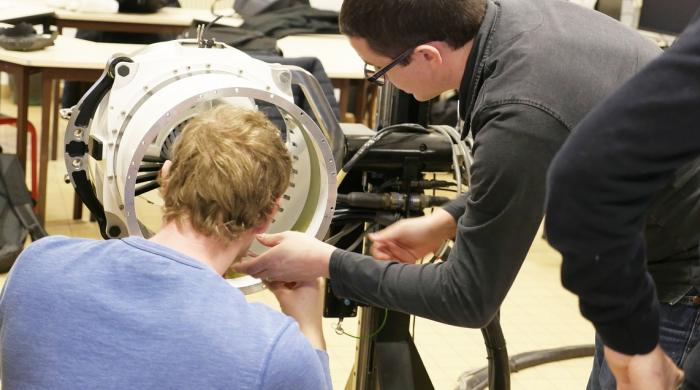
- Practical application of assembly/disassembly for observing the technological solutions of a DGEN turbomotor from PRICE INDUCTION.
- Advanced design methods and optimization of complex systems (20 hours)
- local and global optimization, genetic algorithms
- methods for constructing optimization objective functions
- methods for sorting and classifying solutions (aggregation)
- cardinal assessment methods (interpretation)
- Aeronautical application: optimization of composite structures
- Aerodynamic guidance for high-speed rotating machines (8 hours)
- Implementation of thin film lubrication equations
- Case of compressible fluids (air)
- Static: development, optimization of aerodynamic stops: load capacity issues and technological solutions
- Vibration study of aerodynamic guides, stabilizing effect of internal friction
Module 2: Aeronautical materials and structures: development and dimensioning
- Aeronautical materials and processes for obtaining structural parts (19 hours)
- Nature of materials in an aircraft, criteria for selecting materials, specific characteristics of the materials used (composition and properties)
- Composite materials used in aeronautics: general information, components, characteristics, structural composite materials, aeronautical processes, repair
- Dimensioning of aeronautical structures (47 hours)
- Part 1 (30 hours, including 20 hours of digital project work)
- General considerations on aircraft structures
- Bending and torsion of thin open, closed, and multi-cell profiles: theory and applications
- Structural stability: buckling resistance and post-buckling behavior
- Composite plate behavior
- Digital Project: Sizing of the Delta4 launcher divergent
- Part 2 (5 p.m.)
- Fatigue crack initiation resistance
- Damage tolerance
- Part 1 (30 hours, including 20 hours of digital project work)
Module 3: Products and processes in the aerospace industry
- Discovering aircraft (12 hours)
- Regulations, Stakeholders, Maintenance
- Elements of flight mechanics
- Aircraft
- Introduction to Space Systems (18 hours)
- Solar systems
- The satellite system
- The launch system
- Space applications
- Space programs
- Elements of Space Mechanics
- Space environment
- History of Space Systems
- Quality approach in the aerospace industry (12 hours)
- Application of the quality approach to the three-dimensional conformity assurance process
- General principles
Key scientific and educational leaders in the field
Nicolas Saintier (Arts et Métiers )
Didier Egureguy (Arts et Métiers )
Teaching staff
Nicolas Saintier (Arts et Métiers )
Didier Egureguy (Arts et Métiers )
Pascal Le Roux (Arts et Métiers )
Jérôme Pailhes (Arts et Métiers )
Thierry Palin-Luc (Arts et Métiers )
Frédéric Dau (Arts et Métiers )
Ivan Iordanoff (Arts et Métiers )
Patrick Sébastian (Arts et Métiers )
Marco Montemuro (Arts et Métiers )
Thecle Alix (Arts et Métiers )
Sabrina Houdaibi-Olive (Arts et Métiers )
Stephane Abed (Polyshape)
Anissa Meziane (University of Bordeaux)
Patrick Martinez (IRT, Saint Exupéry)
Daniel Saint-Pe (External Consultant, QSE-FH)
Stephanie Lizy-Destrez (ISAE -SUPAERO)
Related technology platform
GAME platform, FUTURPROD additive manufacturing platform
Assessment methods
Written exam (continuous assessment and/or final exam) for courses, digital project, written report, and oral defense for PJE09 and SFE
Validation procedures
Passing the exam requires an average score of 10 out of 20 (Weighting: Module 1 = 0.3, Module 2 = 0.4, Module 3 = 0.3).
Teaching methods
- Lectures, tutorials, project-based teaching
- Presentations by recognized professionals in their respective fields.
- A day of meetings with companies in the aeronautics sector is being organized on campus. This day is an opportunity to discover career paths and ambitious projects in this sector.
Benefits of the training
The Aeronautics and Space Engineering Unit benefits from a promising regional context, marked by the dynamism of the global competitiveness cluster Aerospace Valley (http://www.aerospace-valley.com/), Europe's leading employment hub in the field of aeronautics, space, and embedded systems, with:
- the presence of major groups that are leaders in this market: ASTRIUM Space Transportation, the CEA, the CNES, DASSAULT Aviation, EADS, the SAFRAN group with TURBOMECA and HERAKLES, etc.
- the presence of a large network of international equipment manufacturers: THALES, Liebherr Aerospace, Messier-Dowty, etc.
- the development of a dynamic network of SMEs/SMIs
The program also benefits from its proximity to numerous laboratories and research networks on the Bordeaux campus linked to the aeronautics and space sector (I2M (https://www.i2m.u-bordeaux.fr/ ), ICMCB (www.icmcb-bordeaux.cnrs.fr/ ), LCTS (www.lcts.u-bordeaux1.fr/), Laser Road ( www.alpha-rlh.com/ )
Partners
- Industrial companies AIRBUS, IRT Saint Exupéry, POLYSHAPE, STELLIA, ASTRUM Space Transportation, CEA, CNES, DASSAULT Aviation, EADS, ARIANE GROUP, SAFRAN,
- Institutions Aerospace Valley Competitiveness Cluster, ICMCB, LCTS
- Academics University of Bordeaux, University of Bilbao, Laval University (Canada)
Targeted companies
The entire aerospace sector, major groups and supply chains, research and development centers such as CNES and ONERA.
Examples of internship opportunities offered / projects carried out
The vast majority of final-year projects are carried out in large companies in the aeronautics and space sector. Examples of final-year internships in 2017-2018:
"Continuous improvement of the supply chain" - Airbus Helicopters
"Simulation of metal additive manufacturing processes" - Lisi-Aerospace
"Design of structural parts for a drone with WiFi integration" - Parrot
"Factory of the Future – Non-contact Measurement Methods and Digital Chain" MDBA France
Digital mock-up of engine assembly lines Ariane Group
"Aerodynamic and thermal interactions on the transient operation of a compressor" Safran Aircraft Engines
Admission criteria
Required level: Master's degree in Mechanical Engineering (Mechanics - Design - Materials - Processes)
Practical information
- Course language: French (except for module 2, part of which will be taught in English)
- Period: Fall
- Number of hours 150
- ECTS credits 13
Contacts
Nicolas Saintier
Keywords
Aeronautics, propulsion, structures, materials, projects, composites, design, engineering, space, buckling, JAR/FAR, mechanics, thermodynamics, pro