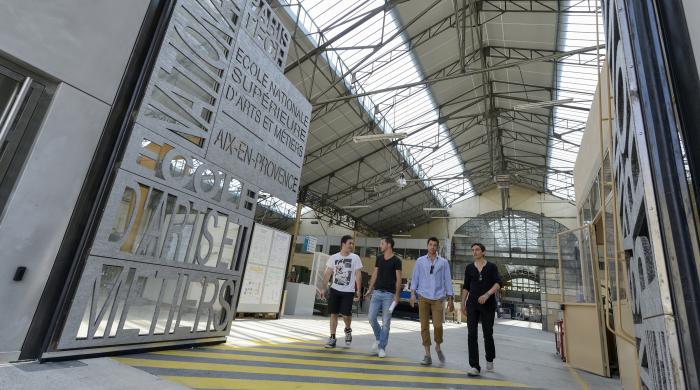
The Arts et Métiers campus Arts et Métiers invites you to the thesis defense of Raphaël MIGNOT-PASTY, doctoral student at the Lispen laboratory, on November 25, 2022.
Title: Dynamic model of a helicopter planetary gear module for defect monitoring: proposal for a modeling framework
Composition of the jury:
- Mohamed EL-BADAOUI Professor, Jean Monet University of Saint-Etienne (Rapporteur)
- Alain DAIDIE Professor, INSA Toulouse (Rapporteur)
- Lionel ROUCOULES Professor, Arts et Métiers (Director)
- François MALBURET Lecturer, Arts et Métiers (Co-director)
- Hervé MOREL Doctor, Engineer, Airbus Helicopters Marignane (Examiner)
- Olivier HONNORAT Engineer, Airbus Helicopters Marignane (Examiner)
- David DUREISSEIX, Professor at INSA Lyon (Examiner)
Summary
The study of the vibrational behavior of transmission assemblies is a subject of prime importance for the aerospace industry, particularly with regard to detecting damage or defects in systems considered critical. The dynamics of gears and bearings in the presence of defects are subjects that have been extensively studied in the literature. Increasingly complex models have been proposed for most of the subsystems that make up power transmission boxes. However, more general approaches considering complete systems combining gears and bearings remain rare.
This thesis focuses on modeling the vibratory behavior of an epicyclic module in a helicopter main transmission box, in the presence of crack-type defects propagating in a gear rim. These defects, specific to integrated raceway gears found in helicopter transmission boxes, are located at the interface between the gears and bearings and are not considered in the literature. A modeling framework is proposed to couple heterogeneous models of planetary gear trains, bearings, flexible rings, and defects into a global model.
The objective of the framework is to develop a modular and scalable model of the dynamic behavior of a complete planetary gear module in the presence of a crack.
The purpose of the approach is to identify and detect the vibration signature of the defect on a signal, measured at a fixed reference point by an accelerometer outside the BTP. Analytical models of planetary gear trains at different levels of complexity are implemented; a spherical roller bearing model is adapted from the literature to correspond to the integrated track bearing subsystem; and spalling and crack defects are modeled using analytical and finite element methods. Transfer functions derived from models and tests are proposed to transform the predicted results in the rotating reference frame to the fixed reference frame of the accelerometer. The various modeling components are finally assembled within the proposed framework according to several configurations, offering different trade-offs between computation time and accuracy of results. The introduction of the defect into the model ultimately makes it possible to identify its vibration signature within the vibration spectrum.
Practical information
Location: Arts et Métiers Campus Arts et Métiers (lecture hall M001)
Time: 9:30 a.m.