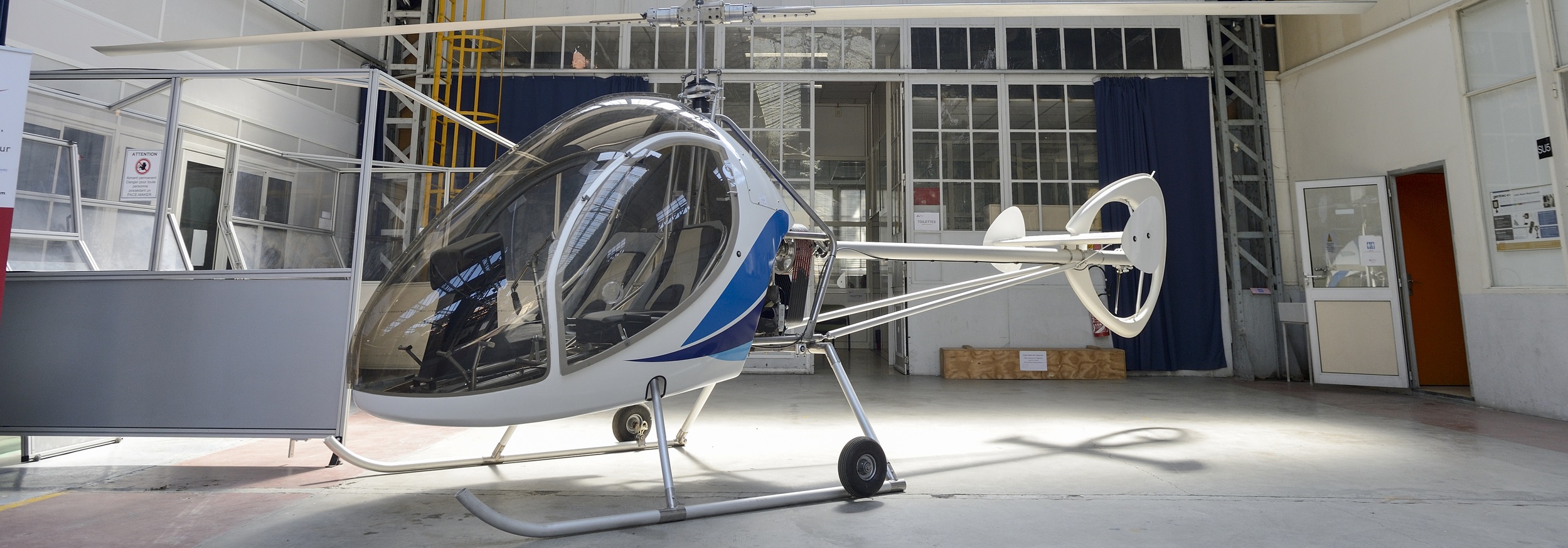
Alexandre Madeira will defend his thesis work conducted at Airbus Helicopters on October 29: "Understanding and modeling the torsional behavior of a helicopter blade with a high advance parameter - Application to the reduction of control effort in a demonstrator," on the Aix-en-Provence campus (lecture hall M001, 9 a.m.).
- Summary:
"The design process for a main rotor blade is becoming increasingly demanding. Helicopters are reaching ever higher speeds, and market pressures are pushing manufacturers to be increasingly competitive: developing safer, faster, and cheaper aircraft. To achieve this, the loads used to design helicopters must be accurately predicted. Among the various loads required, flight control loads are particularly critical. Recent developments and research programs have highlighted the difficulties in predicting relevant control forces and the lack of analytical capabilities, whether in terms of test data or calculations. Understanding and predicting control forces that accurately reflect real-world flight conditions have become strategic objectives for future AIRBUS programs. This thesis aims to pave the way for achieving these objectives.
In order to lay solid foundations, it was necessary to understand how Airbus Helicopters' aeromechanical calculation code, HOST (Helicopter Overall Simulation Tool), works and to determine the relevance of the main models used today. Based solely on physics rather than phenomenology, a modeling basis was chosen as a reference to ensure the traceability of results over the long term. During this phase, it became clear that a good understanding of the differences between calculation and testing could not be achieved without a good understanding of the model and its results. A construction of the causal links of the HOST calculation code and a new analysis tool were therefore proposed. This work made it possible, through a method of elementary decomposition of the various contributors to the control effort, to provide the ability to understand a calculation result. Used in the context of the RAPACE research programs, this tool made it possible to determine relevant areas for reducing the control effort for several blades.
- Jury:
-Marilena Pavel (Rapporteur) - Faculty of Aerospace Engineering, Delft
-Manuel Paredes (Rapporteur), INSA
-Jean-François Deü (Examiner), CNAM
-Lionel Roucoules (Examiner), Arts et Métiers
-François Malburet (Examiner), Arts et Métiers
-François Richez (Examiner), ONERA
-Christophe Serr (Guest), Airbus Helicopters
- Manousos Kelaidis (Guest), Airbus Helicopters