François Gruson, senior lecturer in EEA at the Lille campus, is leading an ANR (French National Research Agency) project dedicated to the interconnection and transmission of electrical energy on high-voltage direct current (HVDC) networks.
For François, an expert in power electronics for the electrical grids of the future, obtaining ANR funding is the result of nearly 10 years of work on the subject, culminating in various projects and theses.
Gaining the ANR's confidence in this project is a true recognition of the capabilities of the L2EP team in the field of high-voltage direct current networks.
Towards a cleaner international power grid thanks to research
The DICIT project, which stands for Development and Integration of DC/DC Static Converters for the Interconnection and Transmission of Electrical Energy on High-Voltage Direct Current Networks, aims to develop international direct current electricity network interconnections to create a grid. A stronger international grid would strengthen energy links between different countries while incorporating large renewable energy production centers (wind, tidal). "For example, we can imagine a cleaner network by taking advantage of the climatic conditions in certain countries to distribute the energy produced in other countries," explains François Gruson. The problem lies in the use of different technologies from one manufacturer to another, and different voltage levels and standards from one installation to another. The grid can therefore only be connected using a high-voltage direct current converter at very high power levels. "We are talking about power levels of around 500 MW. By way of comparison, the latest generation of wind turbines have a power output of 5 to 10 MW,"explains François Gruson.
A multi-disciplinary team for a project that will last four years
The project team consists of seven people, including five from L2EP: Frédéric Colas, research engineer at Arts et Métiers, Xavier Guillaud fromÉcole Centrale de Lille, Philippe Le Moigne from École Centrale de Lille, and Philippe Delarue from the University of Lille. Michael Merlin, senior lecturer at the University of Edinburgh, and Shabab Samimi from Esme-Sudria, complete the team. Their objective will be to select DC-DC converter technologies based on cost and efficiency criteria, integrate them into typical meshed DC networks to control energy flows while ensuring network stability, and then conduct experimental tests on the small-scale demonstrator on campus.
The DICIT project will begin in March 2021 and run for four years. Among other things, it will fund a doctoral position for three years and a postdoctoral position for two years.
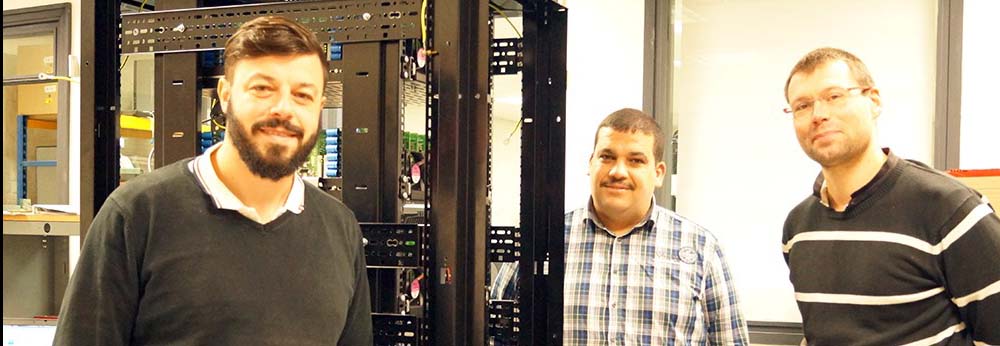
*Illustrative photo, taken in 2018