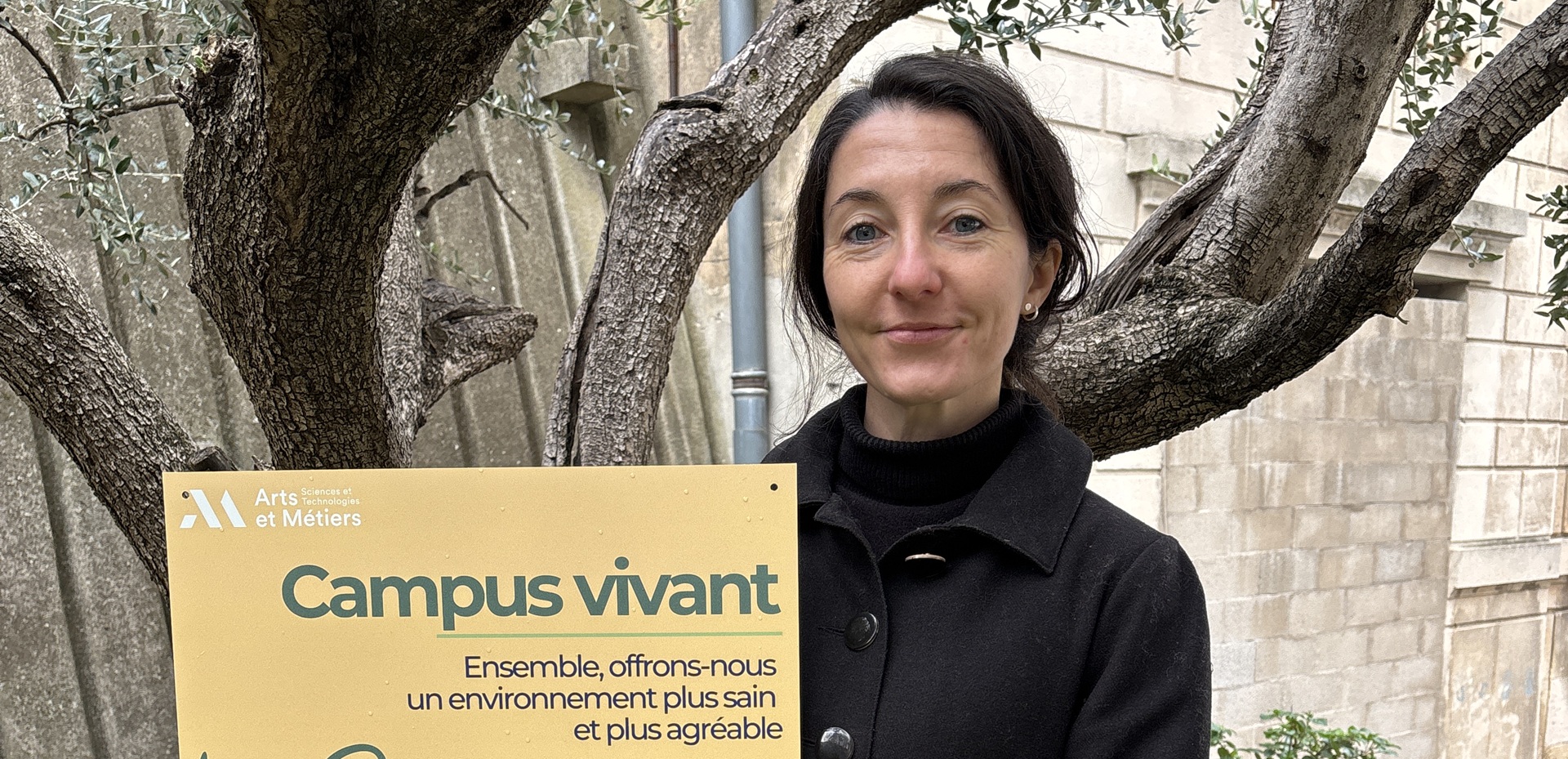
Camille Pédarriosse's commitment to the environment, as DDRS representative and educational engineer at the Arts et Métiers campus Arts et Métiers , is not the result of a sudden epiphany, but rather a sensitivity that has gradually become part of her academic and professional career. More than a series of individual actions, her commitment is based on perseverance, the creation of concrete projects, collective debate, and inspiration drawn from the work of researchers and philosophers, as well as networking and collective intelligence.
Let's meet him.
Where does your commitment to the environment come from? Was there a specific moment, encounter, or event that triggered it?
I can't say there was a specific moment when I suddenly became aware of environmental issues. I've always been sensitive to these issues. I also chose to incorporate them into my law studies. For example, I was interested in the right to a healthy environment for populations affected by the activities of mining companies. Then, when I studied education sciences, I focused my thesis on how to encourage individuals to develop an ecological awareness that is not just a set of externally imposed rules to be followed.
This influences my daily professional life today. I tend to focus my actions on these issues because that is where I can channel my energy. It is more comfortable and mentally soothing to have tasks that are consistent with one's values and interests.
Did you encounter resistance from those around you when you first became involved?
I don't really encounter resistance, but I often get comments, jokes, and sometimes debates to push me into a corner and test whether my arguments and positions are solid.
What often comes up is the feeling of loss of freedom associated with actions labeled "green," such as eating less meat, traveling less, and consuming less. All of this is quickly linked to a loss of freedom. I like to try to discuss this feeling in order to analyze it and show that thinking about and questioning one's consumption patterns is also a way of becoming a little less alienated.
This is ultimately how I can convince people of the importance of socio-ecological issues.
What SD projects are you currently working on on campus?
On campus, I work with various teachers to create and lead courses on socio-environmental issues. The goal is to encourage students to take a step back and ask themselves what the consequences of a particular technical innovation or social project might be. I would like this to encourage our students to think in a more systemic way.
At the national level, I participate in discussions on the evolution of syllabi. We also organize training courses for teachers. It is not always easy to talk about these changes in education. There is already a lot of content to cover. Our institution wants, and rightly so, to train engineers who have mastered the technical skills necessary for their future profession. The training programs are already very dense, and adding these subjects to the courses can be perceived as an additional constraint, and teachers do not always feel qualified to address them.
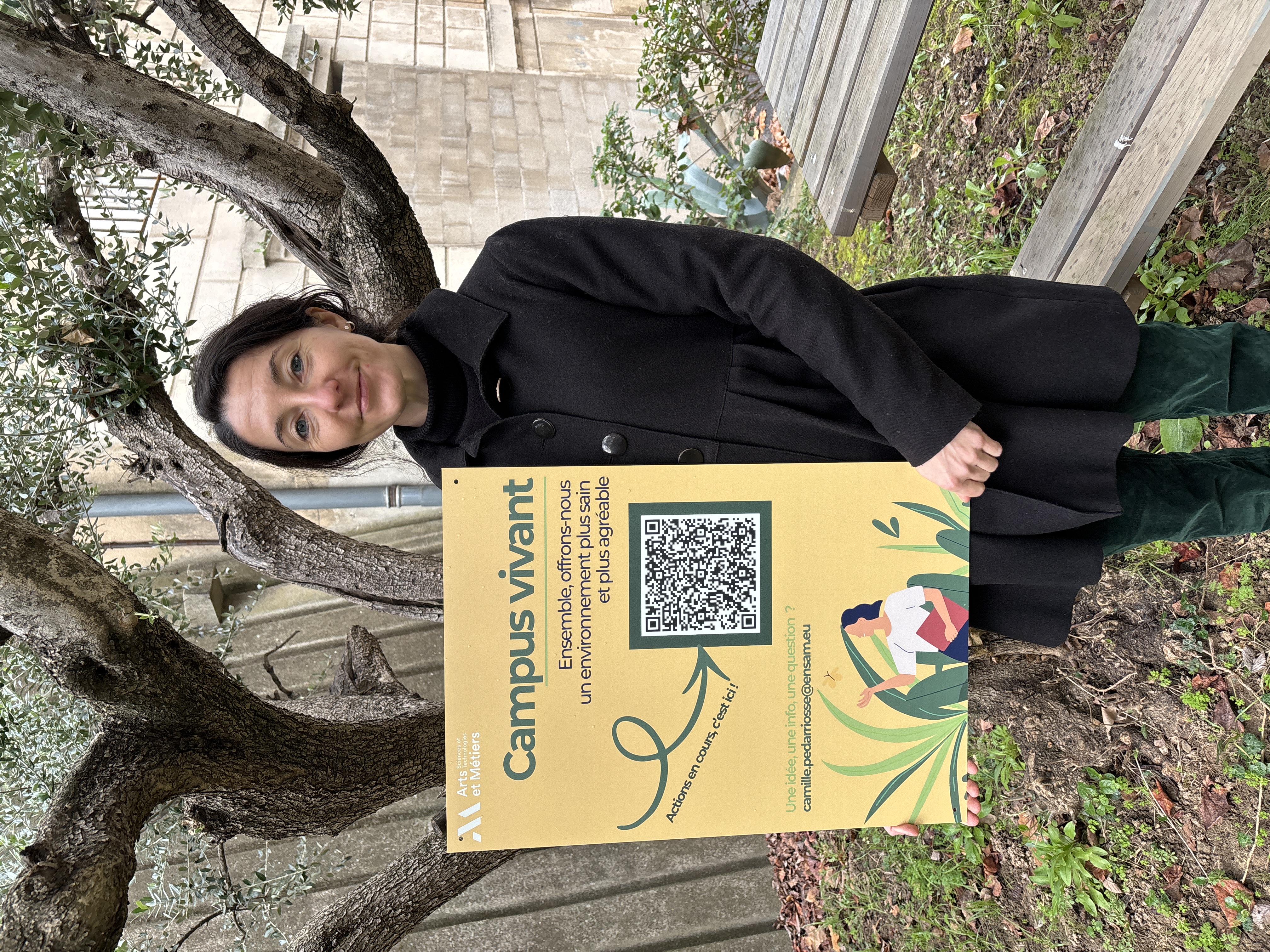
In parallel with my work as an educational engineer, for the past few months I have been leading the " Arts et Métiers Campus vivant" project, which aims to renature the campus. I find it really exciting and complex to take our campus as a subject of study and think about how it can evolve to meet the ecological and well-being challenges of its users.
Since January 2025, I have been working with landscape architects and specialists in integrated stormwater management. Internally, we have organized consultation sessions with users. This requires regular communication with management, the heritage department, staff representatives, etc. It's a comprehensive and stimulating project.
What do we need most today to accelerate the ecological transition?
Willpower and understanding of the issues.
Environmental issues are often treated as a secondary concern, as if we were incapable of thinking long term. What is curious is that when we talk about thinking long term and incorporating the notion of moderation and reducing our consumption, it seems very utopian. However, what is truly utopian is to think that infinite growth is still possible in a world with finite resources. The physical limits of our planet are not expandable.
What eco-friendly actions do you take on a daily basis?
I don't have any particular gesture to remember, but I do have a kind of willpower. It's not easy to maintain that "will" when you look at the current geopolitical situation.
It's difficult to believe in the philosophy of the hummingbird (everyone does their small part) because we have to take into account the larger dynamics that are beyond our control and that are not geared toward action on socio-ecological issues. Despite this, I tell myself that developing projects to bring life back to campus and create spaces for debate and reflection for our students on why we do what we do are still great everyday goals.
Which people, movements, or readings inspire you in your commitment?
There are those with whom I work on these issues on a daily basis. Creating initiatives within a collective such as the DDRS referents or locally with teachers interested in these issues fuels my motivation.
Otherwise, I like to listen to what researchers such as Olivier Hamant, who develops the notion of robustness, and Edgar Morin, who develops the idea of complexity, have to say. I really like the thinking of philosopher Corinne Pelluchon and her book "Les Lumières à l'âge du vivant" (Enlightenment in the Age of Life). There is so much to read in all fields.
I think that feeling useless and powerless at times in the face of all these issues that are beyond us should lead us to forge links with as many people as possible who are dealing with these subjects from different angles. We cannot all be experts in climate, biodiversity, engineering, law, and new economic models. I find it constructive not to limit ourselves to our own expertise and to seek out the resources we need around us.
For more information: " Arts et Métiers Living Campus" project