The JENII project will come to an end on November 1. But is that the end of the story? What progress has this project made? Answers from Véronique Favier, Deputy Director GeneralArts et Métiers Scientific Director of JENII, and Sébastien Fernandez, Director of Development at ELF.
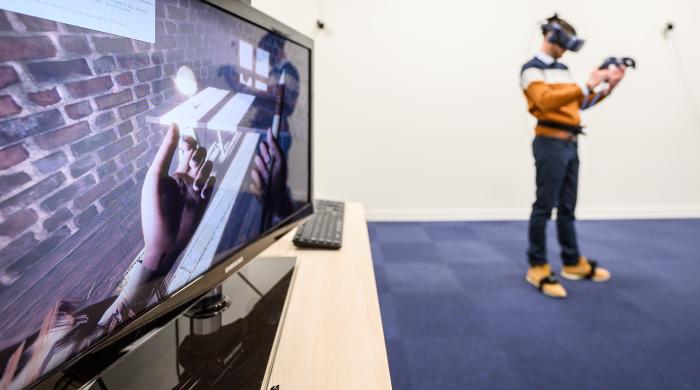
Fifteen digital twins (DTs) Arts et Métiers including eight at Arts et Métiers used to train engineering students using replicas of physical systems. These impressive achievements have been made possible thanks to the JENII project (Interactive and Immersive Digital Teaching Twins).
The eight digital twins ofArts et Métiers
Eight digital twins have been deployed at Arts et Métiers
- The two digital twins of the foundry workshop
Using the digital twins of the foundries on the Aix (low pressure) and Angers (shell molding) campuses, students analyze the impact of casting parameters on the final product. They can then carry out a parametric study and prepare experiments in the digital twin before actually carrying them out on the physical twin. - Digital twins in the forging workshop
The digital twin of the industrial forge in Metz allows students to experiment with manufacturing a part and operating machines (furnace, press, robots). This trains them to deal with dangerous situations in the physical world. In addition, the digital twin allows them to see the invisible, such as how a hydraulic or mechanical press works, by virtually opening the presses or displaying the thermal field of a piece immediately after forging.
The learning outcome targeted is understanding: recognizing concepts seen in class and understanding complex phenomena. - The digital twins of the log peeling workshop
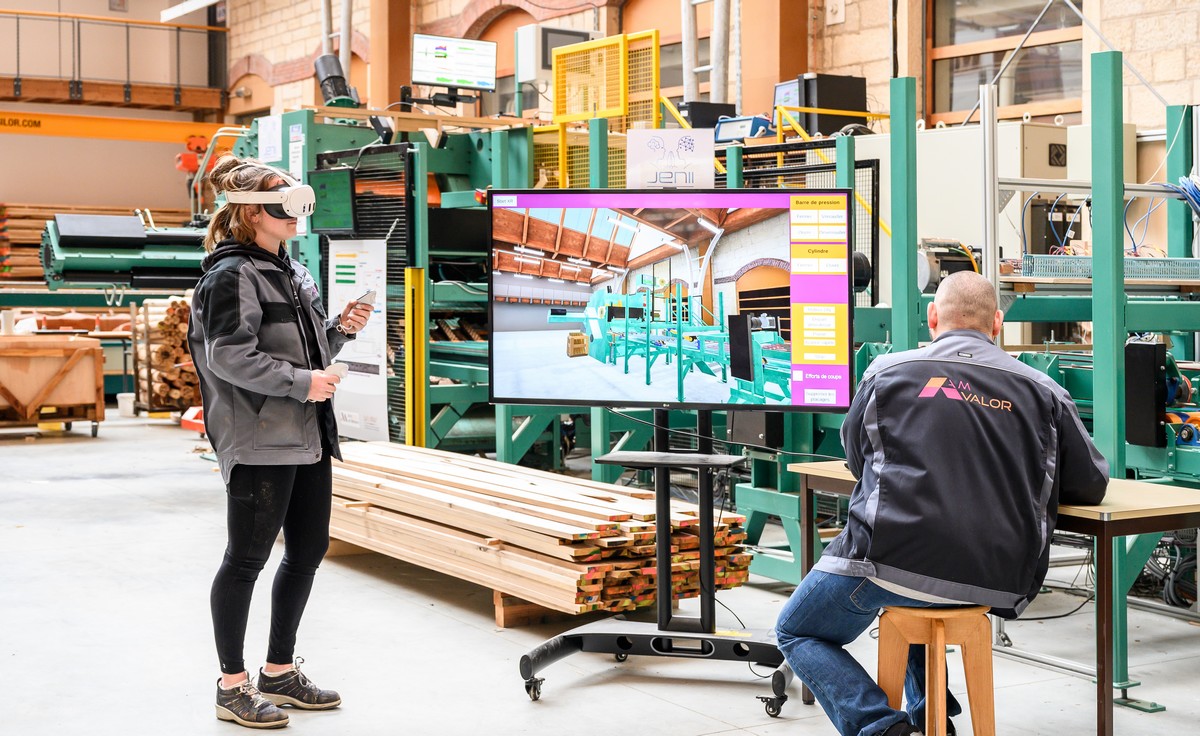
Located in Cluny, the log peeler is a very rare machine, almost a prototype, currently under development.
It is costly and time-consuming to set up for a few minutes of operation in an educational setting, but it is useful for training students and professionals in the wood industry. They can therefore discover it thanks to its JN and learn how to operate it (see also below). - Digital twins High-performance machining workshop
The digital twin of the machining tool is linked in real time to the physical twin on the Cluny campus, providing an augmented view of physical quantities measured or simulated based on real input data. These features give students a better mechanical understanding of live machining. The JN records data in a continuous stream and allows for analysis of the machining conditions and results obtained.
The three other JNs are a turbomachinery workshop in Paris, a flexible factory workshop in Bordeaux, and an agile factory in Lille.
These digital twins were mainly developed in-house, drawing on the expertiseof AMValor, which has expert developers. Within six months, most of them will be accessible in the school's AtriuM.
The educational contributions of digital twins
The JENII project also provided insight into the educational benefits of digital twins.
Comparisons were made between different media (slideshows, interactive screens, total immersion in a digital twin, and the use of physical devices). Slideshows are best suited to learning factual information. However, physical twins are the most effective for putting knowledge into practice, followed by digital twins.
Digital twins are particularly useful when it comes to applying knowledge.
" The feedback from students is very clear. They really enjoy it, which significantly strengthens their engagement in educational activities, " says Véronique Favier. But using them also requires rethinking the relationship between students and teachers, who take on more of a coaching role. It also involves new teaching times: a briefing to explain to students what is expected of them in the activity and a debriefing to review the experience."
" A white paper on educational uses was published in 2023 to clarify the concepts associated with digital twins and make recommendations for their integration into teaching," continues Sébastien Fernandez.
A handbook is also available online and is currently being published in print: " This is a practical guide for teachers who want to start using these tools, even without prior knowledge," explains Sébastien Fernandez. "The guide also aims to debunk a number of misconceptions. It illustrates the main conclusions of the project using examples from all of the digital twins developed. It is the summary deliverable of the project."
What are the consequences?
The JENII project will end on November 1, but logically finds its place within the Evolutive Learning Factories. Ways to continue and sustain the project are being explored, particularly in continuing education.
In addition, its sponsors (Arts et Métiers, CESI, and CNAM, along with ENSAPLV, the Institut Français de la Mode, ESAA Duperré, and Les Compagnons du Devoir et du Tour de France) are already involved in the ConfluenceS project, which has been awarded the France 2030 Excellence label. ConfluenceS aims to transform the training offer and strengthen the professional integration of students throughout France. Launched in 2024, this project is funded by the French National Research Agency. ConfluenceS will run for eight years and has three main strategic priorities: transforming the training offer, transforming teaching facilities, and researching changes in training and employment.
" The project provides funding for the purchase of equipment and the development of digital tools for teaching, research, and innovation within the framework of Evolutive Learning Factories ELF)," explains Daniela Rodriguez, project manager. It also contributes to the development of research by funding doctoral contracts on topics considered innovative. For example, the thesis written by Loris Préaud under the supervision of Frédéric Segonds, Fabrice Mantelet, and Joaquim Silvestre (Paris-La Villette School of Architecture) will address the question of how the integration of craft techniques (carpentry, forging, ceramics, textiles, etc.) can optimize the training of engineers by promoting skills such as precision, creativity, and mastery of materials. "
Each institution is also taking steps to submit projects at the European level. Arts et Métiers the winner of an Erasmus+ grant for the IDT4EU project, which aims to bridge the gap between traditional engineering teaching methods and the needs of Industry 4.0, where digital twins play a central role. Three institutions are collaborating: Arts et Métiers France), WUT (Poland), and POLIMI (Italy), with the aim of modernizing teaching practices and strengthening resource sharing in Europe.
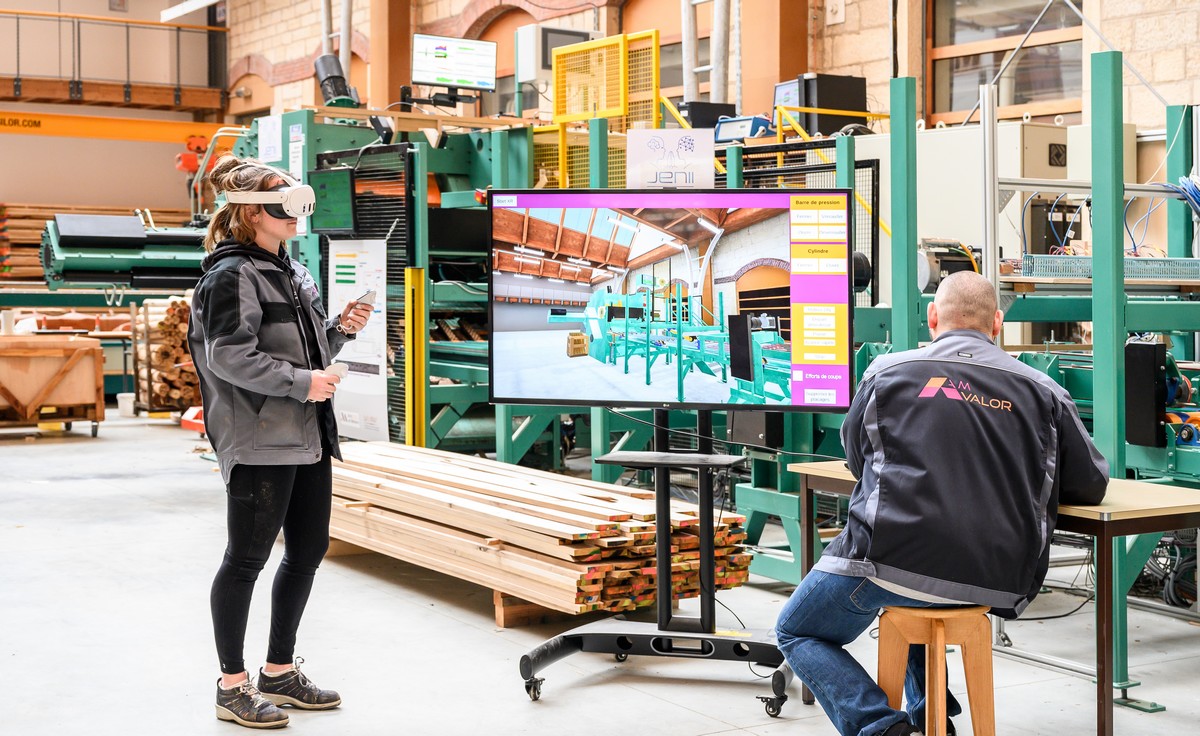
A2ForBois, the next step after JENII for the Digital Twin of veneer peeling
The JENII project leaves behind the Digital Twin of Unrolling, an innovative and immersive tool used in teaching atArts et Métiers. The A2ForBois project, supported by France 2030, will enable this tool to be perpetuated and enriched by continuing developments to expand the educational content and ensure wider distribution for different levels of learners.
Educational experiments conducted over the past year have made it possible to measure and confirm the relevance of this new tool in four areas:
- Pragmatic quality (its usefulness and usability)
- Attractiveness
- Hedonic quality - Simulation (ability to offer captivating and innovative elements)
- Hedonic quality - Identity (presentable and professional)
This is therefore not the end, but the beginning of a new life for this digital twin, now ready to become a permanent fixture in educational practices.
The A2Forbois (Avenir Formation Forêt Bois) project, supported by the French government as part of the "Skills and Jobs of the Future" initiative, for a period of five years, is the ideal vehicle for the large-scale dissemination of the peeling twin, reaching a diverse audience, from vocational training to doctoral level, including engineering schools, and enabling learners to discover this primary processing method through various educational scenarios adapted to all levels.
A2ForBois provides a network of stakeholders, the structure, and the financial resources to advance the peeling twin and associated educational scenarios toward wider dissemination, co-constructed with users.
Thanks to A2ForBois, the twin ofArts et Métiers wood peeling programArts et Métiers available for training in the forestry and wood industry at the regional and even national level.
The use of the twin is also being considered in the context of continuing education via AMTALENTS. In particular, specific features and scenarios designed for professionals are being studied to complement the training courses currently offered by the LaBoMaP team on unrolling.