As artificial intelligence profoundly transforms the fields of engineering, research, and higher education, the Arts et Métiers campus Arts et Métiers Bordeaux-Talence is tackling the issue with a clear ambition: to train all its staff in the understanding and responsible use of AI. This initiative is driven by the CAIRE (Citizen-oriented Artificial Intelligence training for a Responsible Education) program, to which Émilie Pariel, a work-study student since May 2024, has contributed significantly.
The CAIRE project: training artificial intelligence to be civic-minded and responsible
Launched in 2023 as part of France 2030, the CAIRE (Citizen-oriented Artificial Intelligence training for a Responsible Education) project, coordinated by Arts et Métiers partners such as Cnam, CESI, the University of Burgundy Europe, and the Paris School of Business, aims to develop a common culture of AI that is accessible to all. Its ambition is to enable every citizen, student, teacher, researcher, technician, or professional to understand, master, and use artificial intelligence in an ethical and informed manner. Structured in three progressive levels of training, from discovery to advanced uses, the program is designed to be modular, inclusive, and rooted in real-world realities. Ultimately, the project aims to train more than 28,000 people by 2028 and become a national model for responsible AI training, helping to make artificial intelligence a lever for innovation at the service of humanity.
Training to support the digital and technological transition
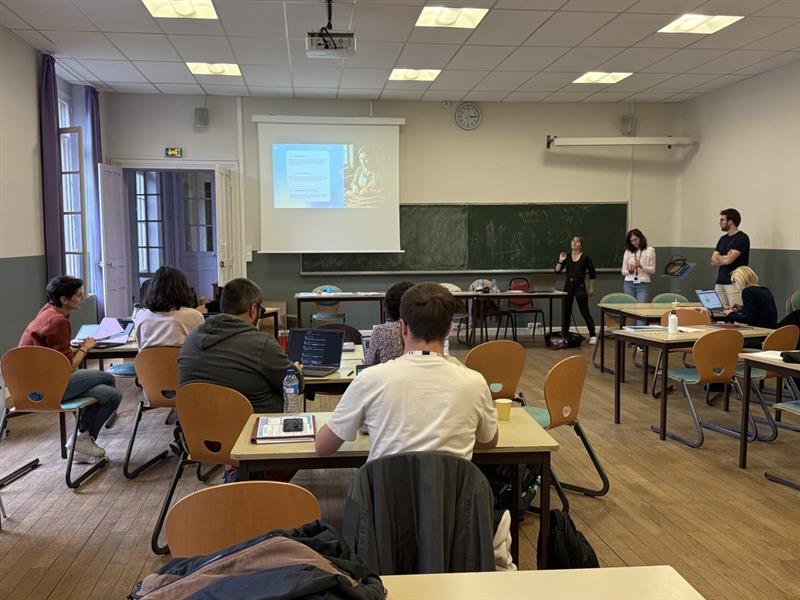
Developed as part of the CAIRE project, this training course on artificial intelligence (AI) aims to demystify the uses of AI and equip campus staff (and students)[PE1] to better understand its impact on their professions.
Designed to be accessible to everyone—teachers, researchers, teacher-researchers, administrative and technical staff—it is based on a progressive educational approach: a first level to understand the fundamentals and a second to explore practical applications in everyday activities.
"The goal is for everyone to be able to grasp the key concepts of AI and see its potential without fear," explains Emmanuelle Chavanne, project lead. The training should enable everyone to become active participants in this digital transformation, rather than mere spectators. "
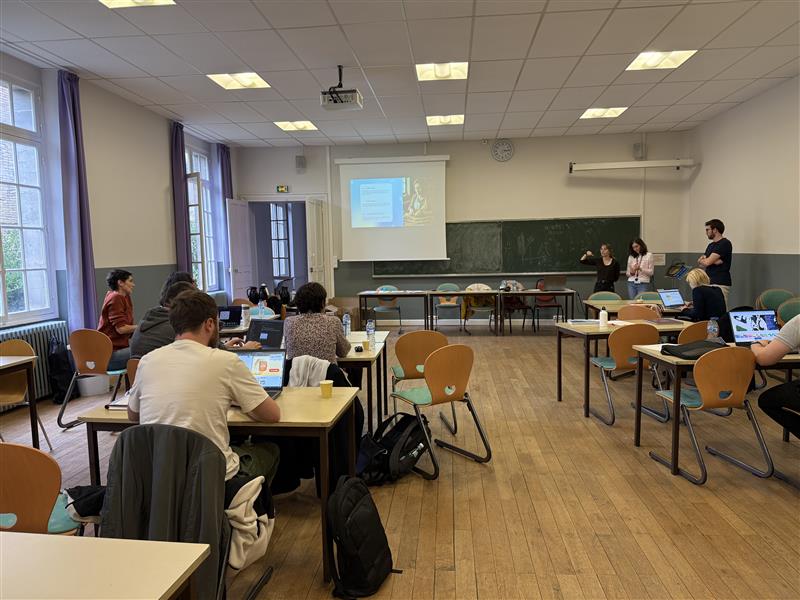
The first sessions have already brought together several groups of staff, while students on campus are made aware of the issue as soon as they arrive thanks to the back-to-school hackathon, with a workshop dedicated this year to artificial intelligence (AI).

Émilie, a work-study student at the heart of the program
Arriving on campus as part of her work-study program in 2024 (i.e., at the start of the project), Émilie played a key role in designing and developing the first two levels of the training program.
"I first participated in the design of Level 1, with Emmanuelle, working on the materials and practical exercises used to introduce the basic concepts of AI," she explains.
Then I helped create Level 2, which is more in-depth and geared toward specific uses for staff. I also updated the first module to incorporate feedback from participants. I also had the opportunity to co-facilitate several in-person training sessions. Being able to contribute to all the different phases of designing a training program is very rewarding!"
Her work has enriched the educational content, improved the clarity of the materials, and strengthened the participatory aspect of the program. Over the months, she has helped to structure a coherent training program that is in line with the needs and expectations of those involved on campus.
"This project has helped me understand how essential continuing education is to supporting technological transitions. It's rewarding to see staff embrace these sometimes complex topics with curiosity and openness. Working with different types of learners confirms to me that it's important to provide training that is accessible to everyone, both in terms of content and format," emphasizes Émilie.
A collective dynamic focused on the future
Driven by the momentum of the Arts et Métiers network, the CAIRE training program is intended to be rolled out to the general public.
This opening reflects a strong ambition: to make CAIRE a model for training in AI and responsible innovation, capable of supporting technological change in all work and teaching environments, while ensuring that everyone uses AI intelligently (human intelligence this time 😉).
"This initiative is not only intended to train Arts et Métiers staff, but also to inspire other institutions and players in the socio-economic world," Emmanuelle emphasizes. The challenge is to create a shared culture around artificial intelligence that is open, ethical, and collaborative."
The work co-created on the Bordeaux-Talence campus is now part of a national initiative to disseminate and share expertise, in line with Arts et Métiers mission Arts et Métiers support innovation and organizational transformation through training and research.