
National Master of Science Degree Master of Science DNM) in Advanced Systems and Robotics (SAR)
Campus
Arts et Métiers Campus Arts et Métiers Paris
Pedagogy
This program lasts two years.
M1: offered at the Arts et Métiers campus Arts et Métiers Paris as part of the "Factory of the Future - Mechanical Engineering" program.
Presentation
The national Master of Science degree is designed to advance the development of mechanical systems equipped with a degree of intelligence capable of providing the autonomy and automation necessary to:
- Improving production and reducing the drudgery of work
- Simplify people's lives and provide people with disabilities, in particular, with the means to live more comfortably.
With a strong focus on mechatronics (the synergistic and systemic combination of mechanics, electronics, and real-time computing), this course covers the following topics:
- The mechanics of multi-body (rigid) systems
- Control systems, sensors, and actuators
- Electronics and signal processing (image, localization, filtering)
- Engineering for health (biomechanics, surgical robotics)
Objectives
The goal is to train specialists capable of addressing issues related to the design, analysis, optimization, and control of complex systems and intelligent machines, among which robots occupy a prominent place.
This training program is designed to meet the wide range of research, development, and production needs related to these advanced "mechatronic" systems, which are of paramount importance in all areas of activity (transportation, manufacturing, robotics, home automation, health technologies, etc.).
Skills acquired
High-level skills will be acquired in solid mechanics, automation, signal processing, and computer science.
Program
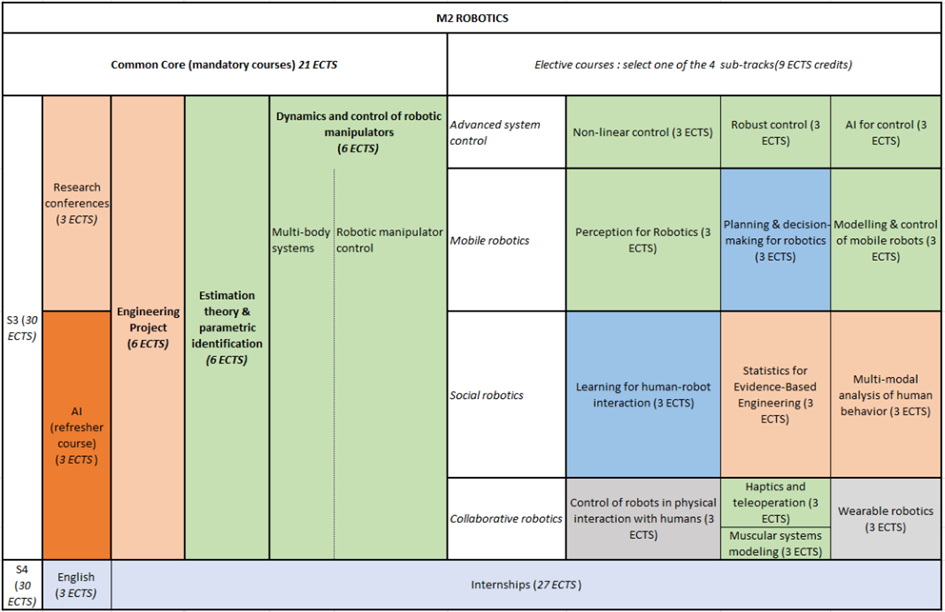
The program is structured into two semesters: one semester of classes and one semester of internship (6 months). The semester of classes consists of 4 compulsory courses followed by 4 typical pathways that share several common teaching units:
- Advanced system control,
- Mobile robotics
- Social robotics
- Collaborative robotics
Additional course units may be taken outside of the study contract.
Validation
Traditional classes with documents and final exam.
Some courses use experimental and digital platforms as support for practical work or tutorials. In this case, practical work and tutorial grades are taken into account.
Benefits of the training
- Responds to strong industrial demand (robotics plan launched by the government to support the robotization of SMEs and SMIs), particularly in the development of embedded systems and robots where there is a need for increasing adaptability and autonomy (aeronautics, transportation, healthcare, etc.).
- Recognized in industrial and academic circles
- Original, topical, and multidisciplinary teaching and research areas
- Draws on renowned laboratories at partner institutions (Sorbonne University, ENSTA, Mines,)..
Career opportunities
The career opportunities for graduates of this program include research and development departments working on new products and processes, engineering departments, and mechatronics design offices in both the public and private sectors.
The areas of activity most specifically concerned by these opportunities are:
- mechanical and mechatronic engineering and manufacturing
- aerospace and aviation industry
- the automotive industry and transportation:
- the maintenance sector
- the education, research, and learning sectors
- the health technology sector
Continuing education
The training program is based on a set of Arts et Métiers laboratorieslaboratories, as well as partner institutions that enable students to prepare a doctorate within the framework of associated doctoral schools.
Admissions
Admission criteria
This program is intended for students with a background in engineering sciences who have completed their first year of the “ Master of Science ” program, as well as students in their final year at engineering schools as part of a dual-track program (particularly students from jointly accredited institutions: Arts et Métiers, ENSTA, Mines Paris, and Polytech-UPMC) or students who already hold an engineering degree. It is also open to international students who have received equivalent training.
- Required level
- Equivalent international level
- Level in French. If a test is required, specify which one and the minimum score to be obtained.
- English level. If a test is required, specify which one and the minimum score to be obtained.
Application deadline(s)
- Arts et Métiers student Arts et Métiers Bicursus: see internal assignment procedures
- Candidates outside Arts et Métiers June 30, 2021. The application form must be completed online
Arts et Métiers students Arts et Métiers dual degree programs must follow the internal application procedure and do not need to fill out the application form.
Partners
Industrial partners
PSA, Renault, EDF, Airbus Helicopters, ENGIE Ineo, CEA, SAFRAN, AIRBUS, Soft Bank (Aldebaran), Robotsoft, etc.
Academic partners
Sorbonne University, ENSTA, Mines Paris
Practical information
- Language of instruction: French
- Schedule: September through February: classes, followed by a Master of Science program
- Number of hours:
- ECTS credits: 60 ECTS
- Cost: See Tuition (Enrollment in Master of Science ) program)
- Training location(s): Paris (Arts et Métiers, Sorbonne University—Jussieu campus, École des Mines)
Contacts
- Arts et Métiers Campus Arts et Métiers Paris
- 151 Boulevard de l'Hôpital, 75013 PARIS
- Tel: 33 (0)1 44 24 64 58