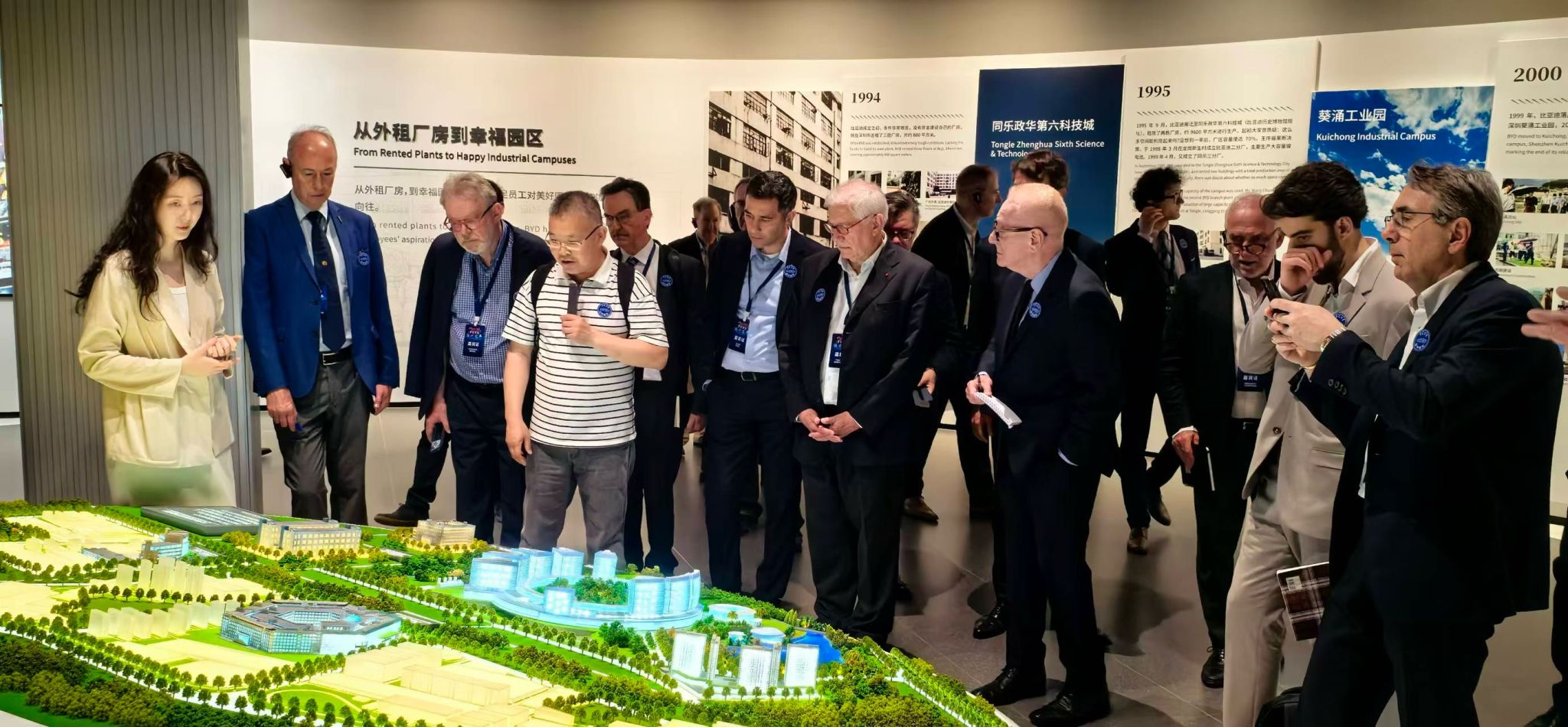
In the spring of 2026, Adel OLABI participated in the “France-China Electric Vehicles” (FCVE 2026) mission, thanks to support from the Arts et Métiers Foundation and the Direction d’Arts et Métiers.
This French delegation brought together automotive experts, industry leaders, institutional representatives, and engineering students around a common goal: to understand the factors behind China’s lead in electric vehicles and to identify avenues for consideration for the European industry.
FCVE 2026: Adel OLABI’s Feedback
A mission centered on observation
Before departure, several working groups prepared analytical reports on various topics, including regulations, industrial capacity, automotive technologies, and factory automation.
Adel OLABI, a professor and researcher at LISPEN in Lille and a robotics specialist, represented the Arts et Métiers in this mission and co-authored a report on automation, industrialization, and quality control.
Objective: To compare the assumptions made earlier with the realities on the ground and to assess the actual level of technological maturity of Chinese sites.
Discovering China's Industry Leaders
Over the course of about ten days, the delegation visited several major players in the industry, including BYD, CATL, XPeng, and Xiaomi Auto. These visits provided an opportunity to tour battery production lines, electric vehicle assembly plants, and several technology showrooms.
For Adel OLABI, the main benefit lay in the direct observation of advanced production technologies, particularly in the fields of robotics and automation. The visits highlighted a high level of automation at certain sites, with body-shop lines that were almost entirely robotized, logistics flows managed exclusively by autonomous mobile robots, and automated quality control systems.
China: From a Low-Cost Manufacturing Hub to an Innovation Powerhouse
One of the key takeaways from the trip is the evolution of the Chinese model: The country’s competitiveness no longer relies solely on its production capacity. It is now based on a particularly ambitious innovation strategy. This is evidenced by the figures announced by certain manufacturers: BYD reports filing up to 45 patents a day, and Xiaomi employs nearly 25,000 people in research and development!
Batteries, artificial intelligence, connected vehicles, robotics: the investments made in these areas are substantial and enjoy strong support from the Chinese government, which is actively expanding its infrastructure to enable vehicles to interact with their environment, paving the way for the rise of connected and autonomous mobility.
A Major Challenge for France and Europe
This mission confirmed an observation shared by many observers: the European automotive industry is facing increasingly fierce competition from China.
Beyond technology, the gap also lies in the resources deployed, the speed of execution, and the emphasis placed on research and development, including the training of engineers.
According to Adel OLABI, one of the major challenges for Europe will be to continue developing skills in the fields of robotics, electrification, and artificial intelligence: “This effort will rely in particular on training new generations of engineers capable of supporting technological transformations in industry.”
A Valuable Contribution to Research and Education
Adel OLABI highlights the value of this mission, both from a technical and a human perspective. The diversity of backgrounds within the delegation fostered particularly enriching discussions on the industrial and technological challenges facing the sector.
“This experience has given me a better understanding of the changes taking place in the global automotive industry. The lessons I’ve learned from this assignment will also inform my teaching activities with students atArts et Métiers.”
Reports and feedback from the mission are available on the dedicated website
Adel OLABI would like to thank the Arts et Métiers Foundation and the management ofArts et Métiers for their support and trust, which made his participation in this strategic study mission possible.