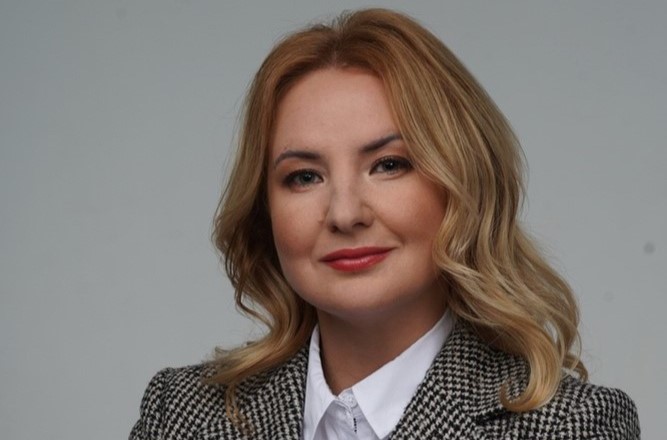
Ganna Polishko holds a PhD in engineering sciences from the E.O. Paton Electric Welding Institute of the National Academy of Sciences of Ukraine, where she is responsible for the institute's international collaboration. During her stay in France, she is sharing her experience and expertise in metallurgy and materials production as a visiting professor at the I2M laboratory.
Meeting with Ganna Polishko
What motivated you to come to Arts et Métiers as a visiting professor Arts et Métiers Can you tell us about your collaboration with Jean-Marc Olive?
My encounter with Jean-Marc Olive is a long story. One of my colleagues was working at Sendai University in Japan, where he met Jean-Marc in 2012. They collaborated on a project involving A2 stainless steel. Upon his return to Ukraine, he presented their work to us, and this project resonated directly with the subject of my thesis. Jean-Marc and I spent a long time trying to define a joint project, but it took us a long time to find one. As part of the Nadiya* program, we were finally able to align our scientific interests and organize this visit to Bordeaux.
During this month-long invitation, we studied a new steel-boron alloy produced in our laboratory in Kyiv. We analyzed samples under a microscope to obtain new information about the alloy's chemical composition and mechanical properties using the equipment and expertise of the I2M laboratory.
In addition, we have begun work on a joint scientific article, which has not yet been published. We have also developed a very interesting project based on this alloy, which we plan to use to manufacture new lightweight structures using innovative production techniques.
*The Nadiya Program is a mobility grant program for Ukrainian scientists in the field of engineering.
How did you feel during your stay?
I must say that this experience has been very enriching. The welcome was warm and the work took place in a very open environment, conducive to exploring new areas of research. Some members of the I2M laboratory were not necessarily familiar with the materials we use, but they showed great curiosity and a willingness to learn. We worked together to discover new approaches, a novel experience for them as well as for me.
We continue to work together remotely. About twice a month, we hold online meetings to discuss results and new ideas. This allows us to keep moving forward, even after my stay in France has ended.
What is the main advantage of conducting research collaborations with other countries? Is there anything in particular that you appreciate about your collaborations with France or with Arts et Métiers
There are many advantages to these collaborations. First, they allow us to acquire new knowledge and make new contacts. By working with researchers from other countries, we discover new topics and, above all, new ideas.
The situation in Ukraine has been particularly difficult over the past two years. As a scientist, it has become difficult to focus fully on my work. This period in France has allowed me to take a step back and think more calmly about my work, far from my daily concerns. This has been one of the most important benefits for me.
To give you some context, I have new responsibilities, which are more administrative in nature, and have taken me slightly away from research. This change of country and environment has given me the opportunity to immerse myself once again in science and in how we can apply and produce innovative materials. I have therefore become interested in the development of low-emission oxidation technology for the production of lightweight structures from high-strength steels, using the CLM process and additive manufacturing in 3D printing. This seems to me to be an innovative approach in this rapidly growing field.
What sparked your interest in metallic materials? Was it the result of a particularly memorable class or something you read on your own?
That's a good question! Actually, it comes from my family: my father was a metallurgist and my sister also studied metallurgy at the Kyiv Polytechnic Institute in Ukraine. I've always been surrounded by this environment. When I discussed my plans and the challenges I was facing, my parents often supported me and shared their knowledge. That has been invaluable to me.
I quickly became interested in metals and steels during my engineering studies. I found it fascinating because there are so many components that influence the properties and applications of materials. I then focused my research on the development of new materials and their potential. It's a field that I'm really passionate about.
One important point: in the metallurgical industry, the number of women is really low. I was often the only woman on the team. This presented an additional challenge in finding my place. As an anecdote, I was the first woman to defend a doctoral thesis in engineering sciences in my field in Ukraine.
When did you decide to work as a researcher?
When I was a student, I used to say that I never wanted to work in research. However, several members of my family (including my uncles and aunts) held positions related to research. Before starting my PhD, I spent a year at the Ministry of Industrial Policy in Ukraine, where I realized that office work did not interest me. I didn't like the idea of being stuck in an office all day, with rigid schedules and little freedom.
Research has given me greater flexibility. I have the freedom to think, write, and work at my own pace. However, there is also a downside: even when you leave the office, the work never really stops. You continue to think, develop ideas, and sometimes it's hard to switch off.
You are organizing an event focused on women in STEM fields and, more broadly, in research. Do you think these initiatives are essential for women?
Yes, I think it's important, because this sector is rich in innovation and recruits heavily with attractive salaries. It's a very male-dominated sector, so it's important to modernize it by including more women. There are many organizations in various countries that organize events to promote the role of women, and not just in science. For STEM in particular, gender equality policies in the European Union, but also in the rest of the world, are helping to change attitudes and encourage more women to pursue careers in these fields.
In our field, which includes materials science, it is crucial to promote these events. When we meet with other organizations, we constantly discover new areas of research and new scientific topics. This appeal and excitement in the field must be highlighted in order to recruit young women who are starting to study or work in our field. It is essential to show them that it is not just for men.
It is important to demonstrate that women can also perform jobs traditionally perceived as masculine, such as metalworking. Promoting new technologies, robotics, and modern tools is a lever for involving women more widely in these fields and professions. This type of event can open doors and encourage more young women to consider careers in STEM. In the metalworking industry, for example, there may be some reluctance to accept women around smelting processes due to the difficult working conditions. It is true that handling molten metal and working in intense heat can be physically demanding. That said, I strive to create a collaborative environment. In our laboratory, we have found ways to include everyone, regardless of gender. Men and women can work together, each contributing their skills to the process.
What advice would you give to students interested in pursuing a career as a researcher in your field or in any other field?
I believe that engineering, science, and new technologies are exciting and promising fields. It is essential to show young women considering a career in these fields that they are open to everyone... There are many opportunities in metal production, construction, and 3D printing, which are booming sectors. These fields offer good career prospects with attractive salaries, both in Ukraine and in Europe.
It is often easier for students to go into industry rather than research. However, I believe that seminars and meetings can show that research offers many opportunities and advantages. For example, research opens doors internationally. Whether you want to live in France, Ukraine, or the United States, if you speak English well, you have access to many opportunities. I have seen many women flee Ukraine because of the war and easily find jobs in Germany, France, Italy, or Spain. They have been able to continue working in metallurgy laboratories or other scientific fields.
It is essential not to hesitate to explore these possibilities. Research is a unique field where you can truly flourish. My advice to all students is to seek knowledge, be curious, and knock on every door.
His career
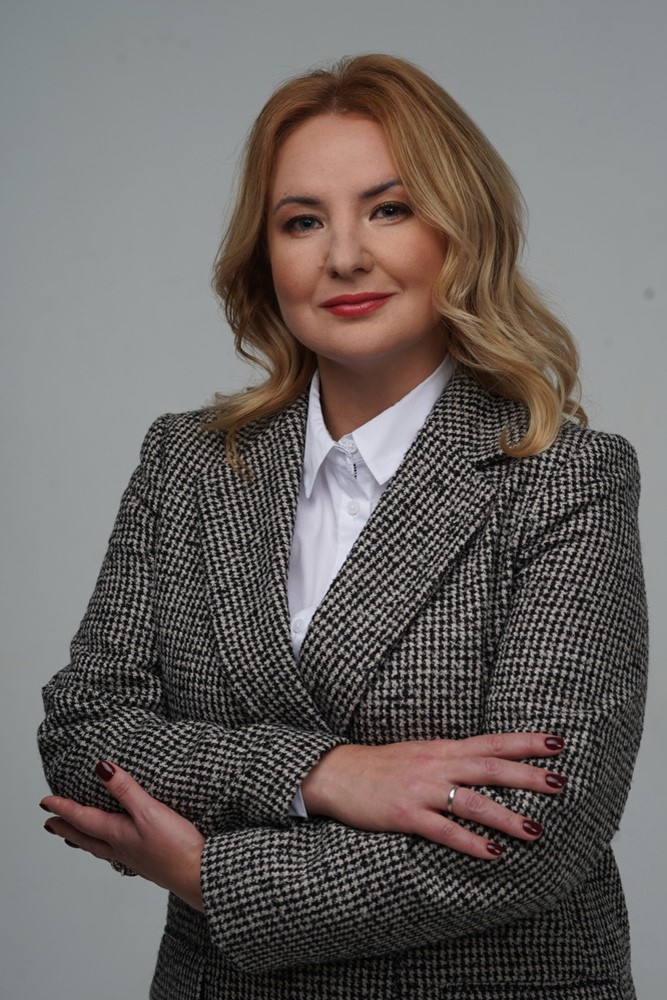
Ganna Polishko holds a PhD in engineering sciences. She is currently based at the E.O. Paton Electric Welding Institute, part of the National Academy of Sciences of Ukraine in Kyiv, where she focuses on metallurgy, particularly the analysis and development of new alloys. Ganna also leads the institute's international collaborations. As part of the Nadiya program, she spent a month at the I2M laboratory in Bordeaux. Together with Jean Marc Olive, Ganna will organize the "Women in STEM" event in 2025, which aims to bring together young Ukrainian and French female engineers to promote STEM careers among women and foster Franco-Ukrainian collaboration.