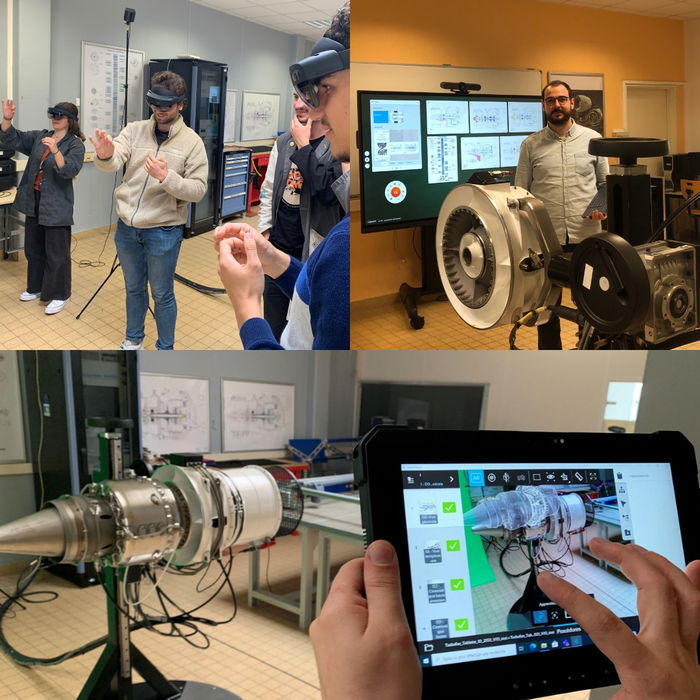
How can AR/VR be integrated into education? Fabian Magnin works with teachers to help them plan ahead and supports them in implementing this technology in their lessons.
Fabian Magnin arrived in April 2023 to implement the mixed, augmented, and virtual reality (AR/VR) equipment invested in as part of the EMIRE project, a project by the Nouvelle-Aquitaine Region aimed at equipping the school with AR/VR technology.
His goal is to introduce the equipment to teachers so that they can integrate AR/VR into their lessons. Fabian sets up demonstrations during which teachers project themselves and think about use cases. He then helps to implement AR/VR modules in lessons and works with teachers on their modules, drawing on his expertise.
Become more dynamic and efficient
Some teachers have already integrated AR/VR into their training. This is the case for Jérôme Pailhès, who offers a practical course on assembling and disassembling a turbomotor to students in the ASPM (Aeronautical Space Project Management) Specialized Master's program and who offers his students a course via Screen Sharing. The integration of this technology allows detailed cross-sectional views of the engine to be displayed. This method of presentation greatly improves image quality and allows for zooming in on the plans for much greater precision. The course thus becomes more dynamic and effective.
Dominique Scaravetti has also integrated augmented reality into his kinematics courses (study of the kinematics of a gate cylinder). Augmented reality facilitates the transition between technical data and plans and provides a greater understanding of the mechanism.
AR/VR is an added value to be used in addition to more traditional course materials: "It is a medium that does not replace others but shows a different perspective. For example, you can better appreciate the scale of a room when you have it virtually in front of you. It adds a new angle."
The real advantage of this project is its ability to immerse students in a variety of environments that they do not always have access to, such as modeled factories. By increasing the number of experiences, students gain skills and the training becomes more diverse.
For staff and students
The EMIRE platform also supports research and knowledge transfer. A doctoral student is currently working on ways to interact with the virtual environment. He has linked the platform to his research tools using 3D glasses and motion tracking.
In the long term, the goal is to make this platform available to researchers and teachers as well as students and technical staff.