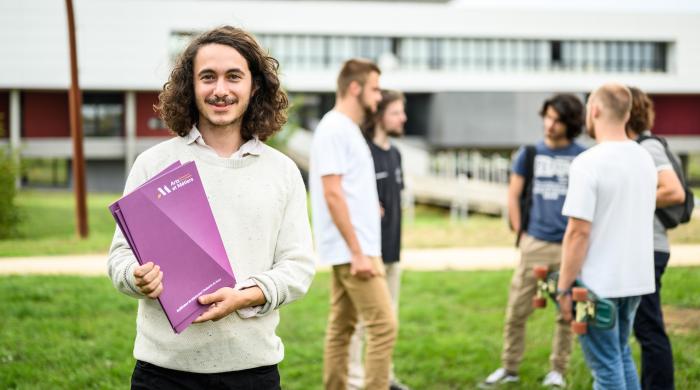
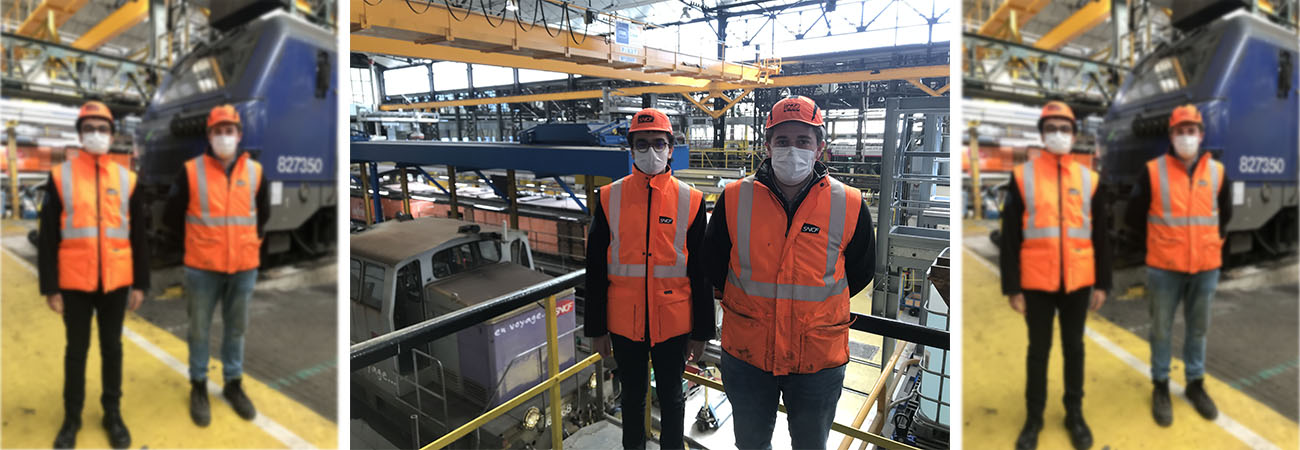
The apprenticeship program at the Grande Ecole Engineering Programme Arts et Métiers, which takes place on the Angers campus, allows a company to benefit from the engineering students’ skills for three years. Alessandro Giannelli, a Methods engineering intern on the maintenance team at the SNCF’s Paris Saint-Lazare Technicentre, and his mentor Xavier Cappe de Baillon, a Methods engineer at the Achères maintenance site, explain the key benefits of this program for both companies and students!
After completing a PTSI preparatory program at the Cachan comprehensive high school, Alessandro Giannelli enrolled Arts et Métiers the apprenticeship track Arts et Métiers . It was his first choice! Tired of theory, he wanted to pursue a hands-on program, enter the workforce right away, and be able to highlight his professional experience on his resume. The Grande Ecole Engineering Programme apprenticeship Grande Ecole Engineering Programme offers him the opportunity to directly apply the skills he acquired at Arts et Métiers service of SNCF.
Training that meets the needs of businesses
Alessandro works in the Methods department at the Achères site, a highly diverse site where maintenance of the Transilien L and J lines, maintenance of locomotives for the Normandy line, and freight and infrastructure activities are managed. " The diversity of rolling stock within the department leads to new maintenance tasks on new equipment and changes to the compliance sheets for agents ," explains Xavier Cappe de Baillon, his mentor. "It was to meet this need that we wanted to hire Alessandro on an apprenticeship contract.".
His responsibilities include adapting national maintenance sheets to the site where he works and assigning tasks to agents, working to improve the workshop using the 5S method, and designing parts to improve the maintenance site. "The challenge is to try to reduce maintenance time, agent fatigue, and risks. For example, I am working on designing a bridge or a gantry that would lift equipment so that agents can work on the ground rather than at height," explains Alessandro.
A pace that requires discipline
Alessandro spends one month at the company and one month at school. This rhythm allows him to focus on his assignments at SNCF and then get back into the swing of classes. However, learning requires discipline : "You have to know how to manage your time between assignments at the company and coursework. It's a significant personal investment, but a very rewarding one! Alessandro and his mentor , , meet regularly to review his progress. When Alessandro isn't in class, he works on site. It's a breath of fresh air for him after distance learning!
A practical application of the lessons learned
"At the start of an assignment, the field approach is very important. We meet regularly, and Alessandro also meets with agents and department managers to gain a better understanding of the engineering profession ," explains Xavier Cappe de Baillon. What's interesting is that it allows students to apply certain principles they've learned during their training. "This alternating rhythm allows apprentices to get a foot in the door of the company and, at the end of their studies, to have a good understanding of the professional world." From specifications to project management, including state-of-the-art technology, design and modeling on 3DExperience, communication and conflict management, Alessandro makes practical use of the skills he has acquired in class for his projects at the company.
Assignments that evolve over 3 years
Over the course of three years, Alessandro will see his responsibilities evolve, which is a sign of trust between him and the company.
The goal is for him to develop his skills over the three years. He is currently working on short assignments, but we want him to become independent in new tasks such as overseeing an industrialization project from start to finish. At the end of the three years, our ambition is for him to have mastered the profession of methods engineer. Xavier Cappe de Baillon
A gain in maturity
For Alessandro, that's the whole point of the apprenticeship program. Gaining experience and working on a variety of assignments to meet the needs of the company.
For me, gaining maturity is the strong point of this program. We have important responsibilities that have an impact on the life of the company, which is very rewarding.
Get your foot in the door and open doors for yourself
At SNCF, work-study programs are an important topic. Xavier Cappe de Baillon has benefited from training on how to manage a work-study student, help them progress, and enable them to flourish. "Work-study programs are a significant advantage because this type of contract allows us to move forward on certain projects that we don't necessarily have the time to develop," he explains .
Once they have joined SNCF, if young people on work-study programs have good skills, their applications will be forwarded, not necessarily to the same department, but within SNCF. "Young people who have completed an apprenticeship will have a better chance of being hired by the company. We train young people so that we can then hire them," concludesXavier Cappe de Baillon.
As for Alessandro, he doesn't have any fixed ideas about what to do next, but says he is open to staying at SNCF and discovering other positions!