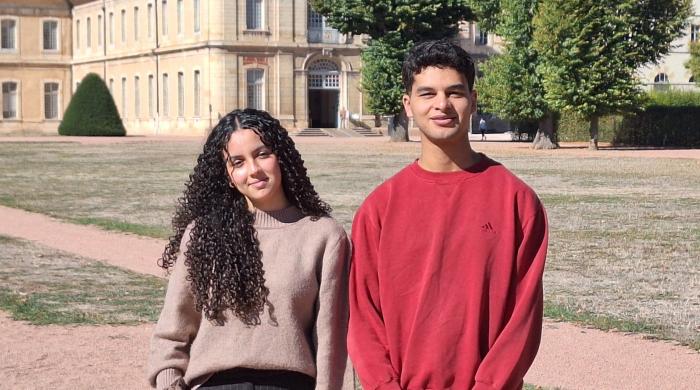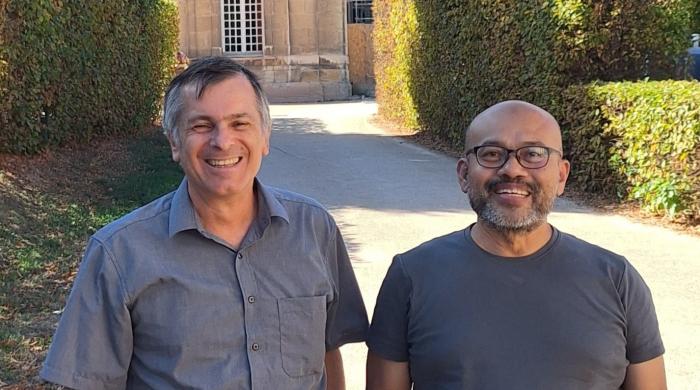
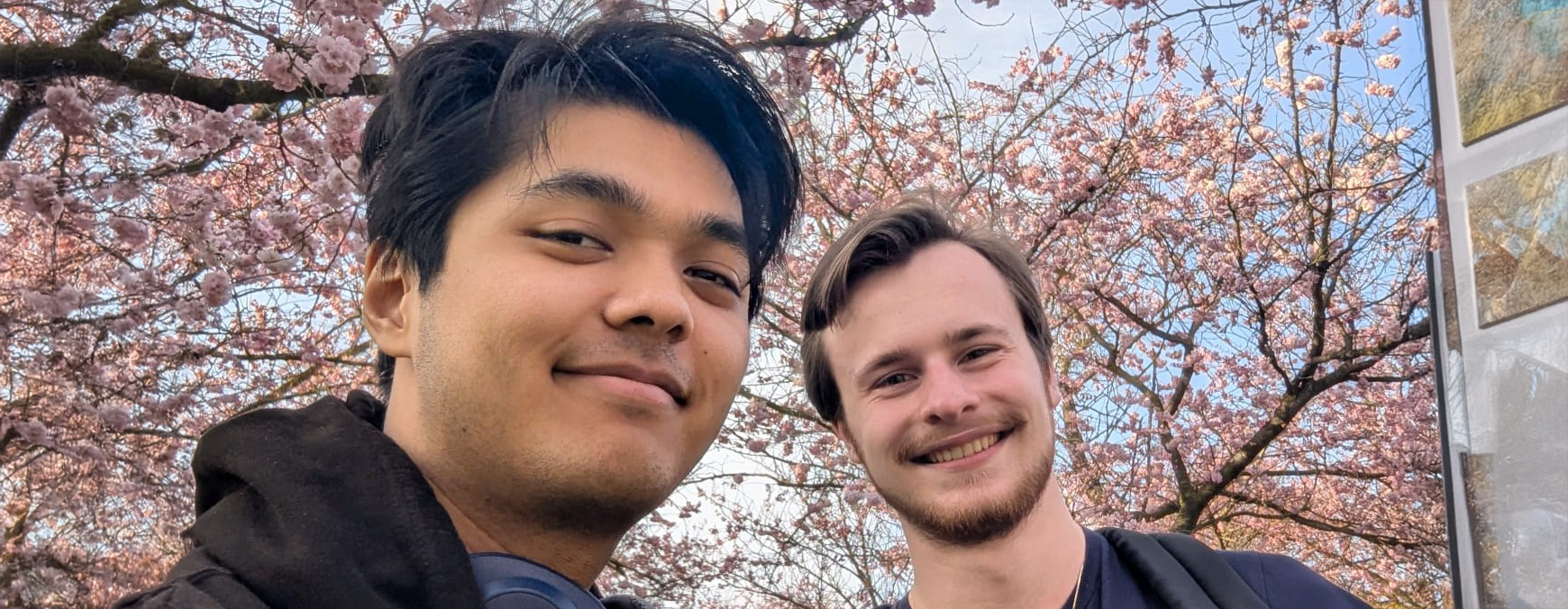
As part of their final-year internship, Maxence and Sayam, studentsArts et Métiers, chose to join a research laboratory at Waseda University in Japan, as part of a collaboration launched in 2025 with the L2EP laboratory at the Arts et Métiers campus Arts et Métiers Lille.
Maxence Acket-Goemaere and Sayam Mouttapa: a capstone internship at Waseda University in Japan as part of a partnership with the L2EP laboratory in Lille
This international mobility is the result of a partnership that began last year when Professor Hideyuki Sawada, a Japanese professor and researcher renowned for his work in robotics and the processing of sound, images, and touch, was hosted at the L2EP laboratory on the Lille campus. This pivotal meeting helped transform a scientific exchange into a tangible opportunity for students.
“This conversation between Professor Sawada and Christophe Giraud-Audine, our advisor at L2EP, was the starting point for our final-year internship opportunity. Without that meeting in Lille, this internship probably would never have happened,” explains Maxence.
Two different paths, but the same passion for research
Although they come from different backgrounds, Maxence and Sayam share a common interest in robotics, innovation, and research.
Maxence, a former student in the CPGE PCSI program at Faidherbe and later in the PSI* program at Baggio, is currently a student Arts et Métiers the Lille campus, in his third year of the Grande École Program in IRIS expertise.
Sayam, who attended a preparatory class for engineering school at Jules Ferry High School in Versailles, also enrolled at the Lille campus, and then chose to pursue the SAR Master of Science Research program Master of Science “Advanced Systems and Robotics” during his third year, as part of a dual-degree program with Sorbonne University.
“The IRIS program at Arts et Métiers focuses primarily on industrial applications. Completing my capstone internship in a research lab allowed me to explore innovation at an earlier stage—starting with an idea and building a system from the ground up,” says Maxence.
For Sayam, whose Master of Science program Master of Science a stronger research focus, this internship was a natural fit for his academic path: “I had a strong interest in robotics and haptics. When I saw the topic, it was pretty obvious that I should apply, ” he explains. “And the fact that it was in Japan—a country where I speak the language and where part of my family lives—really boosted my motivation.”
A research project combining origami and shape-memory alloy wires
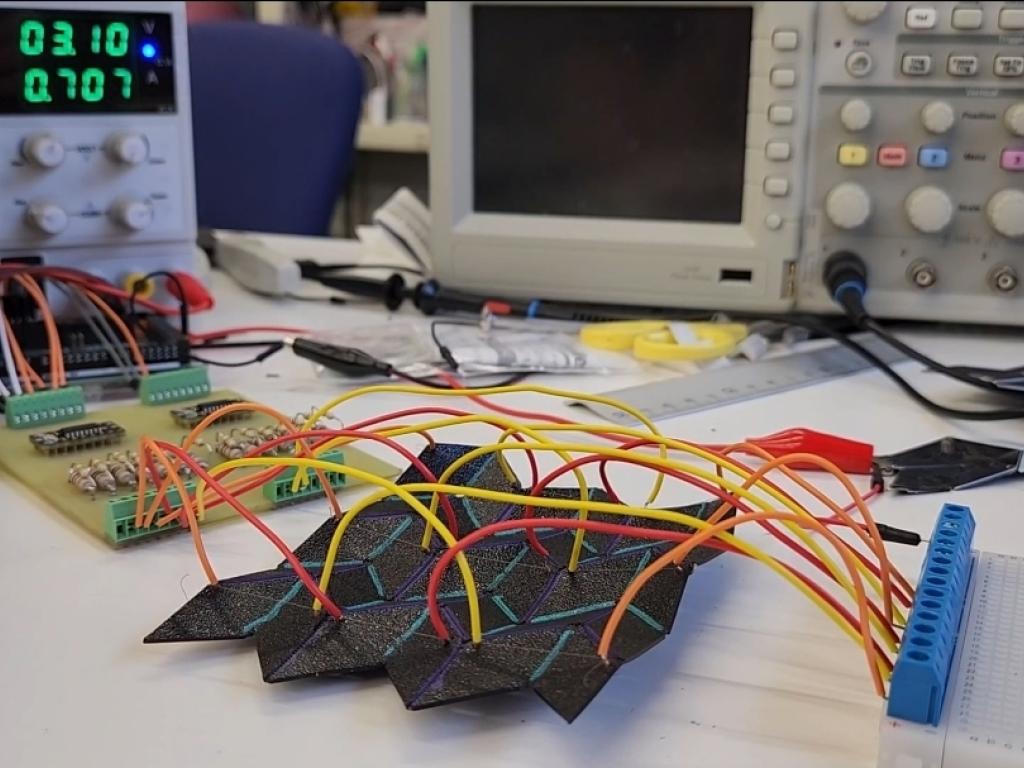
The project entrusted to the two students is based on an innovative combination of origami structures and shape-memory alloy wires, which can contract when heated. These two technological aspects open up numerous avenues for further research.
“The idea is to take these two elements and combine them,” explains Maxence. “On the one hand, for haptic feedback—that is, generating tactile sensations on the skin—and on the other hand, for soft robotics.”
Professor Sawada’s laboratory is indeed renowned for its pioneering work on the integration of shape-memory alloys in robotics .
“These wires have many technical limitations, but here they’ve managed to find ways to apply them that truly make them usable in soft robotics. It’s quite groundbreaking,” Sayam points out.
An internship designed to be exploratory
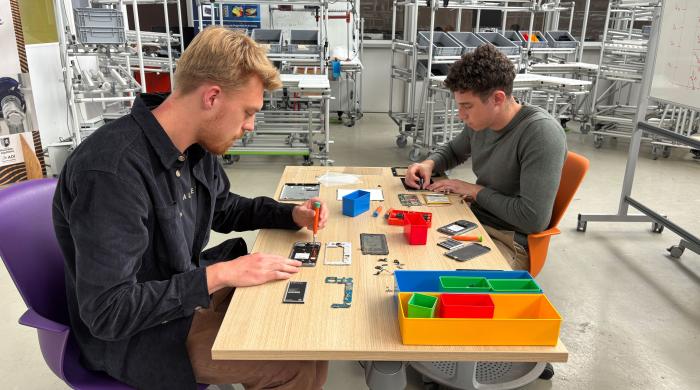
Their six-month-long capstone internship is split between France and Japan: one month of preparation at the L2EP in Lille, three months at Waseda University—during which the two students will also fulfill their international mobility requirement—and then two months back in France to further develop and showcase their findings.
The first phase, conducted at L2EP as well as atIRCICA, aimed to build expertise in shape-memory alloys and to design a functional prototype before departing for Japan.
“There were no specifications, no set requirements or applications,” explains Maxence. “We’re really taking an exploratory approach: seeing how far we can go, what works, what doesn’t… and building it up gradually.”
A complete immersion in the field and methods of academic research, while remaining consistent with the Arts et Métiers educational approach.
“The structure of the work is actually quite similar to our projects: state-of-the-art analysis, forward-looking thinking... The big difference is that here, it’s up to us to set our own goals,” he adds.
An immersive experience at a cutting-edge and highly prestigious Japanese laboratory
At Waseda, Maxence and Sayam had the opportunity to join Professor Sawada’s lab, which is at the forefront of research in soft robotics, where projects also cover virtual reality, augmented reality, and artificial intelligence.
The pace of work there is fast-paced and includes weekly meetings with French and Japanese supervisors, biweekly progress reports to the entire Japanese laboratory, as well as participation in thesis defenses and research seminars organized by the Waseda teams.
“Every two weeks, we present our progress to about thirty people. It’s a great learning experience, and the atmosphere is always supportive,” says Sayam.
“We benefit greatly from the feedback we receive from the lab’s researchers, which encourages us to push further and guide our progress…”
New skills… and a different way of thinking
From a technical standpoint, the students have developed advanced skills, particularly in CNC, signal modulation, image processing, and displacement measurement, as well as in CAD and prototyping, and in multi-material 3D printing.
But beyond the tools themselves, it was the research process that made the biggest impression on them.
“We can’t afford to keep making prototypes indefinitely,” explains Sayam. “So we have to do a lot of planning ahead of time, create models, document everything, and consult with experts before we get started.”
Maxence adds: “We’re guided toward certain methods, but we learn a lot on our own. It encourages us to step back and develop true intellectual independence.”
A rich human and cultural experience
Outside the lab, the Japanese experience is just as memorable. The two students are staying in a “share house,” about a 40-minute walk from campus.
“It’s very common here: everyone has their own room, and we share the kitchen and bathroom,” says Maxence. “We had to find a place on our own because Waseda University’s housing was full, but in the end, it’s a great solution.”
The warm welcome at the lab is universally praised: “We’ve managed to make friends, go out, and explore the local culture. The atmosphere is very supportive, even during our first presentations after dealing with jet lag, ” Sayam says with a smile.
A clearer outlook
By the end of this experience, the two students had refined their vision of the future.
“I see myself moving into the industry—maybe in R&D, but within a company,” Maxence says. “This experience has helped me understand what I’m looking for: clear goals, while still maintaining an innovative edge.”
Sayam, for his part, remains deeply interested in research, though he doesn’t necessarily see himself pursuing it long-term: “It’s helped me understand what the field of research is all about and the way of thinking that goes with it. Even if it’s not necessarily something I’ll do for my entire career, it’s been an incredibly formative experience.”
“It’s worth a try, if this interests you”
Both encourageArts et Métiers studentsArts et Métiers take advantage of these kinds of opportunities, provided they understand the specifics involved.
“The internship is quite different from what I’ve worked on during my studies,” Maxence admits. “But on a personal and intellectual level, it’s an incredible experience.”
Sayam simply concludes: “If you’re interested in the field and open to new cultural experiences, go for it. You’re bound to make some wonderful discoveries.”
Through the experiences of Maxence and Sayam, this internship fully demonstrates the strength of the international partnerships fostered by Arts et Métiers , in this case, the L2EP program at the Lille campus: collaborations that give rise to human, scientific, and professional experiences that profoundly shape future engineers.