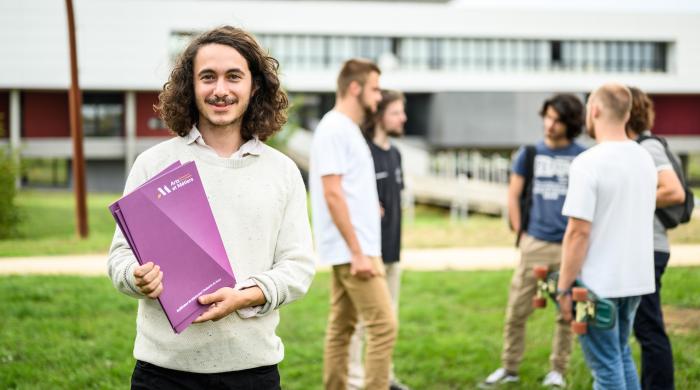
Lucas Vergez, a third-year student in the Grande École Program and Master of Science Cyber-Physical Systems Engineering (CPSE) at theArts et Métiers campusArts et Métiers Arts et Métiers , discusses his academic journey and career goals.

What was your background before enrolling in one of the 20 research master's programs offered by Arts et Métiers
I followed a fairly traditional path, studying PCSI/PSI* preparatory classes in Montpellier, which enabled me to enter Arts et Métiers competitive examination. I seized the opportunity offered by the campus to pursue a research-oriented specialization in my third year.
Why did you choose to pursue the CPSE Master of Science program?
It wasn’t until my second year of engineering school that I was able to choose this path for my further studies. I needed time to let my career plans take shape. I chose this Master of Science I really wanted to specialize in computer science and conduct applied research for the industry of the future. This program is introducing me to a wide range of methods and tools designed to address the challenges of Industry 4.0. I’m glad thatArts et Métiers a program like this. In my opinion, computer science is an underrepresented field at this school.
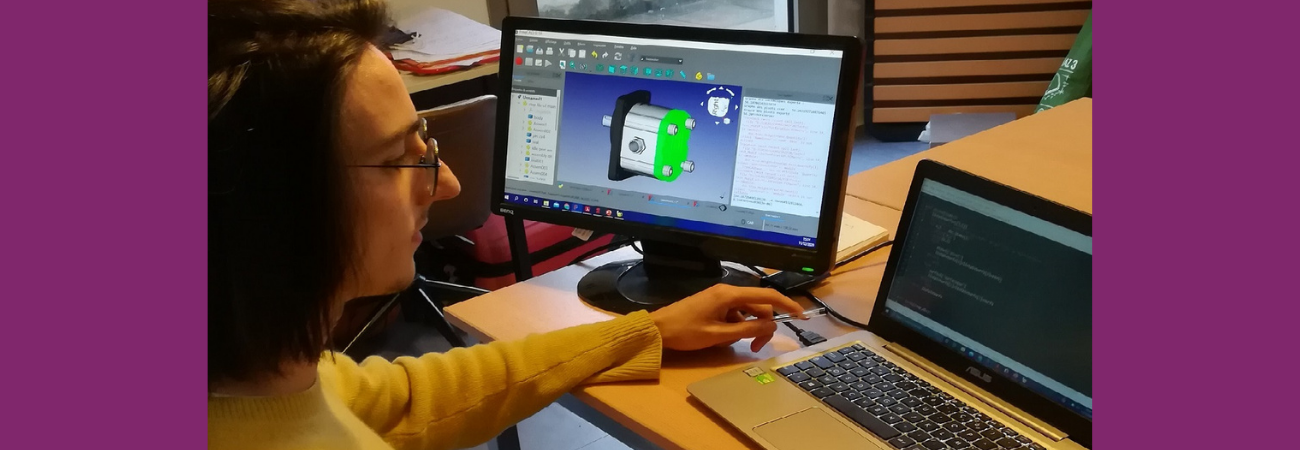
"This allows me to master the fundamentals of the scientific approach and develop my skills in the specific fields of Computer-Aided Design (CAD) and Artificial Intelligence (AI) research."
How does the training work?
The training program is structured around a variety of projects and supervised by a teaching team that is very attentive to my questions.
I have a lot of autonomy in choosing my study projects, which allows me to discover certain fields on my own, such as the Internet of Things (IoT) and reverse engineering. For example, I have been able to work on AI analysis tools in the medical field that enable the recognition of pathologies based on patient symptoms, and on image recognition tools that track hand movements at workstations.
I will also have the opportunity to spend the last six months of my training at the University of Sherbrooke in Canada in a laboratory specializing in robotics. My research will focus on improving operator safety in a factory. As you can see, these are rich and varied experiences.
This training course is still fairly general in nature and therefore provides an overview of Industry 4.0 as a whole, with an in-depth technical focus on your preferred field.
How do you envision your entry into working life?
I would like to eventually move into CAD or AI research projects, initially within a laboratory. With this in mind, I will be pursuing a PhD. Why not in Canada! Then, depending on the opportunities available to me, I plan to work in industry or in the field of animation (special effects and video games), regardless of whether the organization is private or public.
What is the highlight of this Master of Science program?
For those considering this path, this Master of Science interdisciplinary Master of Science —with a strong focus on computer science and CAD—is ideal for anyone interested in pursuing a career in IoT engineering, AI, and cyber-physical systems in general.
Any advice for future candidates?
It’s important to remember that this is a Master of Science degree: This means that the final six months are dedicated to a research project that makes a real contribution to the scientific community.