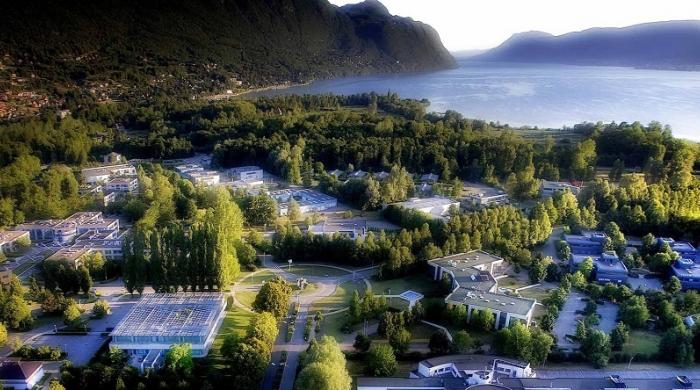

Seeking to anticipate the future needs of businesses and societal expectations in terms of sustainable development,Arts et Métiers its first institute in 1994, in Chambéry at the Savoie Technolac technology park. It is dedicated to taking environmental requirements into account in the design and manufacture of complex products.
The Chambéry institute's activities are potentially limitless in terms of areas of activity, since all products and companies can and must now be concerned with environmental issues. However, at the end of the 1990s, only a few large groups were interested in the environment. This allowed the institute to focus its efforts primarily on the transportation, automation, and leisure sectors.
His main area of expertise is eco-design, which aims to assess the environmental impact of products in order to minimize it as much as possible at every stage of their life cycle: manufacturing, use, and end of life.
At the same time, training programs were developed, and the Specialized Master's Degree (MS) in Eco-Design and Environmental Management was launched in 1995.
Since 1994, the institute has greatly diversified and expanded its R&D and training activities, as environmental concerns have become increasingly important.
Eco-design, recycling, environmental management, and now eco-innovation and the circular economy
The Institute has supported companies of all sizes and from various industrial sectors in implementing eco-design initiatives, including Trixell, Poma, and Naval Group (DCNS).
On the topic of recycling and end-of-life recovery, we can mention:
- The ODEFIRE-BDFI research project: decision-making tool for the deployment of recycling channels and database on recycling channels.
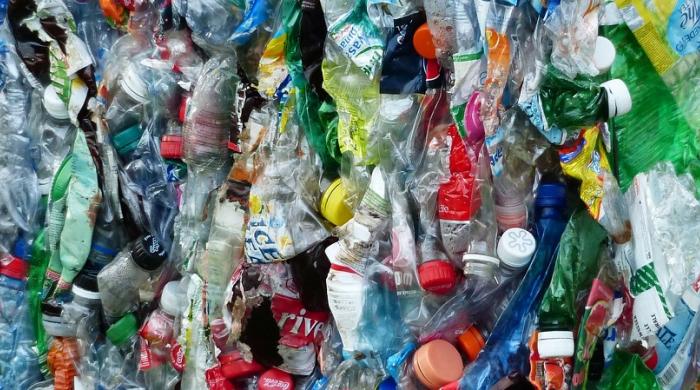
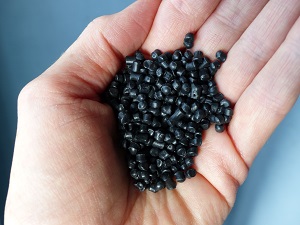
- The development of a process for sorting and recycling plastics from the shredding of end-of-life vehicles and waste electrical and electronic equipment (WEEE).
- As part of the Entrepreneur En Afrique program, support is provided for setting up African companies that recycle plastic and tire waste or produce biofuels.
- Most recently, the development of a prototype industrial unit for dismantling windows for recycling.
The institute assisted Savoie Technolac, the first certified ski resort (Les Menuires), and Naval Group (DCNS), the European leader in naval defense, with ISO 14001 certification (environmental management) for its engineering of armed vessels.
The Institute also conductedArts et Métiers regulatory greenhouse gas emissions assessmentArts et Métiers 2013.
More recently, the research team contributed to the creation of the Urban Mining Chair dedicated to the development of recycling channels for WEEE, which is rich in plastics and rare metals.
Around twenty theses have been defended in 20 years, largely in collaboration with the Arts et Métiers LCPI Paris and I2M Bordeaux laboratories.
As for the training courses, they are all closely linked to environmental issues...
- More than 300 graduates of the MS Eco-design and Environmental Management program since 1996, which became the MS "Change Management and Sustainable Innovation" program in 2017.
- Launch of theEnvironmental Engineering and Risk Management program in 2010
- Launch ofthe Eco-design of Goods and Services unit for Grande Ecole Engineering Programme students in Grande Ecole Engineering Programme in 2012
- Creation of the MOOC "Eco-design Tomorrow" in 2015
- Development of Eco'nectés, paid distance learning modules on eco-design, in 2017
- Hosting of the MS Sustainable Construction and Housing program in 2018
... as well as the events that have marked the life of the institute in recent years.
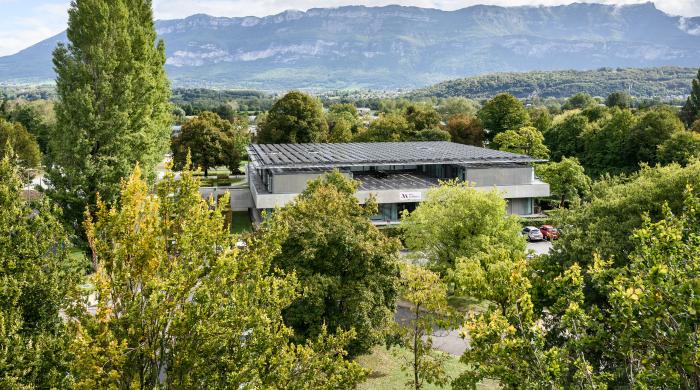
 In 2012, nearly 700 m² of solar panels were installed on the institute's roof, which more than compensates for its electricity needs.
The circular economy: an opportunity to shape the future. This was the theme of the event organized in 2016 to mark the institute's 20th anniversary.
Since 2017, staff and students have participated every year in the Auvergne-Rhône-Alpes Mobility Challenge which rewards the participating organization with the highest number of kilometers saved on commutes to work using alternative means of transportation to private cars.
In 2018, the Techno’Sommet event organized by the institute on innovations and professions for the mountains of tomorrow devoted a third of its workshops to sustainable mountains.
In the summer of 2019, the institute's terrace was covered with vegetable plants and flowers, and in the winter, the lobby was decorated with "100% recycled" Christmas trees as part of an inter-promotional and staff competition!