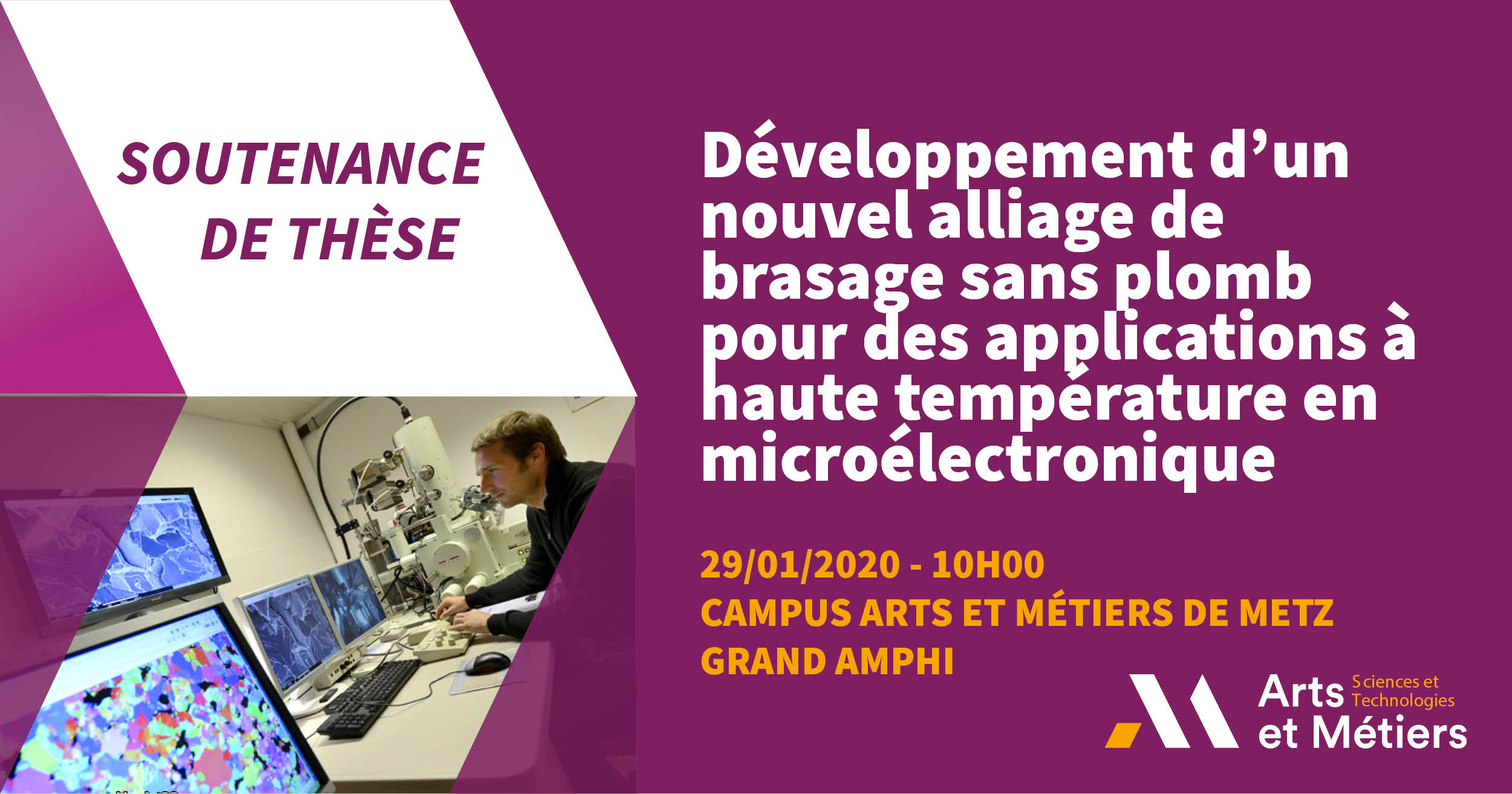
Marc Wary, a doctoral student at the Laboratory for the Study of Microstructures and Materials Mechanics ( LEM3) and a design engineer at the Arts et Métiers campus Arts et Métiers Metz, will defend his dissertation titled "Development of a New Lead-Free Solder Alloy for High-Temperature Applications in Microelectronics" on Wednesday, January 29, at 10 a.m.
Marc Wary’s thesis research focuses on developing a new lead-free alloy for soldering electronic components used in high-stress environments (automotive, rail, drilling, aerospace, etc.). His work has identified a promising alternative—for which a patent has been filed—that can reliably replace lead.
His thesis was conducted in collaboration with Inventec Performance Chemicals, a company specializing in the manufacture of brazing pastes.
Summary
"Originally found in most electronic devices, particularly in solder joints, lead and its derivatives are now considered a direct threat to human health and the environment."
The European RoHS 2 Directive sets the maximum concentration level at 0.1%. However, there are few alternatives to the Pb92.5Sn5Ag2.5 alloy for high-temperature soldering applications in the field of microelectronics.
The objective of this thesis was therefore to develop a reliable lead-free substitute alloy for the reflow soldering process.
To this end, several chemical compositions for potential alloys were identified, based on the state of the art and thermodynamic simulations performed using Thermo-Calc. These alloys were then produced and fully characterized in terms of microstructure, as well as their physicochemical, electrical, and mechanical properties.
One alloy was ultimately selected for its properties. However, its low thermal conductivity forced us to find a way to improve it by adding highly conductive reinforcements, resulting in a composite alloy with high thermal conductivity (λ = 61 W·m⁻¹·K⁻¹), although certain properties related to in-service performance and aging still need to be evaluated on actual assemblies.
Composition of the jury
- Ms. Shabnam ARBAB CHIRANI, Professor, LBMS, ENIB - Rapporteur
- Mr. Denis NAJJAR, Professor, Ecole Centrale de Lille - Rapporteur
- Mr. Thomas PARDOEN, Professor, Catholic University of Louvain - Examiner
- Mr. Etienne PATOOR, Professor, Research Unit, Georgia Tech Lorraine - Examiner
- Mr. Karim INAL, Professor, CEMEF, École des Mines de Saint-Étienne - Examiner
- Mr. Raphaël PESCI, Associate Professor, LEM3, Arts et Métiers Metz Arts et Métiers - Examiner
- Ms. Anne-Marie LAUGT, Director of Technology, Inventec Performance Chemicals - Guest
Practical information
- Wednesday, January 29, 2020, at 10:00 a.m.
- Arts et Métiers Campus Arts et Métiers Metz,
- Large Lecture Hall
- Public defense