Paul Stief is a doctoral student at the Design, Manufacturing, and Control Laboratory (LCFC) on the Arts et Métiers campus Arts et Métiers Metz. He defended his thesis one month after the end of lockdown. Here's a look back at an unusual end to his thesis and defense.
Where were you in your thesis when the lockdown was announced?
I had been writing since December. Ninety-five percent of the scientific aspects were complete, and I had no more experiments to conduct on site. The part that remained to be finished concerned a method for comparing assembly plans. Fortunately, all the product models were already on my computer, which allowed me to continue working from home.
The end of a thesis is often marked by numerous exchanges with the supervisory team. How did you manage this stage?
The lockdown did not completely disrupt our operations because we were used to communicating with the supervisory team via video conferencing: my thesis supervisor had been in Denmark since September.
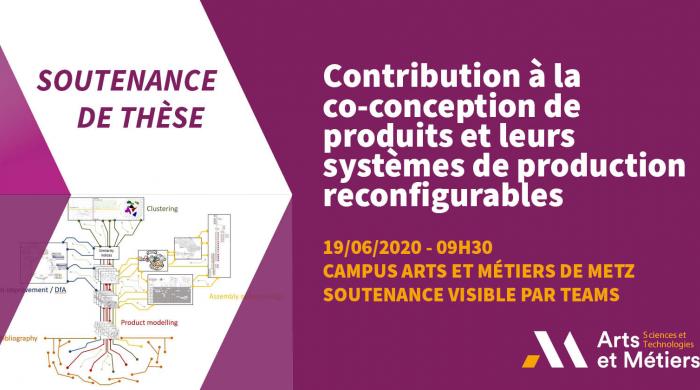
With the lockdown, we switched entirely to Teams. It is a more flexible solution that allowed us to invite industrial partners involved in the thesis. For example, a meeting that had been scheduled some time ago as a face-to-face meeting was intended to provide feedback to industry on the work carried out. We organized this "meeting" on Teams.
Finally, my contract was supposed to end in May. It ended in June to allow me to finish my research work without any stress.
What difficulties did you encounter at the end of your thesis?
At the beginning, the biggest difficulty was the uncertainty of contacting manufacturers to complete the project. In the end, the challenge was more about organizing the defense itself, with frequent changes in health measures.
I also encountered difficulties with administrative issues that had to be dealt with remotely: printing the report, validating the submission, signatures, requests for English translations, etc.
What benefits did you gain from it?
Working remotely, I was more relaxed than I would have been at the office. Writing my thesis was more efficient. In addition, I had the equipment and access I needed to work effectively remotely: a laptop, access to digital tools (remote library, document resources, Microsoft Teams, and Office online).
I didn't feel isolated, as we kept up with remote meetings with the management team and there was the option of participating in virtual coffee breaks with the lab team.
I also enjoyed taking professional training courses offered by the school's training program on various online platforms: research ethics, project management, from manager to leader, digital skills, etc.
How did you prepare for your thesis defense?
I prepared for the defense in close collaboration with my supervisory team, who were always very supportive. We initially planned for only three people to be present at the defense, due to health restrictions.
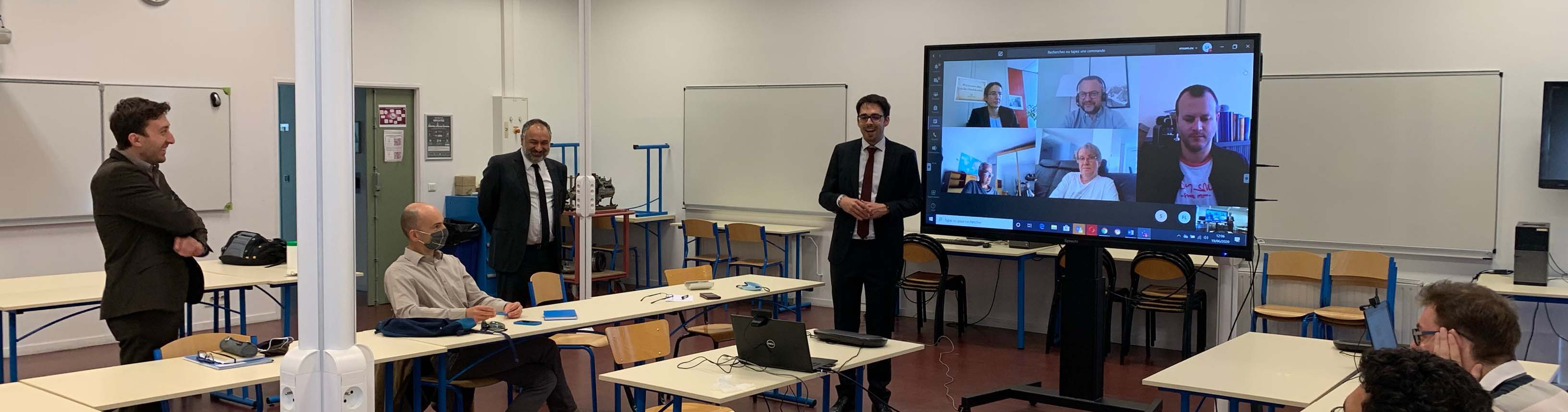
With the easing of these measures, we were given permission to invite ten people to attend in person, including part of the jury, my wife, and a few colleagues from the industrial chair. Using Teams allowed the other members of the jury to connect remotely and invite members of the public.
For the presentation itself, I did four rehearsals on Teams, which went well, as well as a technical rehearsal in person on campus. This allowed us to set up the room and test the IT environment.
In addition to presentations at international conferences, I had good training for the defense.
How did your thesis defense go?
I'm not usually very stressed about public speaking. But in this case, I was still apprehensive on the day itself, especially about the question and answer session. Fortunately, the positive feedback on my thesis report gave me confidence.
The defense went well, especially from a technical standpoint, where the challenge was to manage the various microphones and speakers in the room during the question and answer session.
During the jury's deliberations, I greatly appreciated the very positive comments about my thesis work.
After the defense, we were able to enjoy a friendly get-together off campus while respecting social distancing measures. A virtual drinks party with colleagues from the laboratory was organized on Teams.
About Paul Stief's thesis
Her thesis work focused on developing a methodology for designing a reconfigurable assembly production system. The objective was to take into account the relevant elements for designing a production line that can be easily and quickly adapted in the event of a change in production, whether for new products and/or new volumes.
He has already received a job offer to continue his work.