Arts et Métiers the Naval Academy, which trains naval engineering officers under the supervision of the Ministry of the Armed Forces, have renewed their strategic partnership, initiated in 1999, through a framework agreement signed in January 2025. They will convene the research council of the Institut de Recherche et d'Études Navales (IRENAV), which they jointly oversee, on November 5, 2025.
In an increasingly complex geopolitical context, where sovereignty issues are crucial, this partnership now takes on its full meaning by bringing military research and training closer to the defense industry.
A renewed historic collaboration, driving the evolution of IRENAV
In 2000, Arts et Métiers the Naval Academy created a research institute, which they have jointly supervised ever since.
In 2025, this institute evolved to become the Naval Research and Studies Institute (IRENAV). Certified as a Carnot Institute under the CARNOT ARTS program, its field of study now covers maritime and naval situations, from the deep sea to space, in both civil and military applications.
IRENAV's new identity enables it to better fulfill its two missions:
- Participate in the scientific training of naval officer cadets.
- Contribute, through its multidisciplinary approach, to providing scientific and technological insight into the capability requirements of the French Navy.
IRENAV's work focuses on four areas of research:
- analysis and modeling of maritime data;
- data acquisition and understanding of physical phenomena;
- the design and optimization of naval vessels and systems;
- Command cultures: human and technical factors.
As part of this partnership,Arts et Métiers faculty membersArts et Métiers seconded to the Institute, located at the Naval Academy's Lanvéoc site (Finistère).
This collaboration opens up new training and career opportunities in the marine industry. It is based on structural research and training projects, to which Arts et Métiers its technological and scientific expertise, particularly in the fields of transport, the underwater environment, and decision support in complex systems.
An academic partnership that continues to evolve
In the field of education, since 2014, both schools have offered a dual degree program allowingArts et Métiers studentsArts et Métiers their third year of the Grande École Program to join the French Navy as commissioned officers. In ten years, 20 students have already completed this program.
Since 2023, a new pathway has also been available for students pursuing a civilian career to obtain this dual degree.
Arts et Métiers the Naval Academy also offer a Master of Science with a specialization in “Fluids and Energy Systems” at the Lanvéoc campus. This program is designed to provide hands-on experience in the naval, maritime, and nautical sectors, in collaboration with IRENAV and units of the French Navy, and in partnership with research centers such as IFREMER and industry leaders like Naval Group and Thales.
This Master of Science program, Master of Science trains experts in naval engineering, has been listed in the fourth-year catalog of Polytechnique since last year.
Laurent Champaney, CEOArts et Métiers Arts et Métiers this partnership, which strengthens the consistency ofArts et Métiers actionsArts et Métiers the field of military and civil naval industry and opens up new areas of collaboration in critical decision-making tools, developed in particular with CNRS@Create for the city of Singapore, and which is of great interest to the French Navy. "
Rear Admiral Benoît Hédé-Haüy, Commandant and Director of the Naval Academy: " The Naval Academy welcomes the renewal of this partnership. Having taken up my post this summer after holding various positions within the Navy's general staff, I fully appreciate the value of such collaboration, not only for the training of our future officers, but also for the French Navy in general and the manufacturers within the naval defense industrial and technological base (BITD-navale). In a complex and highly uncertain geopolitical context, having enhanced research and training capabilities is a major asset for all of us."
About the Naval Academy
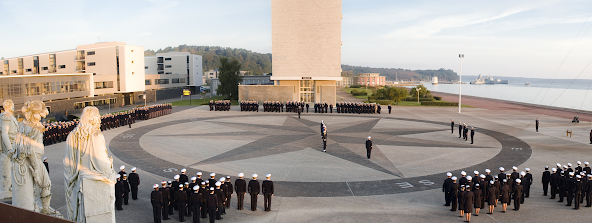
For nearly 200 years, the Naval Academy has been training the officers and sailors needed by the French Navy, while contributing to naval research and innovation.
Naval officers are trained to perform management and command functions within operational units: combat ships, submarines, naval aviation fleets, and marine commandos. Upon joining the forces, they will be responsible for implementing some of the most complex systems ever designed by man. This is why the Naval Academy awards an engineering degree and remains firmly focused on research and the future.
The Naval Academy also trains future technicians and experts in maritime professions: navigators, deckhands, and signalmen. Together, officers, petty officers, quartermasters, and sailors form the crews of tomorrow.
The Naval Academy has a research and innovation department composed of:
- a naval research and studies institute (IRENav);
- three industrial chairs ("Cybersecurity," "Resilience & Leadership," "Navalization of Artificial Intelligence for Decision Support Dealing with Human-Artificial Intelligence System Cooperation");
- and an innovation unit aimed at promoting the development of opportunistic innovations for the benefit of the armed forces.