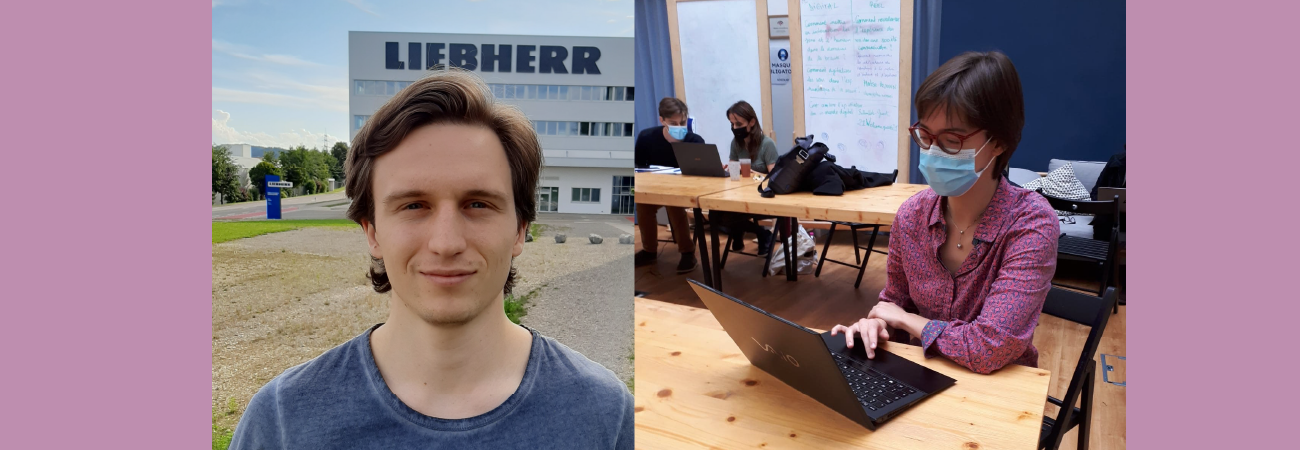
After spending a year atthe Karlsruhe Institute of Technology (KIT), students enrolled in the Franco-German dual degree program complete a six-month research-oriented internship, known as MasterArbeit. This is an opportunity for them to gain their first long-term work experience in a company, but in Germany! Octavie Bouy and Guillaume Verrier look back on their internship, which ended this summer.
Where did you complete your Master's thesis?
Octavie Bouy: I was in Karlsruhe, working for a start-up that develops and produces modular and reconfigurable robotic systems to offer its customers solutions for automating manual processes.
Guillaume Verrier: I worked in the aerospace equipment subsidiary of a large group based in a small town in Bavaria on the border between Germany, Switzerland, and Austria.
What was your project about?
Octavie: I worked on automating a manual assembly process, with the goal of creating a hybrid process involving a human operator and a robot designed by the start-up. My study focused on the effects of automating the process, both in terms of process productivity and the physical and mental well-being of the operator.
Guillaume: For my part, I led a project analyzing geometric defects in steel gears caused by heat treatment for hardening through quenching. The goal was to characterize these defects using a computer program that analyzes the metrology data of the parts in order to ultimately compare the defects of several parts treated with different parameters.
What did you get out of it?
Octavie: This Master's thesis was a very enriching experience for me. Beyond the technical aspects and topics of my project, which I really enjoyed, I worked in a very interesting context, at the crossroads between the world of research and that of a start-up.
This long-term project in Germany required a great deal of adaptation and determination on my part: paying attention to working habits, integrating into an entirely German team, understanding the expectations of KIT and my supervisors, etc.
I have developed the ability to adapt to habits, cultures, and ways of working that are different from what I am used to. This is especially true since I had to finish my internship working remotely.
Guillaume: Although I also spent several months working remotely, this internship allowed me to put into practice, combine, and deepen the knowledge I had acquired during my training: heat treatment of steels and deformations (materials), metrology, and IT in an independent research project.
In addition, I worked for six months in a 100% German environment, which really helped me improve my language skills!
It was very informative to be part of a large German company and to discover the organization and working methods specific to this environment.
What are you doing now?
Octavie: I’ve decided to continue my studies by pursuing a Master of Science in Innovation and Design in the Paris area. This program will allow me to add an artistic dimension to my background as a general engineer. With this Master of Science, I also hope to delve deeper into issues of ergonomics and work organization in an industrial context—topics I explored during my Master’s thesis.
As for the future, I'm not ruling out the idea of working in Germany after I finish my studies, or in a few years' time, to maintain this dual culture that I find really interesting!
Guillaume: The health situation delayed the end of my studies, and I only defended my Master's thesis last month. I am currently still waiting for the results of my final exam. After working intensively on this project for several months, I want to take a step back and get back into sports while starting my job search. I intend to look for work in the Paris area, possibly in companies with operations in Germany.
See Octavie Bouy and Guillaume Verrier in the promotional video for the Franco-German dual degree program, filmed in December 2018 at KIT.