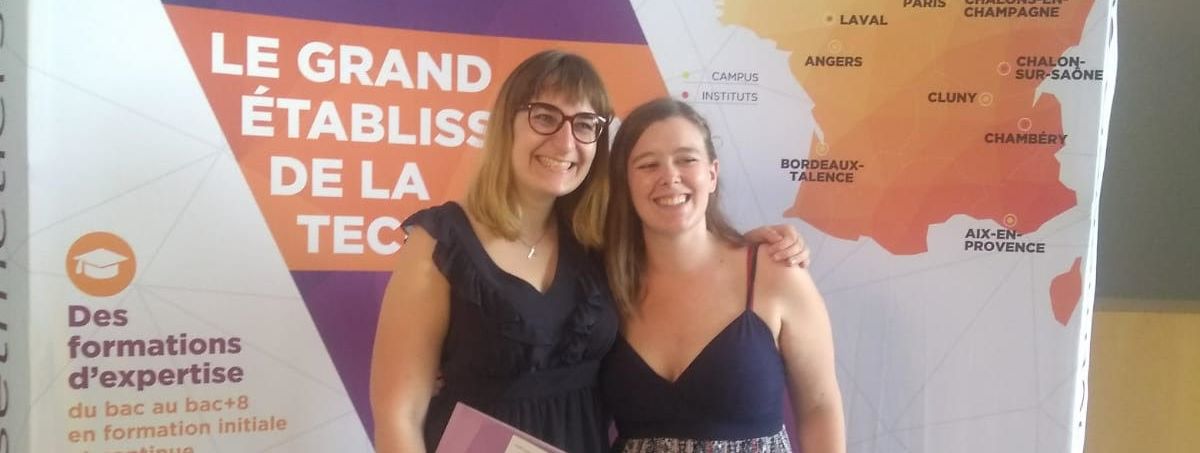
Standing out in the job market with a dual French-German degree. That was the challenge taken up by Cybèle Serin and Amandine Léonard when they enrolled Arts et Métiers 2013. Now working professionals, they look back on their choice of career path and the advantages of this dual degree for their professional lives.
Why did you choose a double degree over an Erasmus semester?
Cybèle: An Erasmus semester does not lead to a degree! It is not valued in the same way. It proves our cultural openness and our language skills, but we cannot sell our adaptability, for example.
Amandine: An Erasmus exchange is good, but a double degree is even better!
If you want to work in Germany as well, you have a degree that companies can compare directly with those of other candidates.
Without realizing it, an Erasmus semester becomes something rather commonplace. What's more, a double degree inspires seriousness and cultural integration.
What did you gain from studying in Germany?
Cybèle: Getting by, adapting, having access to lots of courses and being able to choose the ones that interest us! For example, I took courses on ergonomics, digital manufacturing, and sustainable design. We also had access to all the university's language courses: I was able to start learning Turkish and improve my English while working on a business creation project in a multicultural team made up of Germans, Spaniards, Asians, and a Frenchwoman!
Amandine: Personally, I have gained independence and confidence.
How was this dual degree experience beneficial for your career?
Cybèle: Mastering German is a real plus that sets us apart.
German-French engineers are rare and highly sought after in the job market, particularly in the aerospace industry.
Amandine: Being abroad gives you a huge sense of independence. When you have a problem that seems simple (administrative, medical appointment, etc.), the language barrier is significant.
At German universities, you also have to discipline yourself. It's completely different from the preparatory and engineering school system we know in France. It was a real cultural eye-opener, discovering other ways of working, studying, and even living.
This experience allowed me to mature and show my adaptability to different situations and cultures. These are skills that companies are looking for!
Do you currently work in connection with Germany?
Cybèle: Right after graduating, I worked as a consultant at Airbus for a year and a half. I traveled back and forth between Paris and Hamburg every week because I wanted to speak German on a daily basis while living in France. Germans are in need of engineers: speaking German will always be an asset and a guarantee of employment. Today, I am turning my attention to new horizons, but I know that Germany will always be an opportunity!
Amandine: After completing my studies, I did a one-year VIE internship in Germany near Cologne. I worked exclusively in German, with one of my tasks being to streamline communication between the French and German subsidiaries. After that, I took the plunge and applied "like a German" to a German company, where I have been working for two months on a permanent contract in Koblenz in an international environment.
Cybèle and Amandine on their way to the Aïcha des Gazelles rally