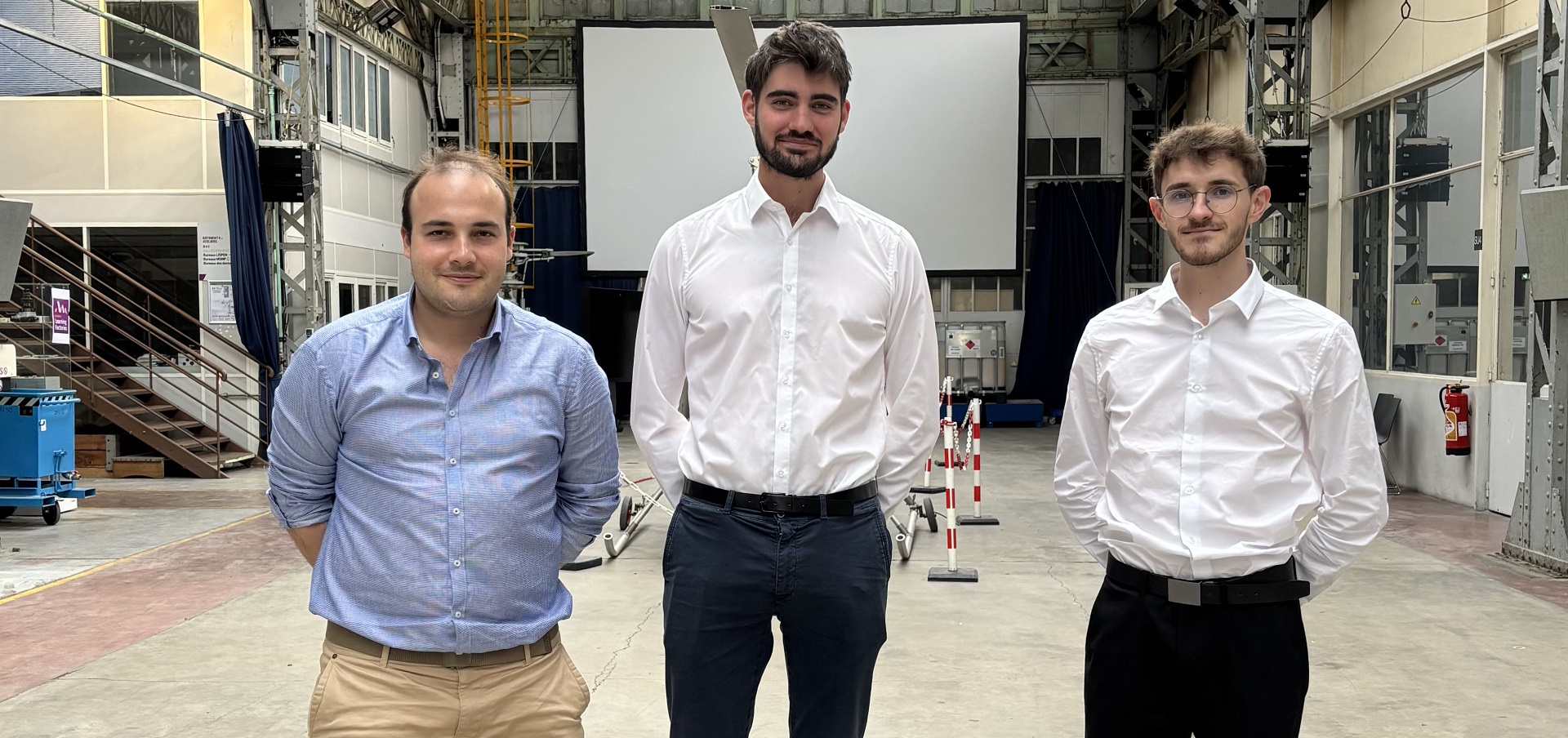
Marc Michelin, Antoine Polge, and Nathan Peurière, second-year apprentices in the Mechanical Engineering Program at the Aix-en-Provence campus, are all passionate about aeronautics and space and are participating in the C'Space 2026 challenge.
This event is organized by CNES in partnership with Planète Sciences.
The goal is to design, build, and launch experimental rockets based on strict specifications and under the supervision of CNES, thereby ensuring safety and technical feasibility.
This is a unique opportunity for these future experts to test their innovations in real-world conditions, as this is not their first attempt.
" Between 2022 and 2023, we took part in our first experimental rocket project: the Helios project, carried out as part of a professional bachelor's degree technology project. It was a real success that took us far beyond the academic sphere and earned us the CNES's 2023 Space & Industry Award," explains Marc.
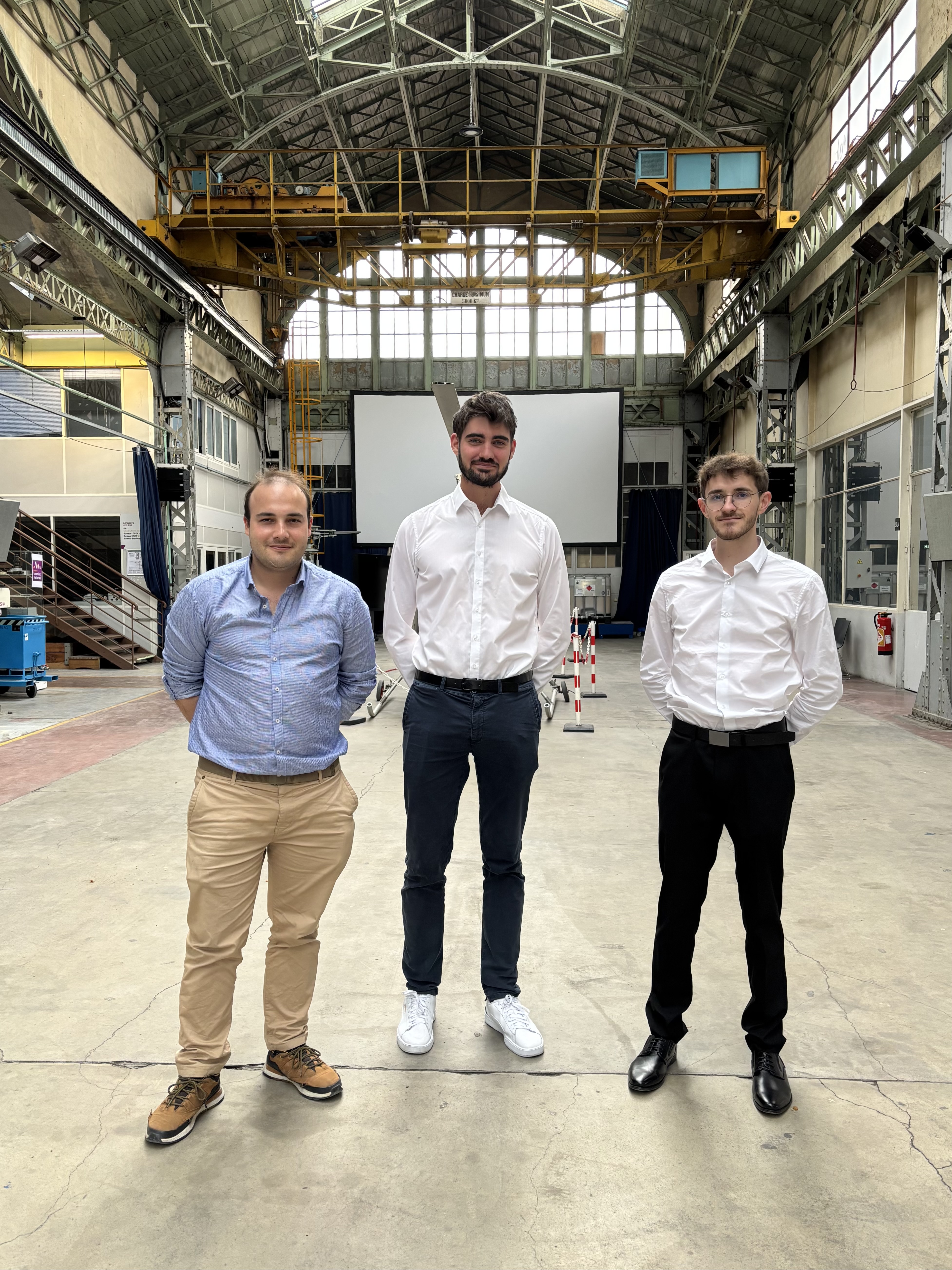
Marc Michelin, Nathan Peurière, and Antoine Polge on the Arts et Métiers campus Arts et Métiers
The Hyperion Project: A Major Challenge
The three engineering students aim to make a lasting impression with their Hypérion project , an active two-stage experimental rocket.
Hypérion promises a major technological breakthrough by incorporating a separation system that releases the upper stage in mid-flight so that it can continue its ascent using a second thruster after the lower module has been jettisoned and descends by parachute.
From a technical standpoint, the Hyperion project incorporates several innovations:
- A separation system that locks and restrains the upper stage in order to comply with a maximum arrow criterion imposed by CNES specifications.
- An inertial measurement unit system tocontrol the separation of the upper stage and the reignition of the second thruster based on the rocket's flight attitude (separation + ignition only possible if a condition of angle of incidence and direction is met, also specified in the specifications).
- A telemetry system from the rocket to the ground, enabling the position and parameters measured by the rocket's sensors to be received during flight.
-The use of numerous 3D-printed components (e.g., outer skin, electronic modules, etc.), mounted on an internal metal structure, in order to characterize different printable materials (notably Onyx (carbon fiber reinforced nylon) and PETG) and test them in a specific environment (temperature, acceleration, mechanical stresses). These measurements will be taken using deformation sensors to obtain the elastic deformations during flight, then by superimposing 3D scans taken before and after flight to measure the plastic deformations.
They are also considering implementing additional onboard experiments in the upper stage.
The aim would be to adopt an entrepreneurial and responsible approach in order to test various innovative concepts via onboard experiments requiring a specific environment (i.e., significant variations in acceleration, temperature, and pressure for approximately three minutes between takeoff and recovery of the two stages).
Possible ideas include:
- A study of different means of reuse in the space industry, through the implementation of a servo-controlled parachute guidance system for the upper stage, in order to reach a predefined GPS plot. However, this concept could be tested separately on a mini-rocket (very short flight), for possible implementation at a later date.
- The implementation of pressure sensors in the upper stage to measure atmospheric pressure variations during flight and compare this data with the current model defined by the ISA (International Standard Atmosphere).
This model defines an average decrease of 1 hPa / 28 ft in the troposphere. However, this model is a linear approximation and also depends on weather conditions (high or low pressure systems), which requires altimeter calibration before each flight based on a QNH (pressure altitude of the departure airport or a standard level of 1013.25 hPa). It would therefore be useful to estimate the values that should be measured before the flight, based on the ISA model and the weather conditions on the day of the flight, and to compare these values with the measurements taken during the flight, in order to refine the model.
- The implementation of one or more sensors to assess air quality as a function of altitude by measuring various components (e.g., CO2, O2, fine particles, radioactivity, humidity, etc.).
Essential academic and industrial support
The involvement of the campus and industrial partners is crucial to the success of the project. Students benefit from organizational and technical support from both schools, with access to state-of-the-art equipment:
- An organizational framework, with the opportunity to continue their research work as part of the "Sustainable Innovation & Entrepreneurship" project carried out in the third year of training.
- Technical support with the help of teacher-researchers for the development and optimization of the various embedded systems.
- Access to equipmentsuch as machine tools, 3D printers, and 3D scanners to manufacture sub-assemblies.
- Increased visibility thanks to the Arts et Métiers network, facilitating their efforts to find sponsors.
- Financial support and access to professional software licenses such as 3DX, MATLAB Simulink, and Abaqus, which are essential for the project's design.
In addition, the association is forming partnerships with other student clubs and actively seeking sponsors to finance its project and obtain state-of-the-art equipment.
" We have several partnerships with associations, notably CLES-FACIL and INSAAP, which are respectively the astronautics club and the association of the GMPPA department at INSA Lyon," Marc points out.
A large-scale project requiring rigor and coordination
In order to maintain group momentum, they created NeoAstra, an association that brings together students fromArts et Métiers, INSA, and professionals working in the sector. It is dedicated to developing and promoting even more ambitious projects.
NeoAstra stands out for the diversity of its members, who come from backgrounds in mechanical engineering (for the team fromArts et Métiers), plastics/polymers, electronics, and computer science (for the teams from INSA). As for the members already in the workforce, one works in Istres in the field of Rafale maintenance, and another is in Methods and Industrialization at AAA.
However, this diversity also poses an organizational challenge, as the teams are spread between Lyon and Aix-en-Provence. To ensure effective collaboration, weekly meetings and technical workshops are held to guarantee the smooth progress of the project.
Another difficulty, but one that is more operational in the context of C'SPACE, is the challenge of passing all the necessary checks during the five days of the event. First, they will have to validate the flight in passive two-stage mode to test the separation system, then repeat the checks with the same rocket and fly again in active two-stage mode, this time with both thrusters armed and the second thruster ignited in flight.
An ambition that goes beyond the competition
After C'Space 2026, NeoAstra is aiming to participate in the prestigious Espace & Industrie award in December 2027, where projects are evaluated by aerospace industry leaders such as Ariane Group and MBDA.
The team hopes to repeat its success of 2023 and continue to take the association forward to new technological challenges.
In the longer term, NeoAstra has an ambitious dream: to organize a Tour de France Aérien (Air Tour of France) in single-engine aircraft.
The objectives are to meet young people in high schools, technical colleges, and preparatory classes for the grandes écoles, to promote the various training courses in aeronautics, the BIA (Brevet d'Initiation Aéronautique) for the youngest, the possible career opportunities, to present the sector and possible career choices (civilian and military), in the hope of inspiring vocations.
After graduating, all three want to continue working in the aerospace industry. This is a desire shared by all members of NeoAstra.
Three words to sum up this experience and inspire other students?
Passion - Innovation - Collaboration.
- If you dream of following them, check out their page Instagram and LinkedIn page!
- C’Space 2026 challenge retroplanning
June 2025: Completion of mechanical and electronic design.
November 2025: Testing of prototype separation and parachute release systems.
June 2026: Completion of Fusex assembly.
July 2026: Launch of the two-stage rocket and preparation of a second Fusex, assembled and ready for launch.
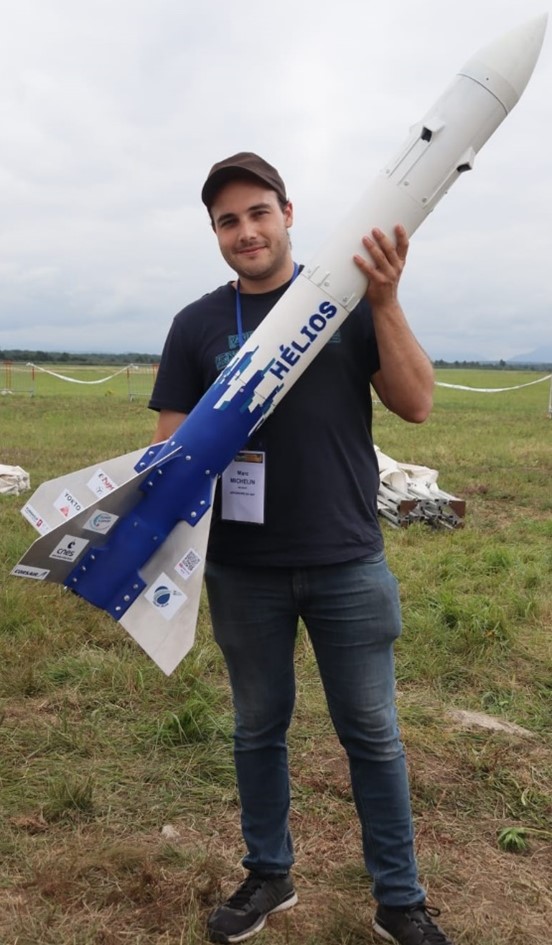
Marc Michelin with the experimental Helios rocket at C'SPACE 2023
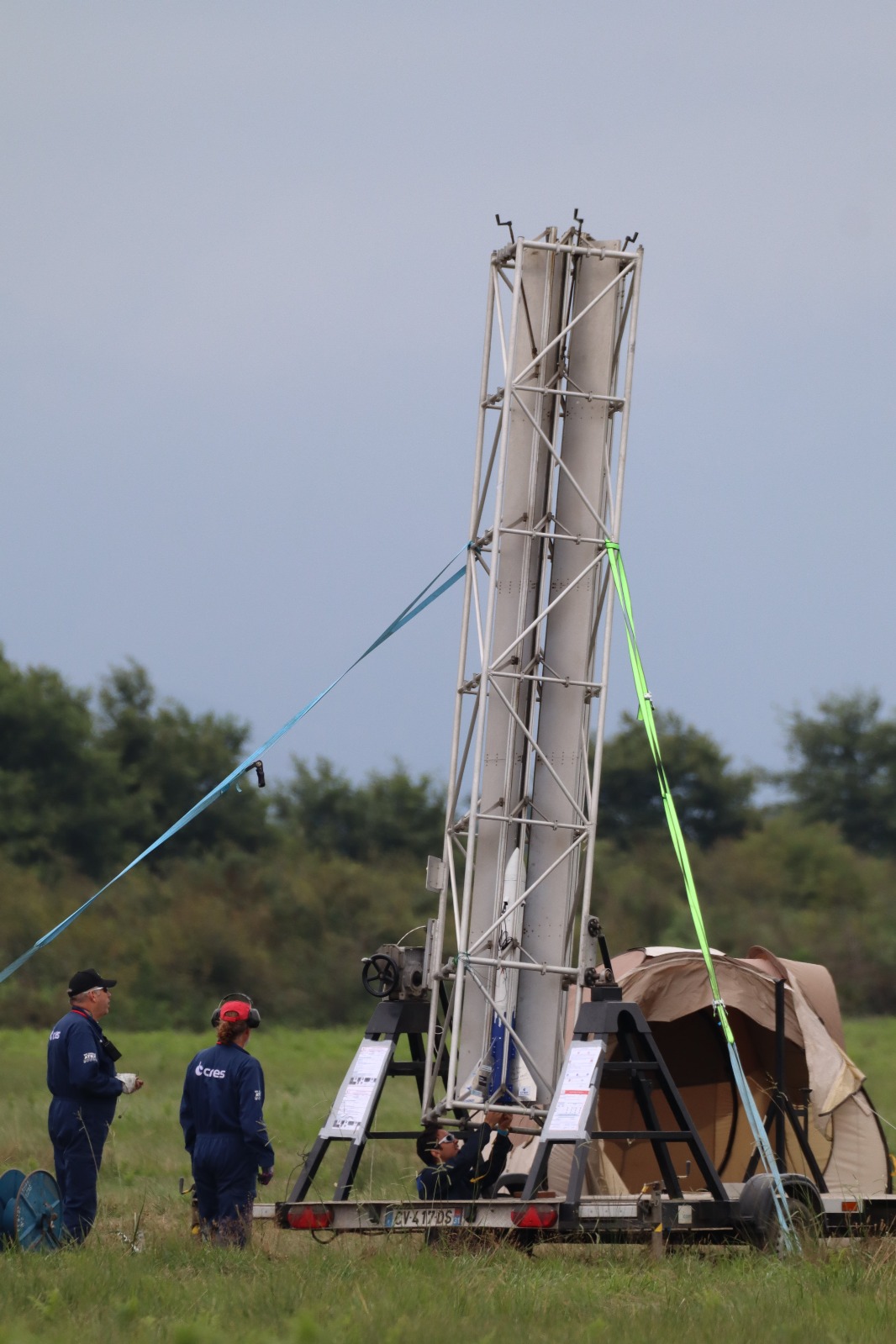
CNES pyrotechnicians arming the Helios thruster just before takeoff
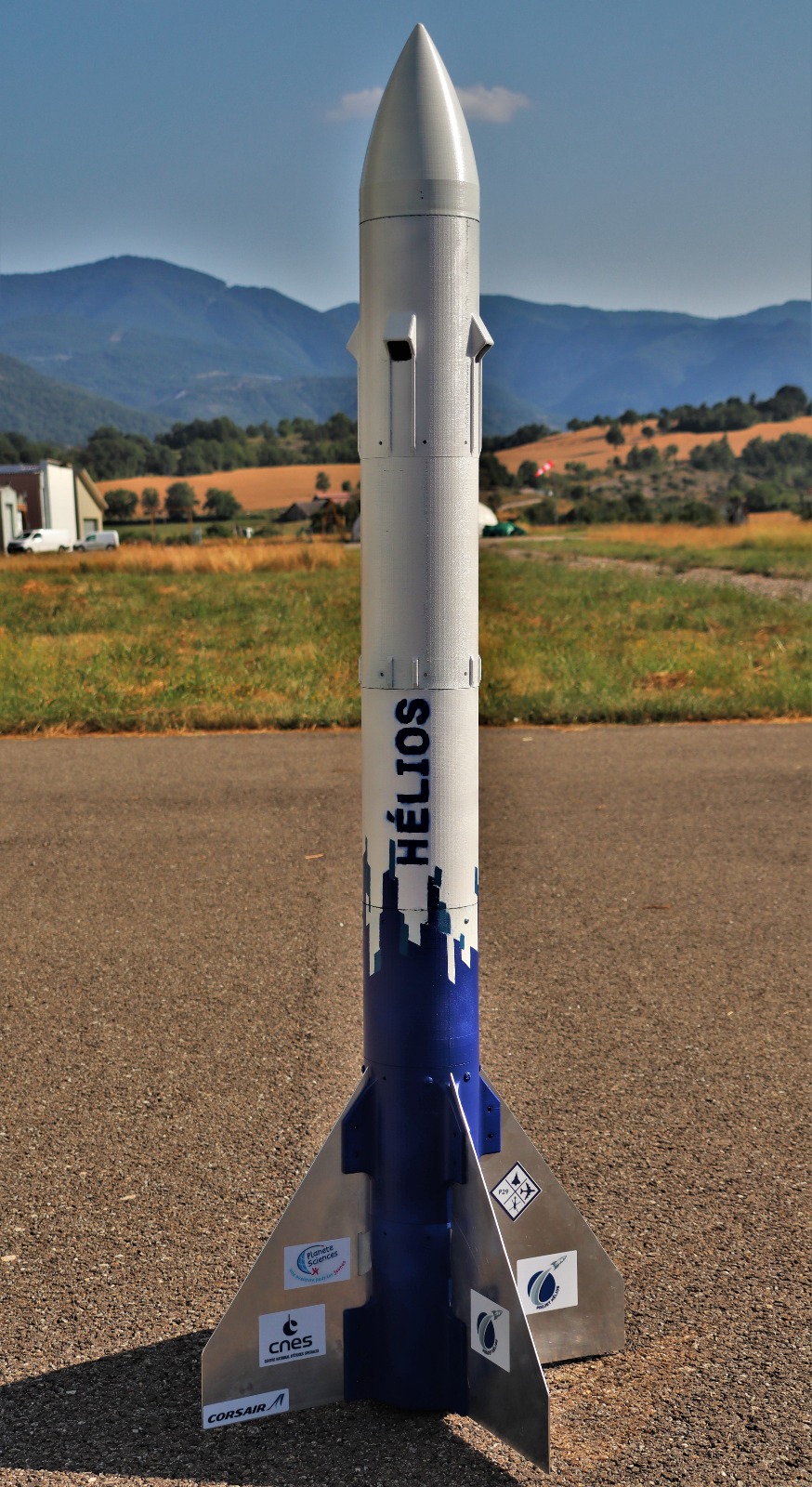
Helios specs: length: 1,472 mm, diameter: 128 mm, empty weight: 6.35 kg, Vmax: 210 m/s (756 km/h), acceleration: 119 m/s² at ramp exit (12.13 G)