Alexandre Isaac is a first-year engineering student in the PGE (Grande Ecole Engineering Programme). With a strong interest in entrepreneurship, he founded his company, "The Repair Academy," in September 2019.
Can you introduce yourself?
My name is Alexandre Isaac. I am a first-year engineering student at the Arts et Métiers campus Arts et Métiers Bordeaux-Talence. I am also the founder of The Repair Academy, a company that offers repair solutions for small electronic devices (e.g., smartphones) to combat electronic waste and planned obsolescence.
Why did you create The Repair Academy?
When I was 15, I started repairing electronic devices. At first, it was for my friends and family, but I ended up repairing hundreds of devices all over France!
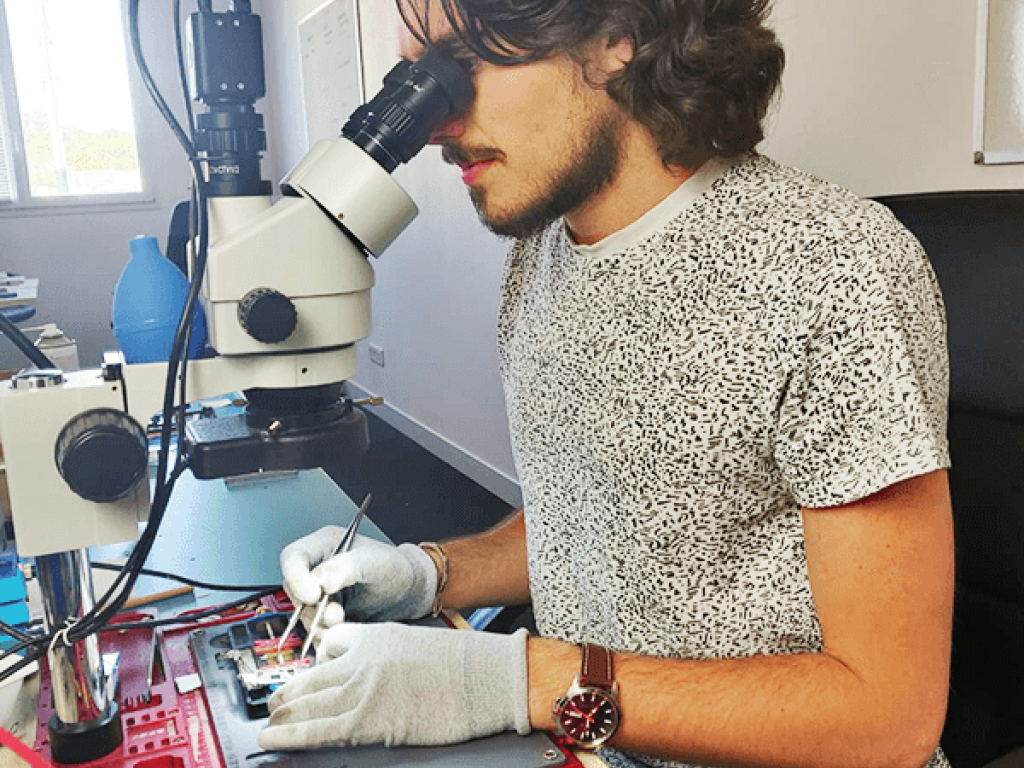
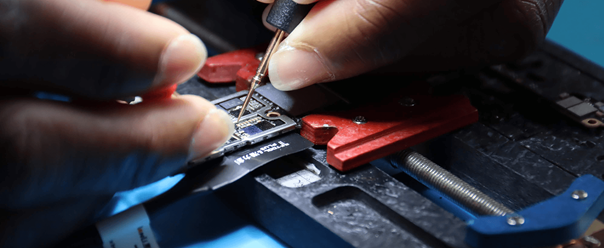
During these so-called "standard" repairs (e.g., replacing a screen or battery), I realized that some devices were beyond repair. Even after replacing all the parts, nothing worked... So I started to examine the circuit boards of these devices (smartphones) under a magnifying glass. I got out my soldering iron and started tinkering, and I found the source of the problem: the capacitor. So, rather than buying a new smartphone (and losing all the data), I was able to offer to repair the capacitor, which was quick and much cheaper than buying a new one. Since then, I've been trying to roll out this approach across France.
So, I founded The Repair Academy in September 2019. Its goal is to train independent repairers throughout France to work on smartphone circuit boards. I chose to train repairers rather than try to repair everything myself so that more smartphones could be repaired. Manufacturers have invented the disposable phone with planned obsolescence, a real scourge for the planet: 20 million smartphones are sold in France every year, then thrown away after too short a period of use, when a simple repair would extend their life. All these problems are caused by undersized components on the board. Our statistics show that the "peak" in smartphone motherboard repairs occurs exactly three years after the device's release.
Barriers to repair are also put in place: proprietary screws, unique and serialized proprietary chips, updates that destroy certain functions, etc. There are countless examples of barriers put in place by manufacturers, but we work every day to develop affordable solutions that can be implemented by someone who does not necessarily have a degree in electronic engineering.
How is your project progressing?
The Repair Academy is gradually expanding to several cities in France. Students are already coming from all over the world. We want to teach all experienced and aspiring repairers how to fix all kinds of faults and reduce planned obsolescence to zero. We also want to develop tools to automate these delicate repairs as much as possible and make this sector more attractive. Finally, we want to apply our knowledge to all existing electronic devices. MacBooks, smartphones, washing machines, printers, car calculators... Components are everywhere today!
We have also recently started buying batches of broken or depreciated electronic devices from individuals and professionals. Yes, even devices that have been dropped in water may be of interest to us! And of course, we offer customers worldwide the opportunity to have their devices repaired by us.
Why did you enroll at Arts et Métiers
Attending engineering school had been a dream of mine since middle school. After completing a 5/2 program in Montauban, near Toulouse, I finally enrolled at Arts. Why this school? I wanted to be "in the field" and get my hands dirty. That's how I learned to do everything I do today.
Why Arts et Métiers I wanted to be "in the field" and get my hands dirty. That's how I learned to do everything I do today.
Thanks to the courses at this school, I am learning how the industrial world works and how I can create methods to solve all the problems that mass production creates. I also see that it is technically possible to produce in a qualitative and sustainable way, and that yesterday's engineers simply had different guidelines than we do today. They had to produce more at a lower price. Things are different in 2020!
Finally, the alumni network has allowed me to meet some wonderful people who have helped me a lot with my projects!
What does the engineer of tomorrow mean to you?
The engineer of tomorrow knows how to move forward, be agile, take risks, and not think about shareholders. The entrepreneurial adventure makes this possible. It also brings us, young startups full of energy, ups and downs, challenges, sleepless nights, and very sweet victories.
My sensitivity to the technological world means that I will always work in a rapidly evolving sector, but I will ensure that I always work for the world, and not just for a shareholder.
Enjoy your youth, be crazy, change the world, and enjoy your time at school!