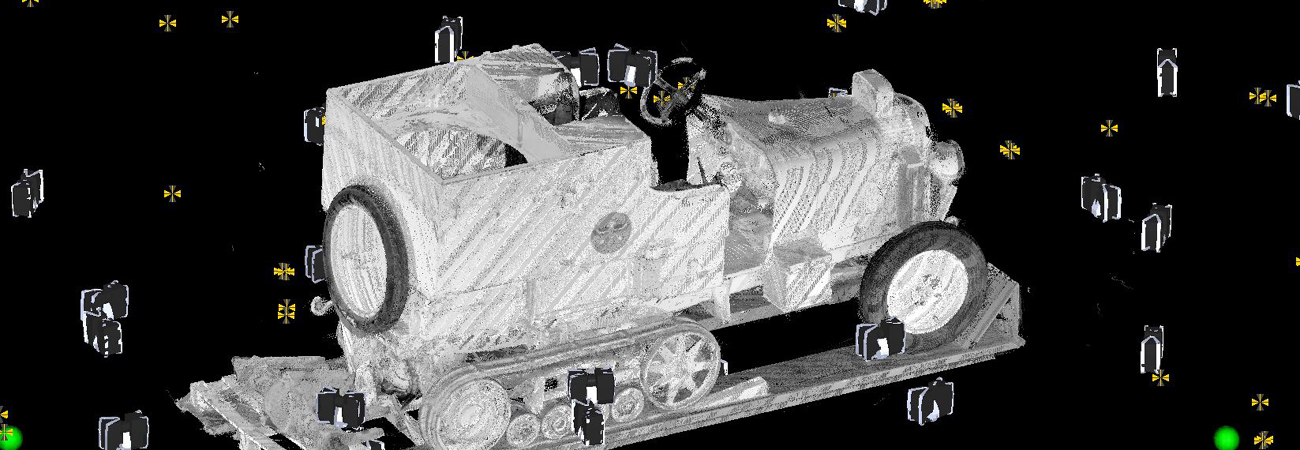
Since March 29, 2017, Scarabée d’Or, one of the two Citroën vehicles to survive the first trans-Saharan crossing in 1922, has been back on the Arts et Métiers campus Arts et Métiers Cluny, where it will remain until May 11. The goal of this second stop is to scan Scarabée d’Or using a laser scanner. From the bodywork to the smallest parts, the team atthe Institut Image and students in Master of Science in 3D Interactive TechnologyMaster of Science (MTI3D) program are working together to create a virtual clone. This digital replica will be used for educational purposes and will help advance the production process for its real-life counterpart, which will be unveiled during Citroën’s 100th-anniversary celebrations.
See you in 2019
As part of Citroën's 100th anniversary celebrations in 2019, the Des Voitures & des Hommes association aims to build an identical replica of the Citroën B2 (model K1) half-track vehicle, known as the Scarabée d'Or , which, along with four other vehicles, made the first crossing of the Sahara in 1922. To achieve this, the association called on Arts et Métiers, a leading technological institution, and its Cluny campus, as well as the Château d'Épluches vocational school for automotive and transport trades (95 Saint Ouen l'Aumône). The former is responsible for the mechanics of the tracks, the latter for the bodywork.
A virtual clone of the caterpillar track
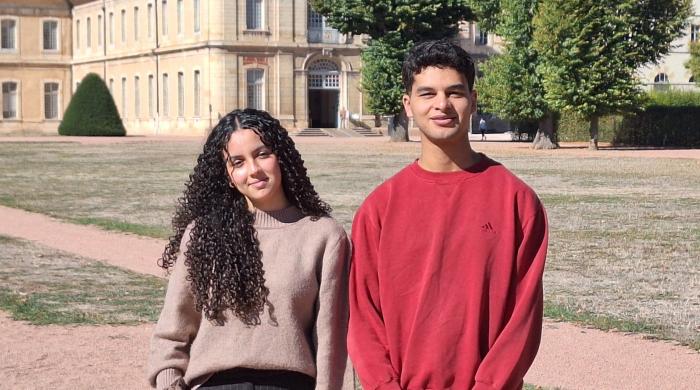
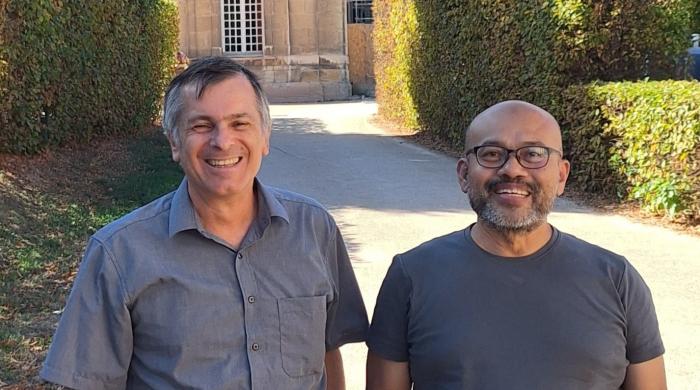
The goal of this second visit to the Cluny workshops is to create a virtual replica of the vehicle. Jean-Rémy Chardonnet, Associate Professor and coordinator of Master of Science in 3D Interactive TechnologyMaster of Science (MTI3D), and two Master of Science students have meticulously scanned the parts and bodywork of the half-track using a laser scanner. As part of their project, the two students, Axel Houot and Elio Khouri, are tasked with creating a functional virtual reality demonstrator. In other words, an application in which a virtual replica of the Scarabée d’Or will be immersed in a virtual environment. A journey through time where the Scarabée d’Or can find itself in the Sahara in 1922. Finally, much like a project review in aeronautics, the vehicle’s mechanism can be animated, dissected, and projected from unprecedented angles.
Different types of laser scanners
The Image Institute team uses two types of laser scanners. The first, which is small, is used to scan small mechanical parts. It is also used in the field of reconstructive surgery. The second, which is larger, has a greater range. The car body was scanned by the laser scanner and transformed into a cloud of digital points, which, once assembled, will form the skeleton of the virtual clone. This laser scanner has already been used to digitize the buildings of Cluny Abbey as part of its 1100th anniversary celebrations in 2010. More recently, it helped to duplicate a Romanesque portal at Chalon-sur-Saône Cathedral. Finally, it was used to digitize the east gallery of the Cluny cloister so that engineering students could virtually recreate the conscripts' hall, the new venue for the grand gala to be held on June 10, 2017.
A renovation focused on training
The Des Voitures & des Hommes association can count on the engineering students and those pursuing Master of Science Arts et Métiers. In fact, a total of no fewer than fifty second-year students have joined forces on this ambitious project. So far, they have successfully completed several stages: disassembly, taking measurements using traditional and digital tools such as a laser scanner, and CAD modeling. The challenge was that there were no paper blueprints of the parts. Since the vehicle’s blueprints had been destroyed, the engineering students revived an old entrance exam task that involved creating technical part sketches using wash techniques. The project will continue with engineering students from Cluny as well as theAngers and Metz campuses. Three campuses and one institute—that of Chalon-sur-Saône—are mobilized to ensure the project’s timely success. ENISEin Saint-Étienne will also be called upon to mill the gears. The Scarabée d’Or project will enable the Château d’Épluches vocational high school for automotive and transportation trades to launch a supplementary course on the maintenance and restoration of historic vehicles.