History/What is a fablab?
Excerpt fromWikipedia: (CC BY-SA 3.0)
The concept of the fab lab was created by Neil Gershenfeld, a professor at MIT, in the late 1990s and launched at the university's Media Lab, in collaboration with the Grassroots Invention Group and the Center for Bits and Atoms (CBA), also at MIT.
He began by exploring how information content relates to its physical representation, and how a community can be made more creative and productive if it has access to technology at the local level.
While the Grassroots Invention Group is no longer part of the Media Lab, the Center for Bits and Atoms consortium is still actively involved in pursuing research in areas related to description and fabrication, but it does not operate or maintain any of the fab labs around the world, except for the mobile fab lab.
The Fab Lab concept also stems from two very popular courses at MIT: MAS.863, entitled "How To Make (Almost) Anything," and MAS.S62, entitled "How To Make Something That Makes (Almost) Anything." These highly sought-after courses are still open to students during the fall semester.
In France, the first initiatives were launched in 2009:Artilect FabLab Toulouse in 2009, thenPing,Nybi.cc, andNet-ikiin 2011, theFabLab at the University of Cergy-Pontoise, and theLabFabs in Rennes5,Lannion, andMontpellierin 2012.
Fab labs are based on the principles of openness and collaboration. They rely on digital manufacturing machines and networks that enable files to be exchanged worldwide. An object can therefore be designed in one fab lab, manufactured in another, and improved in a third.
Thanks to simplified, user-friendly, and increasingly interoperable computer interfaces, it is becoming easier for non-specialist users to take control of technical tools (for example, writing, illustrating, designing, and printing their own book online, using commercial or free software such as Wikibook).
The appropriation that free software has facilitated now extends to free hardware (or Open Hardware), and for example to the methods of digital prototyping enabled by platforms such as Arduino, or to physical prototyping enabled by fab labs.
Fablab Charter
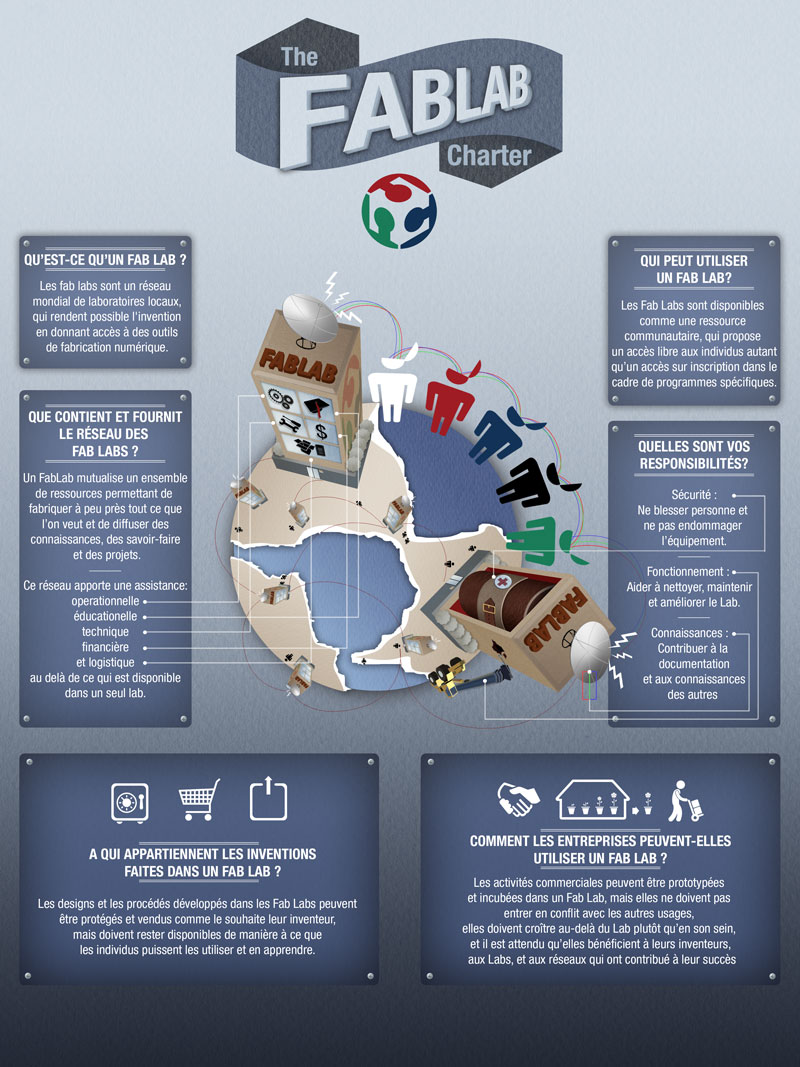
Image credit CC-BY free license
Mission
Fab labs are a global network of local laboratories that enable invention by giving individuals access to digital manufacturing tools.
Access: you can use the fab lab to make just about anything (as long as it doesn't harm anyone); you must learn how to make it yourself, and you must share the use of the lab with other users.
Education
Training in the fab lab is based on projects and peer learning; you must participate in knowledge sharing and instructing other users.
Liability
you are responsible for:
- Safety: knowing how to work without endangering others or damaging machinery.
- Cleanliness: leave the lab cleaner than you found it.
- Continuity: helping to maintain and repair tools, manage supplies, and report incidents.
Secret
Concepts and processes developed in fab labs must remain available for individual use, even if intellectual property can be protected.
Business
Commercial activities may be initiated in fab labs, but they must not impede open access. They must develop outside the lab rather than within it, and in turn benefit the inventors, labs, and networks that contributed to their success.