
National Master of Science Degree Master of Science DNM) in 3D Interactive Technology Management (MTi3D) – Digital Engineering (MTI3D IN)
Campus
Chalon-sur-Saône Institute Arts et Métiers
Objectives
Educational and scientific
- Become an expert in digital chain methods and tools for product lifecycle management
- Mastering the design of 3D interfaces and multisensory interaction for virtual immersion in all areas of application
- Mastering the integration of humans into the loop to ensure an effective user experience
- Knowing how to develop a scientific approach
Professionals and career opportunities
- Become a digital technology specialist for digital transformation and Industry 4.0
- Mastering the development of innovative digital projects
- Encouraging the creation of startups based on innovative ideas in the digital field
Skills acquired
- Knowing how to implement a virtual reality and augmented reality system
- Knowing how to implement an application that meets an industrial need
- Know how to implement an experimental protocol for validating virtual reality/augmented reality methods and tools (know how to develop a scientific approach)
- Know how to develop and manage a research and development project in collaboration with companies
Program
Structure (course semester, project/internship semester, etc.)
- Master of Science : 2 semesters of coursework totaling 677 hours, including 300 hours of independent projects, followed by a 3-month technical internship
- Master of Science : One semester of coursework totaling 457 hours, including 195 hours of independent projects, followed by a 6-month research internship
- For both years: weekly professional and scientific seminars
Master of Science
UE 1 - Software Tools (98 hours)
- Algorithms - Introduction to algorithms
- Object-oriented programming - Elements for programming in C++/C# useful for application development
- Image processing - Fundamental concepts of digital image processing and development in Python using libraries such as OpenCV
UE 2 - Engineering Sciences (69 hours)
- Electronics and rapid prototyping - Programming an Arduino electronic board and introduction to rapid prototyping tools
Introduction to Artificial Intelligence (AI) – Discover the fundamental concepts and areas of application of artificial intelligence and their practical implementation through Python programming.
Mathematics – Basic elements necessary for computer graphics, image processing, and AI.
- 3D Scanning - Introduction to 3D Scanning Techniques and Technologies
UE 3 - Virtual Environments (104 hours)
- 3D modeling - Use of virtual object modeling software for real-time rendering using dedicated software
- Real-time 3D programming - Creation of interactive real-time 3D applications using Unity3D
VR & AR interfacing – Development of interactive and immersive interfaces using VR/AR headsets, smartphones, and tablets.
Vision systems and virtual reality (VR) - The fundamentals of vision systems in the context of virtual reality
EU 4 - Methods (40 hours)
- Value analysis - Principles of a competitive, organized, and creative method aimed at satisfying user needs through a specific design approach that is functional, economical, and multidisciplinary.
- Design and innovation - Opening up to innovation through design
- Innovation Engineering - Fundamentals of creativity and methods for staying competitive through technological innovation
- Entrepreneurship - Principles for starting your own business based on an innovative idea
EU 5 - Management and Communication (66 hours)
- Technical English and TOEIC preparation - Advanced English for engineers
- Professional communication - Methods for selling yourself and convincing a customer
- Team management - Methods for taking the human aspect into account at work through relationship building
EU 6 - Projects
- Virtual Reality Project - Development of a simple coupled virtual reality interface.
- Junior Project - Development of a functional application on a defined topic.
- Chal'enge Project - Challenge consisting of developing a functional application in two weeks in partnership with a company in the Bourgogne-Franche-Comté region, presentation to a jury of companies and elected officials from Greater Chalon.
Master of Science )
UE 1 - Research Methodology (57 hours)
Scientific approach methodology - Definition and role of the researcher, definition of a scientific problem, understanding and presenting a scientific article
Experimental study for virtual reality - Setting up virtual reality experiments
Data analysis - Statistical analysis tools (mean, standard deviation, ANOVA, PCA, etc.) for analyzing data after user experiments
UE 2 - 3D Imaging and Immersion (45 hours)
Vision systems - Understanding the principles of vision systems and essential knowledge for augmented reality
Multisensory interactions - Studies of different sensory modalities that increase interaction in virtual environments
Virtual reality: principles and applications - Methods enabling the use of virtual reality technologies that are best suited to the desired application, taking into account human perception patterns.
Augmented Reality – Technical Principles of Augmented Reality and their implementation in Python
Image rendering – Digital image rendering pipeline and its implementation in Python
UE 3 - Digital modeling and tools (71 hours)
Artificial intelligence - concepts, methods, and tools in artificial intelligence, advanced level
3D modeling - Modeling of a virtual object for real-time rendering using dedicated software
Real-time 3D programming - Advanced use of Unity 3D, the 3D scene editor for creating interactive and immersive applications. Introduction to a second game engine, Unreal Engine.
EU 4 - Knowledge of the company and language (32 hours)
Business strategy and marketing - Demonstrate that marketing techniques are particularly useful to engineers in successfully managing recurring characteristics in technology markets.
Scientific English - Mastering English for Research
UE 5 - Projects (195 hours)
Senior project - Development of a functional application on a specific topic. Completed in pairs.
Chal'enge Project - Challenge consisting of developing a functional application in two weeks for a company in the Bourgogne-Franche-Comté region, presentation to a jury of companies and elected officials from Greater Chalon. Carried out in a group with M1 students.
EU C1 - Perception and interaction in a virtual environment (25 hours)
- Cognition of Perception-Action Coupling – General Introduction to Human Motor Control
- Sound interactions – Fundamental concepts related to sound and its use in interactive and immersive interfaces
- Interactive multisensory systems - Various interactive systems and studies of different sensory modalities to increase interaction in virtual environments
EU C2 - Industrial Virtualization (32 hours)
Production line – Application of AR/VR technologies to assembly lines.
Building construction – Application of VR/AR technologies in the building sector.
Key scientific and educational leaders in the field
- Faculty members of the Institute
- Development Engineers at the Institute
- External speakers specializing in digital technology, virtual reality/augmented reality
Related technology platform
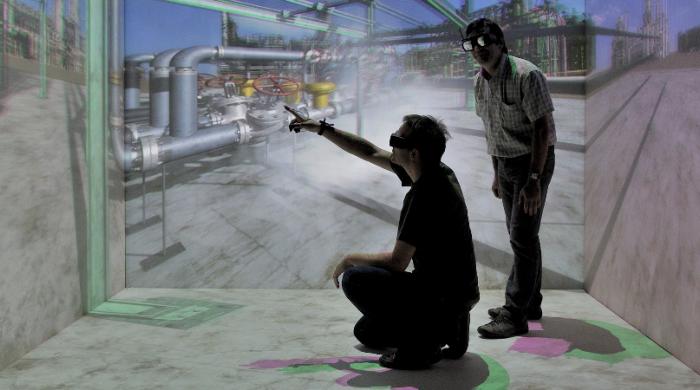
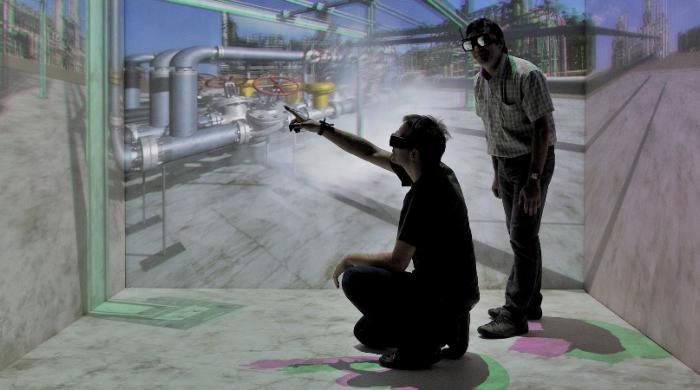
- The Institute's technical platform: CAVE-type immersive system, virtual reality and augmented reality headsets, interaction and force feedback devices, 1 dynamic driving simulator
- Institute's team of development engineers
Assessment methods
- Oral and written exams
- Technical achievements in applying knowledge acquired during the course
- Project reports and defenses
- Internship reports and presentations
Validation procedures
Per year
- 10/20 average for each course unit (same for internships)
- 10/20 average for the whole year
Teaching methods
- In-person for theoretical courses
- Autonomy for projects with access to the Institute's facilities
Benefits of the training
- The only training program in France in a rapidly growing field
- Employment rate close to 95% at the end of training (profiles increasingly sought after by companies)
- Access to a wide range of technical facilities that are unique in France
- Project-based learning training
- Training with strong links to industry in a wide range of application areas
- Opportunities to study abroad for internships during both years of Master of Science program
- Reasonable student numbers (9 students in the first year and a maximum of 14 in the second year) allowing for personalized support and constant contact with the Institute's research and development team.
Career opportunities
- Virtual reality project engineer in design offices
- Virtual Reality/Augmented Reality Project Manager
- Research and Development Engineer
- Manager of a collaborative virtual immersion platform within large industrial groups
- Entrepreneur (creator of digital startups, with the support of Pépite BFC, DECa BFC, and theArts et Métiers incubator)
- Virtual reality/augmented reality business developer
- Doctor in the field of virtual reality
- Researcher or engineer in public institutions (CEA, INRIA, CNRS, etc.) or private institutions (large industrial groups, SMEs)
Partners
Manufacturers
- Renault, SAFRAN, Enedis, Suez, Areva/Framatome, AVSimulation, SNCF, AlfaLaval, ABMI, Arcom, Diota, Haption, EDF
Institutional
- Greater Chalon, Nicéphore City, UIMM, Nuclear Valley, Burgundy-Franche-Comté Region, Imaginove, French Institute of Horses and Riding, French Virtual Reality Association, CEA List, Cetim, Departmental Council 71, Dijon University Hospital
Academics
- France: CRVM, Collège de France, Inserm, INRIA, University of Burgundy, LEAD, LIRIS, UTCompiègne, Georges Charpak Institute of Human Biomechanics, LAMIH, Grenoble INP, I2M
- Foreign: Los Andes University (Colombia), University of Calgary (Canada), Macquarie University (Australia), Iowa State University (United States), University of Petronas (Malaysia), Karlsruhe Institute of Technology (Germany), Polytechnic University of Bucharest (Romania), Rey Juan Carlos University (Spain)
Targeted companies
- Large corporations (Renault, SAFRAN, Suez, etc.)
- Very small enterprises, small and medium-sized enterprises, mid-sized companies
- Various fields of application (Industry 4.0, automotive, aeronautics, construction, training, healthcare, social services, etc.)
Examples of internship opportunities offered / projects carried out
Internships
- Vertigo simulator for future electricians (with Enedis)
- Training simulator for doctors (with Dijon University Hospital)
- Virtual reality and augmented reality applications for student training
- Virtual immersion for design assistance (with I2M)
- Interactions and Collaboration in Mixed Reality (CapGemini)
- Augmented reality for aerospace maintenance (with SAFRAN)
Projects
- Application on raising awareness of energy poverty (with CD71)
- Virtual situation of the start-up process for a production line (with Gerresheimer)
- CACES virtual reality forklift training (with EFCO Formation)
- Application allowing users to choose packaging based on a photo of the item (with Groupe La Poste)
- Immersive application for raising awareness of risks in a factory (with Saint Gobain)
Admission criteria
Required level
- M1: Bachelor's degree or equivalent in a scientific field (computer science, design, applied mathematics) from a university, engineering school, or through validation of prior learning (VAE).
- M2: Master of Science (M.S.) Level Master of Science or equivalent in a scientific field (computer science, design, applied mathematics) from a university program, an engineering school, or through recognition of prior learning (RPL)
Equivalent international level
- M1: bachelor's degree level
- M2: Master of Science degree
French language level: Minimum level B2
English level: Minimum level B1
Practical information
Course language: French with course materials in English (courses adapted into English if international students are present)
Schedule (start and end dates)
- M1: Second week of September
- M2: 4th week of September
Number of hours
- M1: 845 hours of classes, including 340 hours of projects, followed by a 4-month internship
- Master's degree: 449 hours of classes, including 195 hours of projects, followed by a 6-month internship
ECTS credits: 60 per year
Training location(s): Chalon-sur-Saône Institute
Contact
Additional information
You can visit the Institute at any time (by appointment).
Keywords
#VirtualReality #AugmentedReality #3D #digital #modeling #ComputerEngineering #IndustrialEngineering #industry4.0 #maintenance #design