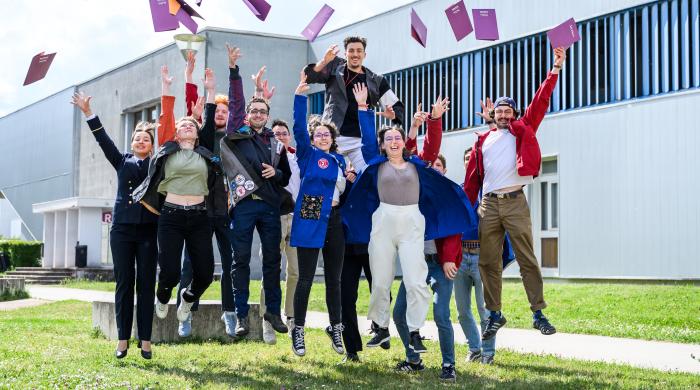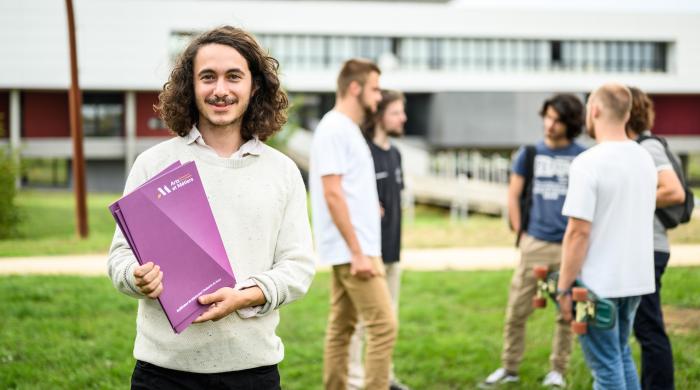
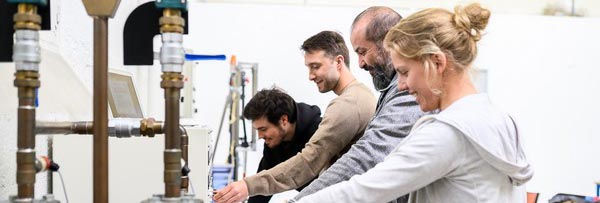
Evolutive Learning Factories ELF) are transforming teaching practices to make them more agile and innovative, with the aim of training engineers who are prepared for the challenges of tomorrow's industries.
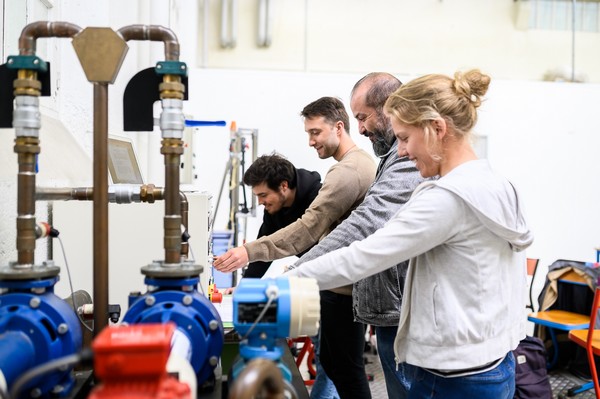
The ELFs thus become a concrete testing ground, serving all campus projects.
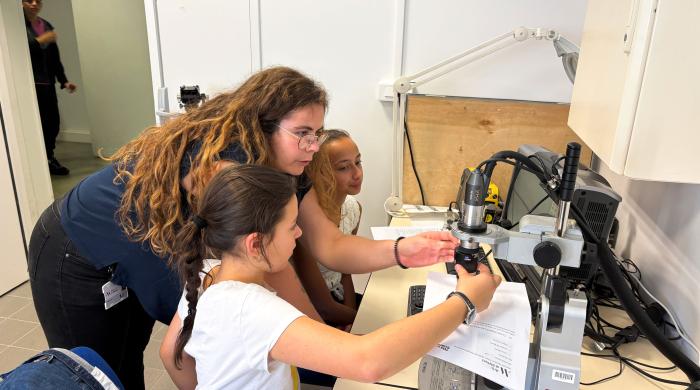
On the Angers campus, the Evolutive Learning Factories ELF) are a real educational highlight. These platforms, organized into thematic units (machining, materials, foundry, etc.), allow students to work on industrial-scale equipment, supervised by teachers and technical staff.
The educational progression is structured over the three years of the Grande École Program: in the first year, students learn about the equipment and fundamental principles; in the second year, they experiment through concrete projects; in the third year, they carry out innovation initiatives related to the campus's areas of expertise.
Of their 1,800 hours of training, students spend around 450 hours on ELF platforms working on practical assignments and projects. This system reinforces an active teaching approach in which student projects, often linked to developments in the platforms, engage learners as active participants in their own training and in the modernization of teaching tools.
Concrete projects for learning differently
Each level of study offers projects tailored to the students' skill development.
In their first year, students learn about ELF cells in a highly guided manner. For example, in the materials cell, they learn about the different equipment used for characterization and what they measure.
In the second year, projects become more independent and technical. Students are tasked with optimizing a process in areas such as casting, machining, or composites. This may involve manufacturing a new part, creating a device, or collaborating with an industrial partner or research laboratory on a project.
In the third year, projects focus on innovation. Students, whether they come from the Innovation Management (MANAGINOV), Sustainable Construction Engineering and Management (IGDC), or Innovative Process Engineering (IPI) programs, can carry out creative and innovative projects, particularly with new AR/VR technologies. For example, a third-year student recently created a 3D map of the campus cloister.
Developing technical programs towards 4.0
To support this educational initiative, ELF platforms are relying on an equipment modernization program, requiring public and private funding, sponsorship, or funding from the apprenticeship tax.
The goal is to modernize platforms to prepare students for the technologies of the industry of the future, while breaking down barriers between educational activities.
Two new facilities in 2025
In 2025, two new pieces of equipment were acquired thanks to this co-financing:
A fluid mechanics wind tunnel that allows students to experiment with flows, design devices such as low-speed wind turbines, and combine digital simulation with real measurements;
An automated molding cell in a foundry that replaces a manual technical platform and can be used to teach the principles of industrial automation.
In addition, cross-disciplinary work is being carried out to integrate IoT and data technologies into the workshops. Student projects aim to connect both old and new machines via a local network. The objective is to experiment with machine-to-machine communication, data storage and analysis, and to introduce students to these essential and real-world challenges that they will encounter in the field tomorrow.
Also support for research and innovation projects
ELFs also provide support for research and innovation projects. The RéCLasSif program is a concrete example of this, with several components developed around material recycling, immersive processes, and energy management in processes (more information).
Other projects are currently under review and awaiting funding, including a project focused on robotics, which aims to explore robot control and the robotization of manufacturing processes through the integration of autonomous mobile robots (AMRs).