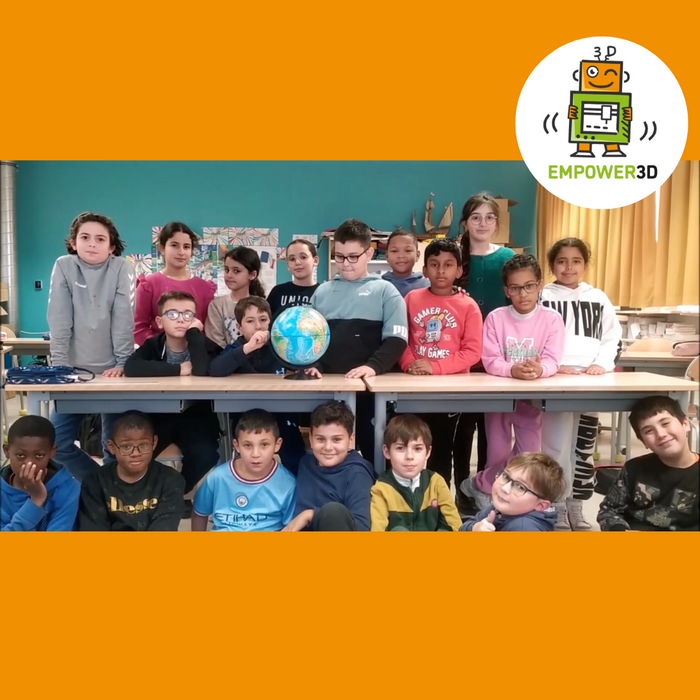
Teaching elementary school students about 3D printing is the challenge taken on by the Erasmus+ project coordinated by Arts et Métiers began on September 16.
Because primary school students will be the engineers of tomorrow, EMPOWER3D is committed to introducing young students of all genders and backgrounds to the engineering of the future, placing environmental transition at the heart of their work: "The aim of the project is to help children understand that engineering can be part of the solution to ecological transition. The goal is to make them want to continue in this field later on," explains Léopold Boyart-Bienenfeld, European project manager at DGARI.
European partners with complementary expertise
"EMPOWER3D is the successor to the Manufacturing a Healthy Future (AMHF) project," continues Léopold Boyart-Bienenfeld. "We are working with two European partners, University College Dublin in Ireland and Masarykova Univerzita in the Czech Republic. The Irish university was already involved in the AMHF project and is therefore familiar with the challenges facing EMPOWER3D.
Masarykova University has a faculty of education that trains school teachers and has expertise in robotics and 3D printing.
The University of Dublin is responsible for the working group on training teachers in design and 3D printing. It is also responsible for writing all the documentation, including a guide.
"Thanks to EMPOWER3D, we have also submitted other projects with University College Dublin and are exploring new opportunities for cooperation," says Léopold Boyart-Bienenfeld enthusiastically.
Crossing borders
EMPOWER3D is more interested than AMHF in ensuring the project's long-term viability and how to take it further. The idea is to produce video tutorials that can be viewed independently by teachers across Europe. This will enable them to learn how to use a 3D printer and discover models of objects that can be built with the machine. The aim is for everyone to take ownership of these issues and pursue the project's ambitions on their own: "The videos will be in English, so we can even hope to distribute them worldwide at a later stage," adds Léopold Boyart-Bienenfeld.
Regular meetings
There will be three face-to-face meetings throughout the duration of the project. The kick-off took place on September 26 in Paris. The next one will take place at the beginning of the 2025-2026 school year in the Czech Republic, followed by a review at the very end of the project in Ireland. The idea is to alternate meetings in the countries of the three partners.
Regarding the launch on the Paris campus, the members met to discuss the review of the working groups, a reminder of the objectives and budget, the distribution of tasks, and organization with the European partners.
The afternoon was devoted more to dissemination, with the first elements created by Mathilde Destelle, multimedia graphic designerArts et Métiers a colorful logo and graphic charter reminiscent of childhood, the target audience of the project.
EMPOWER3D is a two-year program that is part of the Erasmus+ program and brings together a consortium of three European countries: France with Arts et Métiers, the Czech Republic with Masarykova Univerzita, and Ireland with University College Dublin.
Its goal is to promote STEM (science, technology, engineering, and mathematics) in elementary schools by making learning fun. Using 3D printing, teachers and students work together on a creative project. They experiment with the use of materials and equipment, as well as the reasoning and teamwork required for any scientific experiment.
The EMPOWER3D challenge involves all students in a primary school class in the creation of an original object, made with the help of a 3D printer. They must choose between two challenges: giving a second use to an object or extending the life of a broken object destined to be thrown away.
Arts et Métiers teachers and provides them with equipment. The challenge concludes with a national final in each country, followed by an international final between the three partners.