ScCRYO2: promoting machining that respects the environment and people

ScCRYO2: promoting machining that respects the environment and people
News
Innovation

The ScCRYO project2 aims to provide reliable data and models for understanding the mechanical, thermal, and tribological phenomena involved in scCO2.

ScCO2: a magical fluid?

The exceptional solvent qualities of supercriticalCO2 have been known for a long time. This "green super solvent," which combines tool cooling capacity with increased lubricant effectiveness, has emerged as an alternative to industrial oils, which are threatened by European REACH regulations and criticized for their environmental and health impacts.
Increased productivity is also an issue.
"50% of the electricity consumption of certain machines is dedicated exclusively to powering their cooling systems," points out Frédéric Rossi, LaboMaP. The energy savings generated by the use of recycledCO2 assistance are therefore potentially considerable. By combining these savings with reduced oil purchases and time savings associated with eliminating cleaning operations (which are also very water-intensive), we can expect real productivity gains that will be of interest to all manufacturers.

Moving from empirical evidence to scientific certainty

However, although very convincing results have been observed in companies that have adopted the system, we don't really know how to explain them. Worse still, for certain uses, the solution is disappointing... and we can't explain it any better! To definitively remove the barriers to adopting this new production method, it is imperative to move from empirical uncertainties to scientific certainties.
For this technology to become established in many sectors, it needs to be better understood in order to make it more reliable.
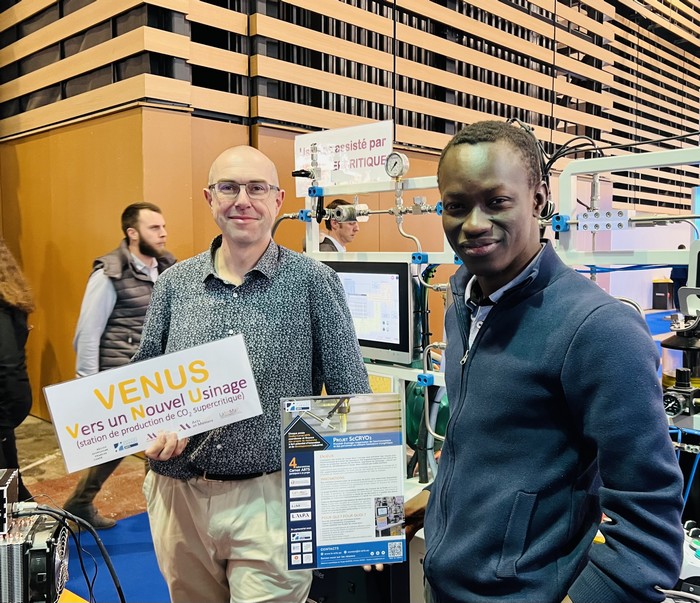
This is the objective of theScCRYO2 research project, led by Frédéric Rossi and his "Venus" demonstrators on "environmentally and people-friendly machining processes using cryogenic assistance."

A Carnot ARTS project

This five-year project, launched in 2021, brings together the expertise of four Arts et Métiers  laboratories Arts et Métiers  LaBoMap in Cluny, LIFSE in Paris, LAMPA in Angers, and I2M in Chambéry.
It is funded by Carnot ARTS as part of its initiative to revitalize research projects with high industrial potential. CETIM, the Pays de Loire and Bourgogne Franche Comté regions, as well as the Angers metropolitan area and the CSC are also partners in the project.
The aim is to obtain reliable data and models in order to understand the mechanical, thermal and tribological phenomena involved inscCO2-assisted machining. This will improve tool life and the quality of the parts produced, while protecting the environment and the health of operators.
"Thanks to our Venus demonstration stations, it will finally be possible to compare the differentCO2 assistance configurations with each other and/or with more traditional machining practices on several criteria in order to choose the most efficient processes, depending on the materials and applications,"explains Frédéric Rossi.
"The first Venus 1 model allowed us to carry out tests without any lubricant or with a small amount of conventional oil," explains Koffi Samuel Koulekpa, a PhD student associated with the project. With a gleam in his eye, he adds: " With the next demonstrators, we will compare several lubricants dissolved in scCO2 and evaluate their effects on the process."

The planned end of cutting oils?

For Koffi Samuel Koulekpa, cryogenic assistance will not completely replace cutting oils, but the solution is undeniably set to develop in various sectors. He predicts: "In a few years, these solutions will be much more widespread in factories producing high value-added parts, but oils will not be completely replaced everywhere." "
For Frédéric Rossi, this also raises the question of "structuring theCO2 recovery sector around a true circular economy that contributes to decarbonization."
Hakim Cheniti, Director of European Business Development at Fusion Coolant Systems, whose ScCO2 was developed at the University of Michigan, concludes: "Since 2016, we have proven thatscCO2 cryogenics is a game changer in many sectors, but no one really knows the new rules of the game yet."
It is precisely these new rules that the Arts et Métiers researchers Arts et Métiers the ScCRY02 project are in the process of establishing. To be continued...
ScCO2: a magical fluid? The exceptional solvent qualities of supercritical CO2 have been known for a long time. This "green super solvent," which combines tool cooling capacity with increased lubricant effectiveness, has emerged as an alternative to industrial oils, which are threatened by European REACH regulations and criticized for their environmental and health impacts. Increased productivity is also an issue. "50% of the electricity consumption of certain machines is dedicated exclusively to powering their cooling systems," points out Frédéric Rossi of LaboMaP. The energy savings generated by using recycled CO2 assistance are therefore potentially considerable. By combining these savings with reduced oil purchases and time savings associated with the elimination of cleaning operations (which are also very water-intensive), we can expect real productivity gains that will be of interest to all manufacturers.  Moving from empirical evidence to scientific certainty However, although the results are very convincing in companies that have adopted the system, we don't really know how to explain them. Worse still, for some uses, the solution is disappointing... and we can't explain it any better! To definitively remove the barriers to adopting this new production method, it is imperative to move from empirical uncertainties to scientific certainties. For this technology to become established in many sectors, it is necessary to understand it better in order to make it more reliable. This is the objective of the ScCRYO2 research project, led by Frédéric Rossi and his "Venus" demonstrators on "environmentally and people-friendly machining processes using cryogenic assistance."  A Carnot ARTS project This five-year project, launched in 2021, brings together the expertise of four Arts et Métiers  laboratories Arts et Métiers  LaBoMap in Cluny, LIFSE in Paris, LAMPA in Angers, and I2M in Chambéry. It is funded by Carnot ARTS as part of its efforts to revitalize research projects with high industrial potential. CETIM, the Pays de Loire and Bourgogne Franche Comté regions, as well as the Angers metropolitan area and the CSC are also partners in the project. The aim is to obtain reliable data and models in order to understand the mechanical, thermal and tribological phenomena involved in scCO2-assisted machining. This will improve tool life and the quality of the parts produced, while protecting the environment and the health of operators. "Thanks to our Venus demonstration stations, it will finally be possible to compare the different CO2 assistance configurations with each other and/or with more traditional machining practices on several criteria in order to choose the most efficient processes, depending on the materials and applications," explains Frédéric Rossi. " The first Venus 1 model allowed us to carry out tests without any lubricant or with a small amount of conventional oils," says Koffi Samuel Koulekpa, a doctoral student associated with the project. With a gleam in his eye, he adds: "With the next demonstrators, we will compare several lubricants dissolved in scCO2 and evaluate their effects on the process. " Is this the end of cutting oils? For Koffi Samuel Koulekpa, cryogenic assistance will not completely replace cutting oils, but the solution is undeniably set to develop in various sectors. He predicts: "In a few years, these solutions will be much more widespread in factories producing high value-added parts, but oils will not be completely replaced everywhere. " For Frédéric Rossi, this also raises the question of "structuring the CO2 recovery sector around a true circular economy that contributes to decarbonization." Hakim Cheniti, Director of European Business Development at Fusion Coolant Systems, whose ScCO2 production solution was developed at the University of Michigan, concludes: "Since 2016, we have proven that scCO2 cryogenics is a game changer in many sectors, but no one really knows what the new rules of the game are yet." It is precisely these new rules that the Arts et Métiers researchers Arts et Métiers ScCRY02 project are in the process of establishing. Watch this space...

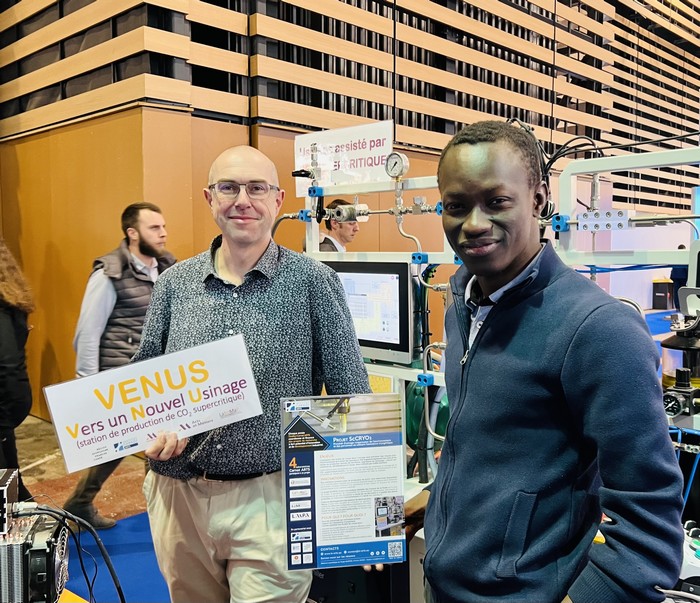
Frédéric Rossi and Koffi Samuel Koulekpa, LaBoMap of Cluny

Latest news

Arts et Métiers the appointment of Jérôme Pailhès as director of its Bordeaux-Talence campus.

News, Focus

Starting in September 2026, the Arts et Métiers campus Arts et Métiers Metz will offer a new Bachelor's degree in Science and Technology, specializing in Materials and Energy, which will be accessible directly after high school graduation.

News, Training

The Arts et Métiers campus Arts et Métiers Lille welcomesmany students every year

Training, Testimonials, Research

12 Arts et Métiers Specialized Master’s® programs Arts et Métiers ranked in 9 different fields at the national level in the EDUNIVERSAL EEA Ranking of the Best Specialized Master’s Programs 2026!

News, Training