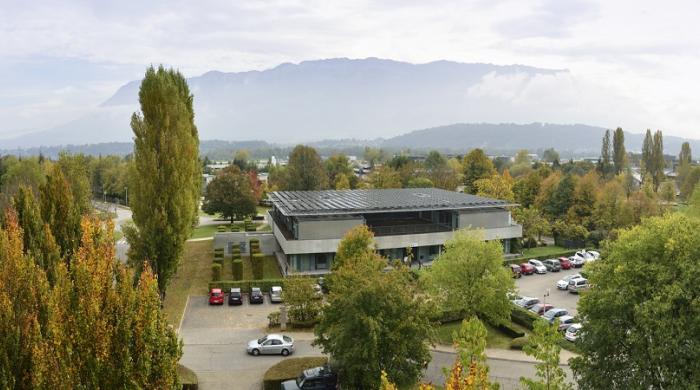

The Chambéry institute has been working on controlling the life cycle of complex products containing plastics since 2012. This is evidenced by recent and ongoing theses.
All of the theses aim to improve control over the life cycle of a complex product by using tools such as Life Cycle Assessment (LCA), eco-design, developing end-of-life indicators for products, or optimizing end-of-life in line with a circular economy approach. A complex product is one that incorporates a variety of materials, manufacturing processes, and functions, such as a smartphone, a car, or a photovoltaic panel.
These theses respond to industrial demands to develop products with less impact and to have eco-innovation and eco-design tools adapted to their issues.
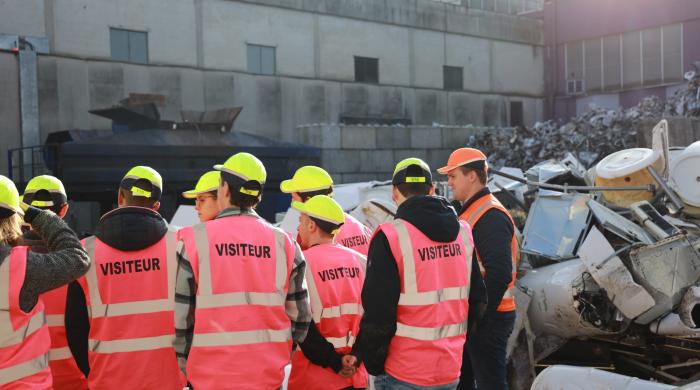
All industrial sectors are concerned: construction, automotive industry, electrical and electronic products (within the framework of theUrban Mines Chair), etc.
Assess the possibility of recovering the materials contained in a product from the design stage onwards.
From 2015 to 2019, Jorge Martinez Leal worked on indicators to assess the possibility of recovering materials contained in a product from the design stage onwards, taking into account the actual capacities of recycling channels. The indicators were tested on smartphones to validate their relevance.
In this context, theFairphone, designed for dismantling and repairability, was compared to a conventional smartphone. These indicators make it possible to steer choices towards materials with a higher level of recyclability and compatibility, or to reduce the diversity of materials. They lead to changes in product design to adapt it to the possibilities of recycling channels or to support the development of these channels. More info
Improving the treatment of metals from WEEE
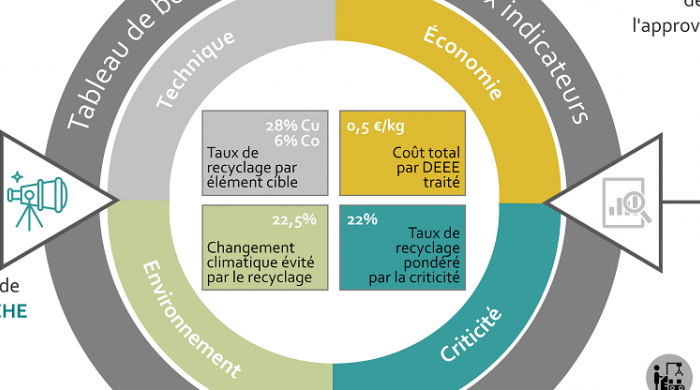
Between 2016 and 2019, Rachel Horta Arduin developed a dashboard of indicators for the eco-design of waste electrical and electronic equipment (WEEE) treatment sectors for eco-organizations. The thesis benefited from collaboration with theJRC(Joint Research Center of the European Union) for the application of the indicators developed on critical metals contained in screens (high demand, complicated geopolitical context, and scarcity). This dashboard made it possible to identify the actual quantity of metals recovered through recycling and to identify priority actions to improve this recovery. It can be adapted to the case of plastics contained in EEE. Her thesis has been awarded the European label and won theJean-Marc Gey prizein 2020. More info
Improving the circular economy for plastics in EEE
Nicolas Nève started his last November. He is working on developing a method to increase the integration of recycled plastics in product design, particularly EEE. The aim is to promote their use in order to improve the circular economy of plastics in EEE, but also to identify the changes that need to be made in design and in the supply chain to ensure that they are compatible. More info
Plastic recycling is a topic that resonates with many current environmental, political, and economic issues.
These three theses are linked because they enable all phases of the life cycle of a complex product containing plastics to be connected, particularly the design and end-of-life phases, which in principle contributes to the circular economy.
Theses also on the usage phase
The institute is also interested in other phases of a product's life cycle, such as the usage (or utilization) phase. A thesis is currently underway on the eco-design of plastics for marine applications, and another is starting on the eco-design of emerging technologies for the energy and industry of the future.
The institute's research also covers the entire life cycle, with a thesis on the methodological development of consequential LCA (measuring the long-term environmental consequences of a change) applied to the construction sector.
All of these theses are part of research into product life cycle engineering, combining the expertise of the IMC Department IMC (Mechanical Engineering and Design) department of the I2M laboratory laboratory on the Bordeaux campus (mechanical design, recycling, LCA indicators) and those of the Chambéry institute (recycling channels, end-of-life indicators, eco-design, life cycle vision).