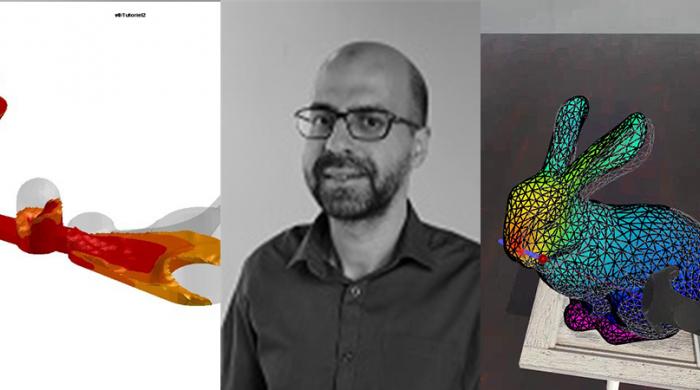
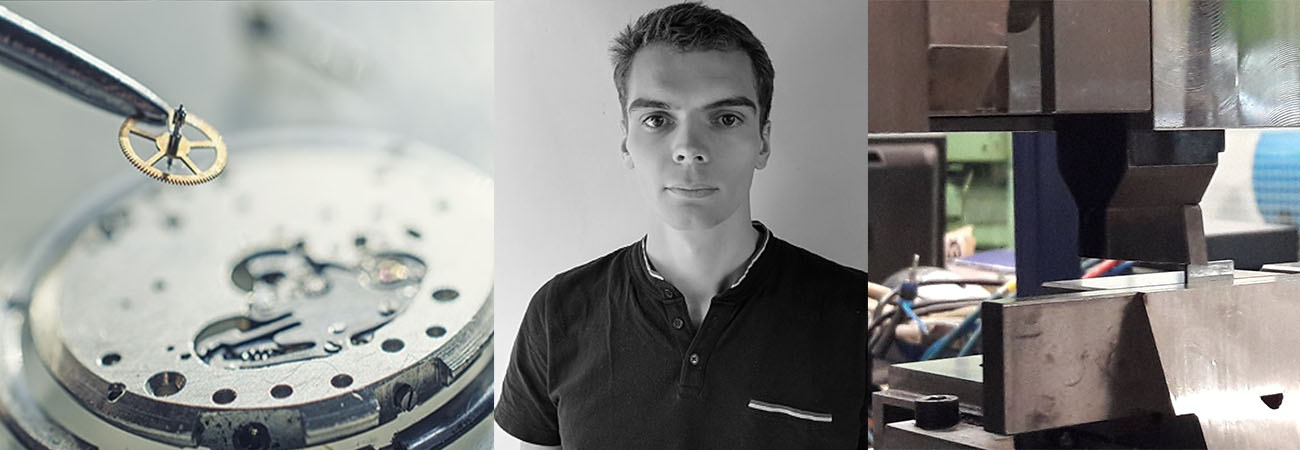
Bruno Lavisse, lecturer in processes and young teacher-researcher at LAMPA on the Arts et Métiers campus Arts et Métiers Angers, is leading his first research project on metal glass machining thanks to the "PULSAR – Academy of Young Researchers in the Pays de la Loire" program . He is thus benefiting from support that offers young teacher-researchers the best conditions for success right from the start of their scientific careers.
 Pulsar: a comprehensive program to support young teachers and researchers
The Pulsar program offered by the Pays de la Loire region has two components: collective support and enhanced individual support. Only one young teacher-researcher per research laboratory in Pays de la Loire can benefit from this program. For LAMPA, Bruno Lavisse is receiving this support for his research project on metal glass machining in partnership with Vulkam, the company that developed Vulkalloys®, innovative amorphous metal alloys (often referred to as metal glasses).
"This program allows us to take training courses on topics such as project development and fundraising. We also share our experiences with other young teacher-researchers and benefit from mentoring through connections with experienced researchers from other laboratories," explains Bruno Lavisse. For LAMPA, Guénaël Germain, University Professor and Doctor of Mechanical Engineering, will therefore mentor a young teacher-researcher from another laboratory. Another significant advantage of this program is its financial support based on 50/50 co-financing between the region and the institution. Through this program, the region pays half of a certain operating budget to help, for example, with the purchase of equipment, the publication of articles, and the payment of conferences and interns. "It's a great help to get started!" says Bruno Lavisse. For the Pays de la Loire region, the challenge is to attract new talent to the area to develop research in the Loire region.
A cutting-edge collaborative research project on innovative materials
Bruno Lavisse is thus leading his first research project in collaboration with the company Vulkam. It is a challenge and a very rewarding experience in a cutting-edge field of research. The machining of metallic glass is an important issue for the industry, which is always looking for increasingly high-performance materials.
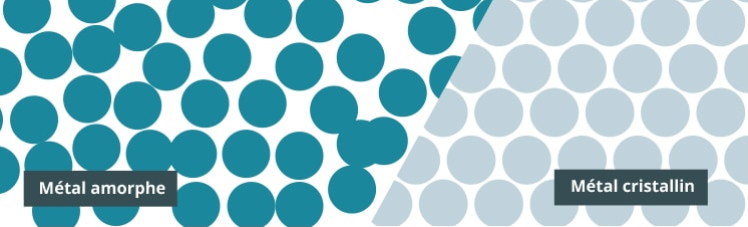
Highly sensitive to temperature, metallic glasses are innovative materials heated to high temperatures of around 1000°C and then cooled very quickly to solidify and retain an amorphous structure at room temperature. The advantage of the material obtained in this way lies in its high elasticity and mechanical strength.
"The goal is to work on developing these alloys to make them biocompatible. These materials are used for small parts in applications such as watchmaking, aerospace, and biomedicine," explains Bruno Lavisse. The challenge of this project is to find the right tools for machining these innovative materials (cutting angle, cutting inserts) and to identify which cryogenic machining process could be used.
We must provide answers to our partner company by determining the cutting conditions that allow the material to be machined during the finishing phase without compromising the quality of the finished part.
Thanks to the Pulsar program, Bruno Lavisse will be able to hire two Master of Science interns—one this year and another next year—to conduct testing campaigns on these metallic glasses using the laboratory’s instrumented orthogonal cutting bench. “ “The first intern’s mission will be to continue the work already begun on identifying tool geometry and cutting conditions suitable for machining metallic glass. He will also be involved in designing cryogenic machining assistance technology compatible with our orthogonal cutting bench,” explains Bruno Lavisse. An exciting program lies ahead!
Leading your first research project: a highly rewarding experience
The Pulsar device frees up time and operating budget for setting up experiments. It provides significant support to help young teacher-researchers develop applied research projects and pursue scientific research by publishing scientific articles. It also provides an opportunity to develop project management and team management skills!
This is the first research project I have led, so it is very rewarding. I hope the results will be conclusive, and the link with the company motivates me to develop my skills. It is an important responsibility to maintain Vulkam's interest in our work and to ensure our collaboration with them continues in a climate of trust.
This PULSAR device is a launch pad for the future continuation of this research topic on the machinability of metallic glasses within LAMPA. Indeed, bibliographic research indicates that research is currently only in its infancy. "Gaining expertise in the machining of metallic glasses within the laboratory within the next two years would enable us to seriously consider more ambitious industrial and academic collaborations on European, ANR, or CIFRE projects," concludes Bruno Lavisse.